Moriah participates in Book Fairs this Summer

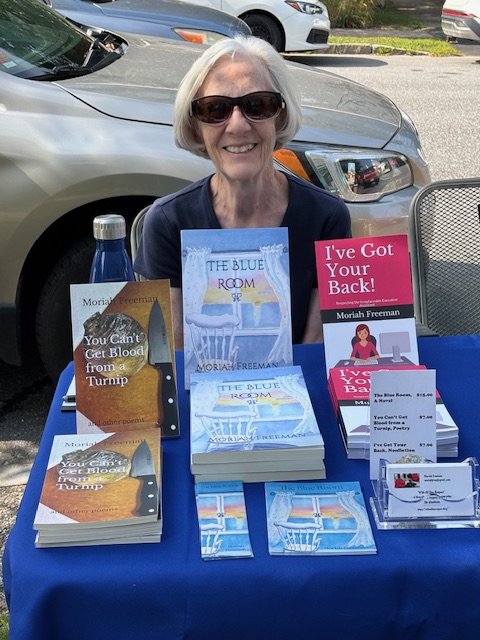
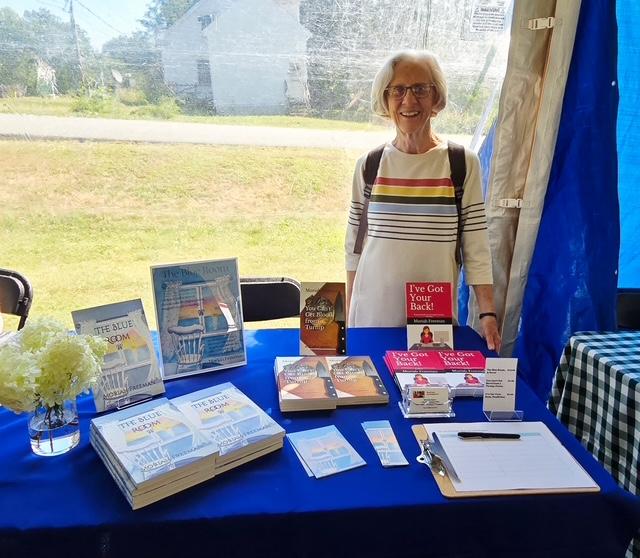
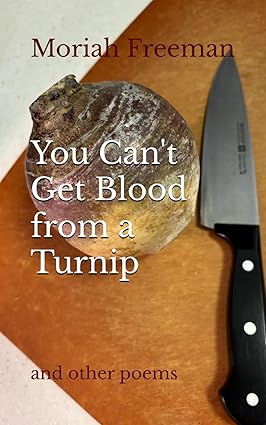
I will be participating in two local book fairs in August 2025, offering for sale my three publications: The Blue Room, a novel; You Can’t Get Blood from a Turnip, a collection of poetry; and I’ve Got Your Back, non-fiction.

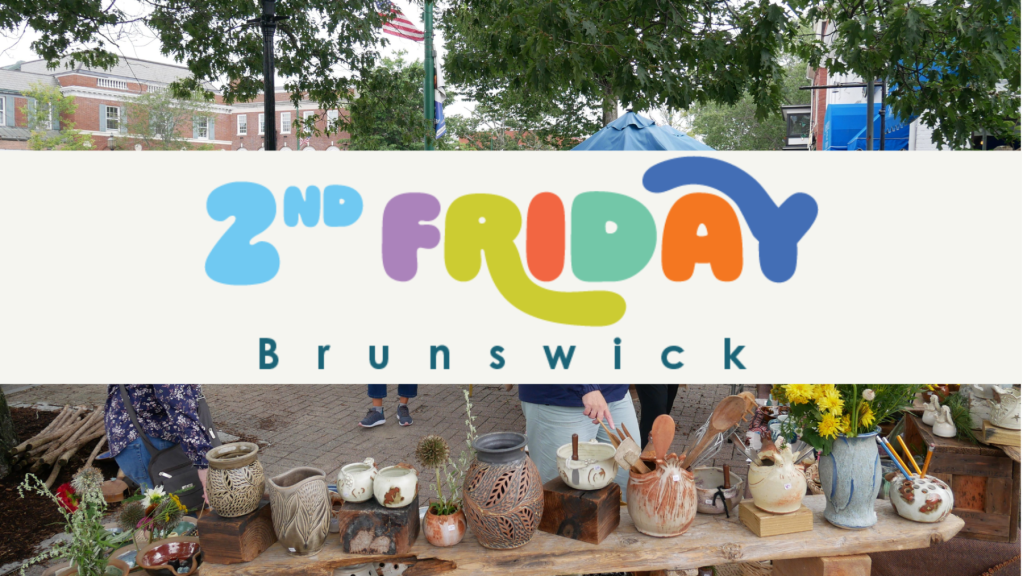
The first event, 2nd Friday, Brunswick, is scheduled for August 8 from 4:00 to 7:00 p.m. in downtown Brunswick, located on Pleasant Street.

My friend and fellow writer, Nancy Collins, who has recently published a memoir entitled The Perfectly Imperfect Potter, will join me for this event. We’ll sell our books, visit with shoppers and other vendors, and enjoy the culture of Brunswick. Please plan to stop by as you explore the offerings by local artists, writers, musicians, and actors.

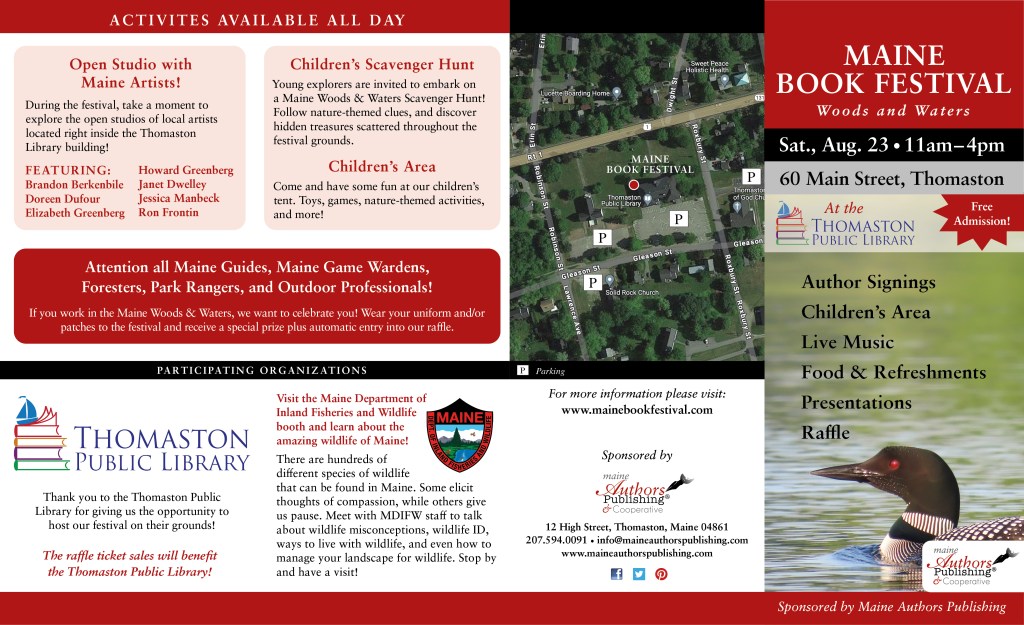
The second event is scheduled for August 23 at the Maine Book Festival, held at the Thomaston Public Library in Thomaston, Maine.

Please join me and other Maine authors, and share this with your friends!

Tea Bag Wisdom – Self Respect

I drink Yogi Tea every morning, first thing, right after I feed the animals and take the dog out for his first sniff and tinkle of the day. Just after I ring my meditation bell, turn on three tea lights in front of my Buddha statue, and sink into my seat on the couch, facing the window overlooking our garden. I take a sip of Yogi tea, a deep breath, set my timer for twenty minutes, and come home to myself.

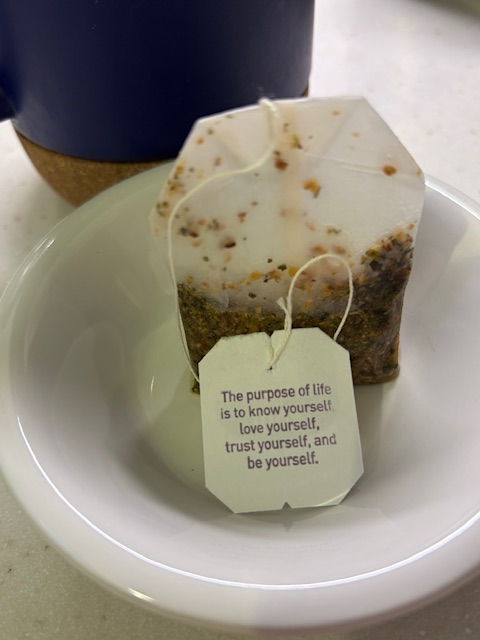
The other morning, as the cats were chowing down and my electric kettle was bubbling, I opened a new tea pouch and pulled out a fresh bag of ginger tea. As I unwound the paper tag attached to the bag by a thin thread, I was astounded to see this message: “The purpose of life is to know yourself, love yourself, trust yourself, and be yourself.”

I’m fond of the word ‘gobsmacked,’ which is British slang for being astonished. I was gobsmacked that the universe had sent me such a message, first thing on a July morning in the politically, socially, and personally turbulent summer of 2025. Right away, I knew it was a message that needed some unpacking, so I settled into my meditation posture—the dog tight to my left thigh, the Maine Coon cat spread across my lap. The black and white cat was, of course, doing his aloof morning meditation on chipmunks, squirrels, and birds at the screen door that opens onto the patio. I took a sip of ginger tea and began.

Know yourself. No problem for me, the most introspective creature on-the-planet, as my friend Bruce would say. Self-examination is my middle name, has been since birth, for good or ill. For most of my life, self-examination has meant self-critique. I have a more than passing familiarity with all my faults, bad habits, propensities, temptations, mistakes, and the karma that results from them. However, genuine self-knowledge or self-awareness has only emerged in later life as I learned to meditate and look deeply at the roots of my motivations—my fears, attractions, and repulsions. That self-awareness, though more true, is also softer, as I’ve allowed self-compassion to touch and soothe the wounds uncovered by my x-ray inner eye. It felt good to have my ingrained habit of self-reflection validated as part of life’s purpose by the Yogi Tea Messenger. Part of myself is okay. Phew! That’s a relief!

Love yourself. My stomach twisted in a knot, and I knew this was not going to be an easy one to delve into. I make this deeply personal revelation only because I suspect there may be a few of you out there who share my experience, and I want you to know that you are not alone. Since early childhood, I have sensed that I am, at my core, a flawed person. There is something wrong with me that makes me do bad things, or, at least, fear that I will do bad things. I think this sense may have come from my mother, and I am certain my Baptist upbringing with its emphasis on original sin reinforced it. I long ago forgave my mother, but I will never forgive St. Paul and the Christian Church for instilling the hideous notion that I was born full of sin. Buddhism, which I’ve gravitated towards in recent years, teaches that we each contain both good and harmful seeds in our store consciousness and can learn to nurture the former rather than the latter.

But let’s not get too theoretical here. Loving myself is challenging! And I don’t believe I am alone with this challenge. Understanding what self-love is and how to practice it will take me the rest of my life and then some, and I’m getting a very late start. But, while breathing evenly and gently as the ten-minute meditation bell chimed, I remembered the self-compassion I congratulated myself on developing as I’ve aged. Let’s start there, add a little self-forgiveness, tenderness, thanksgiving—whatever else might water those tiny seeds of goodness the universe has planted in me. I recalled my connection to all the beauty around me and recognized that I am made of the same stuff. Soon, I thought, I may have enough confidence in my basic goodness to…

Trust myself! Again, the passage of time, also called aging, is of some help here. It teaches lessons of humility but also repeatedly validates my intuition, my gut, or bodily intelligence. As I’ve looked back over my life, I’ve seen instances where I had a premonition, an insight, or an inner sense about the reality of a situation, the right course of action, or an action to avoid. Sometimes I heeded the hint, and other times I ignored the impulse.   But time and again, what my body intuited was revealed as events unfolded. I pay more attention to my un-rational intelligence these days. The more self-aware I am, the more I accept and love myself, the more I can trust myself to make the right choices, the life-giving, kind, and just ones. And I understand these three—self-awareness, self-love, and self-trust as inextricably linked, forming the foundation on which I can…

Be myself. What a sense of relief and ease washed over me as I entered the home stretch of that morning’s meditation. I paid attention to my body, as I set my imagination free to envision what it might be like to be who I truly am, instead of who I or others expect me to be. I noticed a sense of effortlessness. Straining and striving melted away, replaced by an unhurried settledness. A pervasive feeling of well-being and wholeness refreshed my tired mind and body. Yet, on the horizon, I saw the tremendous responsibility of freedom dawning, and I experienced a charge of fear, like a tiny electric shock—joy and sadness, pain and pleasure co-arising and interdependent.

The meditation bell chimed three times, signaling the end of twenty minutes. I breathed out, letting go, and lingered for a few moments longer in the silence and stillness. Then I lifted my cup and took a long, full gulp of still-warm tea while reciting the Tea Messenger’s morning wisdom one more time: “The purpose of life is to know yourself, love yourself, trust yourself, and be yourself.”

Practicing for the Big Let Go: Love

To view the images in this post, click Read on Blog

I have mentioned here before that I meet monthly on Zoom with a group of women who talk about our experiences of aging and our musings on death. We explore our stories, insights, discomfort, and fear about the inevitable decline of our bodies and the certain end for us all. A few weeks ago, we had a courageous discussion about dying, our own and that of those we love. Not surprisingly, most of us expressed more fear about the possibility of a painful, demeaning, drawn-out dying process than about the moment of death and what, if anything, comes after it. We ventured onto the delicate topics of Death with Dignity and Physician-Assisted Death, which is legal in some countries, including Canada, where I was born.

I told the story of my Canadian cousin’s husband’s death. I’ll call him Leigh and her Meredith. He suffered for years from debilitating cancer, which was diagnosed just after his retirement when they had planned finally to begin their travel adventures together. Leigh, supporting and delighting in Meredith’s wanderlust and love of natural beauty, encouraged her to go exploring on her own and with their daughters. He enjoyed her travels vicariously and enthusiastically. However, as time went on, she traveled less as he needed more care and experienced frequent hospitalizations for treatment and long energy-less periods confined at home.

Though he tried his best not to be a burden for his family and patiently bore the symptoms of his disease, it troubled him that Meredith’s life centered around him and his ups and downs. He recognized her profound sadness as she watched him suffer, helpless to alleviate it, and worried about how she would cope with what they had good reason to believe would be a painful and degrading end. As the pain increased and his energy ebbed, recognizing his own and Meredith’s exhaustion and the toll his suffering was taking on her, he decided to apply for MAID, Medical Assistance in Dying. Canadian law provides this option for individuals who are terminally ill or in intolerable pain.

Together, Leigh and Meredith navigated all the legal requirements and preparations and finally arrived at the day of his death. Meredith and both of their adult children gathered around his hospital bed, said their goodbyes, and expressed their love and gratefulness for each other. Medical personnel administered the necessary medications, and quietly and peacefully, Leigh went to sleep and then ceased to breathe. Meredith experienced the meticulously planned and compassionately orchestrated end as a gift of love Leigh gave to himself, her, and their daughters. Years later, she still speaks movingly of this gift and her memories of their last intimate moments together. She says Leigh was right; a horrible end would have been much more difficult for both of them to endure and for her to recover from. Instead of her beloved in agony, her last memory of him is tender and peaceful.

I did not tell the story of my mother’s death in that morning’s discussion group. In her early eighties, she was diagnosed with pancreatic cancer after a long period of ignored symptoms and then months of waiting for tests and doctors’ appointments. The specialists said that her only hope of survival was a drastic surgery in which her abdominal organs would be removed from her body to make the tumor on her pancreas accessible for excision. Then, they would replace the organs, and everyone hoped everything would work properly again. It was a risky option back then for even a younger, more fit person, but it was a long shot for someone in their early eighties. By demonstrating determination and pestering her doctors, she got them to agree to perform the surgery, even though success was extremely uncertain. She wowed them on the pre-surgery stress tests, proving that she was strong enough to withstand the operation, but as the day approached, she was anxious and irritable. 

One evening, I asked her why she was willing to put herself through such trauma for perhaps just a few more years of extended life when she could not count on a full recovery or high-quality health. She responded without hesitation, as though she had already asked herself that very question and was certain of the answer. “It’s for your father,” she said. “He will be too lonely when I die. But don’t tell him.” I didn’t press her further. She and my dad did not have an overtly romantic relationship. I can’t remember her ever expressing feelings of love to anyone. On the contrary, she tossed criticism liberally in all directions. But they had been married for more than fifty years, and their lives were so intertwined that she knew her death would be his undoing. 

She had the surgery. The team opened her up and saw an abdomen riddled with cancer, so they closed her and sent her to recovery. The surgeon told us the outcome and gave a prognosis of one to three months. She lived through the night and, early the next morning, experienced massive internal bleeding, was taken back to surgery, and died of heart failure. My father’s sobbing heartbreak is seared into my memory, as is the sight of his forlorn, defeated figure standing outside her empty bedroom at home that evening.

I’m not sure if my mother ever told my father that she loved him, but she knew how much he loved her, and she was willing to endure a horrendous surgery out of compassion for him—her gift of love. He lived for five lonely years after her death, making the best of each day but missing her profoundly. It was tough to watch.

Another member of the aging-and-death discussion group shared a glimpse into a recent awakening. She’s been seeking understanding of love, what it is, how it feels, how it manifests, for quite some time. Recently, she and her husband were walking during an outing. He is older than she and is slowing down slightly. She found herself dropping back to match his slower pace and wondering at the tender willingness she felt as she did so. Could this be love, she asked herself—some facet of love? 

As I draw nearer to my own inevitable death—The Big Let Go—I ask myself what will be most important to me, and I know instantaneously and completely that it will be love. Everything else will fall away, and the only important activity will be loving—giving and receiving it. Knowing this, shall I start to practice now? Let go of all but love, in every moment and situation, and lean into loving—fall into it, and trust it utterly.

Your Boulder

A hint for those who have difficulty commenting on these posts: Click on “Read on blog” at the top right of this email, and you will be taken to my blog site. Scroll to the bottom of the post, and you will have the opportunity to reply. Happy commenting!

*******************

Ajahn Chah, a Thai Buddhist monk of the Forest Tradition, was walking through a field with his disciples.  They came upon a large boulder, and he asked his followers,

            “Is this boulder heavy?”

            They responded, “Yes, teacher, it is very heavy.”

            Ajahn Chah smiled. “Only if you try to pick it up,” he said.

****************

Only if you try to pick it up.

If you stand on it and look around, you can see farther into the distance, and you might get a sense of the bigger picture.

If you gather sticks and build a fire on top of the boulder, the fire may serve as a beacon, drawing others to this place.

If you lean your back against it or sit on it, you can rest.

If you take a chisel and chip away at it, you may find precious minerals inside or create a beautiful sculpture.

If you hide behind it, you may find solitude, shelter, or safety.

If you plant flowers around it, you will create a garden.

If you join hands around it, you may find friends and build community.

Oh yes, and if you lift it together, combining your strength, ingenuity, and shared intention, you may discover it is lighter than you thought.

Here’s a boulder?  What will you do with it?

What Now? Reprise

It’s been over a month since I posted here and over two since I wrote the first “What Now?” article. Honestly, I don’t know what to think or say about anything these days. I’m tongue-tied. That’s as it should be, counsels the Tao te Ching: “Those who know, don’t talk. Those who talk, don’t know.”

Each morning, sometimes before and sometimes just after my meditation time, I read Heather Cox Richardson’s daily newsletter, Letters from an American. I choose to follow her rather than some other news commentator because I like her framing of current events in the context of history, and she’s a Mainer from near my home. Her newsletter and listening to the occasional few minutes of NPR while driving are my meager attempts at awareness of significant events in our country and the world. Like many of my friends, I feel a responsibility to be aware but cannot cope with more intense and in-depth exposure to the news. It is too depressing, frightening, and immobilizing.

As I’ve grown older, I’ve identified and clung to specific anchors that steady me in times of turmoil like this one—help me rise and fall with the tides but keep me from drifting in rough currents. Some anchors are rituals or repetitive practices that calm and focus me. Some are objects or words that inspire or guide me. I’m always looking for symbols that help me make meaning and keep me steady. 

A few weekends ago, I visited Blue Cliff, a Vietnamese Buddhist Monastery in upstate New York. The monks and nuns who live there practice the Thich Nhat Hanh Buddhist tradition. That weekend, they were celebrating the third anniversary of his death, or “continuation” as they call it. Besides a few American Buddhists from Maine, Vermont, and elsewhere, dozens of Vietnamese Americans from the New York-New Jersey area came to meditate, chant, hear Buddhist teachings, and eat delicious Vietnamese food. I was fascinated by the rituals and chanting, curious about the customs, and delighted by the food. It wasn’t the sort of silent, secluded retreat I typically seek or enjoy, but it had a simplicity, pageantry, and wisdom that moved me deeply.

One of the most potent takeaway images from the weekend was this wooden calligraphy panel that focused the eyes immediately upon entering their exquisitely designed meditation hall.

I was awestruck the moment I saw it—so profoundly true and precisely the message I needed to receive, an anchor I could cling to. This Is It. This moment, this place, this situation, this country, this world—this is all there is. So, stop wishing for this to end, for something else to come, to be somewhere else, to be rescued from this current calamity. This is it—the only thing you have to work with, the only reality, your only opportunity. So, embrace it, celebrate it even. Open your eyes, ears, and heart, let the right action arise within you and proceed from you, and let go of the burden of the outcome. This is it. Nothing more, nothing less, nothing other.

For an hour on Sunday afternoon, their gift shop was open for guests to browse and shop. I went looking for a token of the message I had received and found this simple postcard in Thich Nhat Hanh’s calligraphy. I purchased it and brought it home to place in the window opposite my meditation seat so, as candles flicker beneath it and the sun rises behind it each morning, I can look at it and beyond it to what is outside my window.  

This Is It—the only time and place I have. I am surrounded by the only people I can respect and love. This is the only moment when I can recognize beauty, speak the truth, be kind, and do justice.

The World is Coming Apart at the Seams

The world is coming apart at the seams.

A stitched and restitched garment

Now, tearing

Everywhere.

I awake from tossing and turning,

Sleep that gives no rest,

From dreaming a companion seamstress,

Abandoned me midst ragged scraps.

My body is heavier than a mountain.

The weight of grief and hopelessness,

Countless tons of it,

Pins me, motionless to my bed.

But I must rise and stitch,

Though the garment is split far beyond my skill—

Rips gaping and subtle,

Ancient and new,

Fissures spread across the earth,

Among and between the nations

And now to us.

My thread is thin and frayed,

My craft, rudimentary and crude,

My tools modest:

Needle, thread and vision:

Do no harm.

Ease suffering.

Embrace what is and learn from it.

These, my implements for mending.

With them I practice sewing.

Insert the needle gently,

Draw thread

Through tattered fabric,

Hold it tenderly,

Mending its ruptures.

Come seamstress, tailor, join me.

Draw threads of love and beauty,

Kindness, patience, truth,

Through our torn world,

Stitching it back together again.

What Now?

With All Due Respect has never been, nor is it about to become, a forum for expressing political opinion, mine or anyone else’s. However, I don’t feel I can overlook the outcome of the 2024 election at this web address. Its effects are too far-reaching to ignore completely. The people of the USA have elected a president who aspires to become an autocrat, a person ruling with unlimited authority. (Merriam-Webster Dictionary.)

I am bewildered by this outcome and have spent considerable time and mental effort in the last three weeks trying to understand how and why it occurred, though my gut always told me it was a strong possibility. I’ve listened to the various theories apportioning blame to politicians, political parties, educational elites, globalism, immigrants, and the “woke” culture, but I’m still baffled. I’m entertaining the possibility that I might never understand.

I’ve spent early morning meditation sessions asking myself what this new reality in America might require of me, a white woman, moderately well-educated, of the middle class (with working-class origins), a 72-year-old lesbian living in the relatively liberal southern part of the conservative state of Maine. Oh, and I also identify as a former Episcopal nun, now a practicing Buddhist-cum-Taoist.

I’m looking for an anchor to help me move forward into the unknown, changing, uncontrollable, undoubtedly challenging future. I want to do so with integrity, courage, and hope, but frankly, I’d just like to know how to put one foot in front of the other and not make a mess of things.

For the last two years, I have done the same thing each morning when I get out of bed. At home, this ritual is preceded by feeding my dog and two cats, making tea, and turning on my heating pad. I then stand before my stone statue of the Buddha and sound my singing bowl three times, sending delicately beautiful vibrations out into the universe, my way of greeting the new day. Next, I light three tea lights (no live flames allowed in my retirement housing) and recite three commitments for the day. 

When I am away from home, my routine gets simplified. I just call the intentions to mind:

  • Do no harm
  • Help others
  • Embrace the world just as it is, using everything as a means for further awakening.

Invariably, as I turn to walk across the room to my meditation seat, I become aware of some fresh insight, a spring of hope, or a surge of encouragement. I developed this daily practice after reading the Buddhist nun Pema Chödrön’s book, Living Beautifully With Uncertainty and Change. The book expounds Tibetan Buddhism’s Three Vows or Three Commitments. According to Chödrön, they are “methods for embracing the chaotic, unstable, dynamic, challenging nature of our situation…”

Sound like our situation? Yours and mine?

Recalling these commitments at the beginning of the day for the last nearly eight hundred days has provided a much-needed anchor amidst the exigencies of my life. On many mornings, they have pierced the prison of my limited perspective and illuminated a path forward when I have felt trapped, confused, misunderstood, vulnerable, tired, and scared—pretty much how I have felt ever since November 5, 2024.

The first vow or commitment is to do no harm in thought, words, or actions. I think of it as the refraining vow. If I can’t figure out how to think, say, or do good, helpful things, can I at least refrain from doing anything? After years of practice, I’m getting a little better at sometimes shutting my mouth and doing nothing. The thought thing is still beyond my reach.

The next vow is to help others. This one can be problematic for me, a compulsive caregiver, intervener, and do-gooder. I add the words “if you can” to the vow. It’s what’s known as the “Bodhisattva Vow,” the orientation towards opening our hearts in compassion for everyone to relieve suffering in the world.

The final commitment is to embrace life just as it is, using everything that happens to wake up and become more self-aware. This is the most fruitful of the vows for me. Sitting across from the three flickering candles in the early morning darkness, I often ask myself, “What does this situation weighing so heavily on my heart and mind have to teach me about myself? How can I see the truth about myself and respond with self-compassion, the will to change, and the patience to start anew?”

So, back to my original questions, “What now? What might this new reality, the second presidency of Donald Trump, require of me?” After lighting the candles and reciting the three commitments this morning, I made a list: respect, simplicity, moderation, generosity, truth, courage, kindness, and resilience. I’m confident I will add more qualities as the new reality dawns. Or is it new? Will it require anything that every day of my 72 years has not already called for?

  • Do no harm.
  • Help everyone.
  • Embrace life just as it is.

The Art of Life

Boston, South Station Bus Terminal, Peter Pan Bus Line, August 15, 2024.

Anxious, tired, embarking on an unfamiliar journey. I sit—rolling suitcase parked in front of me, heavy backpack drooping from my thin shoulders, iPhone in hand with QR code for boarding queued for use—trying to take up as little space as possible in the waiting area and the world. My fellow travelers are as silent, anxious, and self-absorbed as I am—our noses all pointed towards our screens, lost in texts, music, or internet searches, earbuds contributing further to our intentional isolation.

I look up as a dark-clad figure passes the window before me, separating the waiting area from the boarding dock, where the bus will arrive in minutes. The man lopes gracefully, quietly pulling a large utility cart behind him. He pays no attention to the passengers waiting on the other side of the window, and none of us pay him any mind either.

I’m only vaguely aware of his presence until he removes a long pole from the cart and attaches a dripping, soapy white window scrubber, which he draws from the bowels of the cart with the dexterity of a magician pulling a bouquet out of a hat. What rivets my attention in these first moments is the fluidity with which he attaches the scrubber to the pole. He presents himself to the first in a row of grimy windows, and, with a well-rehearsed and measured flourish, swishes the plush tool back and forth on the dirty glass, his body flowing with the movement of his arm, the bubbles on the panes lining up in precise rows each about twelve inches wide.

I am watching an artist at work, and now I cannot look away. He dances along the row of windows, spreading suds over the top half of each, covering the entire set in under a minute, pausing briefly to examine and correct his work here and there with another stroke or two. From my side of the window, I can’t imagine what flaw in his artistry he has detected and repaired. Then, plop goes the scrubber back into a bucket in the innards of the cart, and out from behind him, a pocket perhaps, he draws a squeegee, flips it in the air, and catches it with precision. 

Almost before the bubbles on the windows burst, his arm sweeps, with delicate pressure, back and forth across the surface of each pane, creating a clarity I would not have believed possible. He brings the blade to the exact edge of the glass and deep into each corner so that no drip or smudge remains. He stands back and examines his work with the refined eye of an art critic, seems to judge it satisfactory, and then repeats the entire process with the bottom half of each windowpane, his laser attention, poised relaxation, and complete dedication to excellence not wavering for a single second.

I sit, mesmerized by this performance, feeling that I am in the presence of a master who has studied his craft intently with an innocent dedication to excellence. No one else lifts their head from their phone.

The incoming bus arrives, the driver emerges, and a few passengers debark. They retrieve their luggage from the underbelly of the still-humming giant, and the outgoing passengers crowd the door to the boarding platform. The window artist gently places two tall yellow hazard pillars on the concrete platform to alert wayfarers to wet pavement. He adjusts them several times, looking around carefully to judge where an oblivious traveler might place an unwary foot. Then he steps aside, at ease in his invisibility.

I’m in the middle of the line of those embarking, and in the bustle of QR code scanning, luggage stowing, and seat choosing, I lose track of the window artist; my anxiety about decision-making and getting things right blinds me again. But once we pull out of the station onto the southeast expressway, I take a few deep breaths, reconjure the window washer image, and secretly smile behind my N95 mask.

I feel the gods have smiled on this journey, fortuitously begun by watching another human give his very best to an ordinary act of labor, transforming it into a labor of love, a dance of dignity, and an icon of respect for self and others.