This is one of my favorite passages in the Tao Te Ching. It speaks to me of humility, contentment with what is, and authenticity.
“In dwelling, live close to the ground.
In thinking, keep to the simple.
In conflict, be fair and generous.
In governing, don’t try to control.
In work, do what you enjoy.
In family life, be completely present.”
—Stephen Mitchell, Tao Te Ching, Harper Perennial Modern Classics, 1988
Unpacking it, line by line—
Living close to the ground represents humility: living simply, without excess, with stability, in harmony with nature.
Keeping thinking simple is a little harder to interpret. To me, it means not getting lost in complicated, convoluted thought patterns, but thinking and expressing myself in a straightforward, common-sense way.
In conflict? I notice that conflict is assumed to be normal and expected, rather than abnormal and something to avoid. In it, I’m asked to be generous, give the other person the benefit of the doubt, assume the best of my opponent, and treat them with respect.
In governing? Let’s change that to leadership in any form or situation. In leadership, don’t try to control. I notice that it doesn’t say, “don’t control,” but “don’t try to control.” Control is an impossible illusion we/I constantly try to achieve. So, trust people to be reasonable and honorable; give guidance and support, but believe they will come up with a workable solution they can buy into freely.
In work, do what you enjoy, not what makes the most money, brings the most fame, or gives the most power, and certainly not something that oppresses or harms others and the earth. Do what you enjoy, what makes you happy, and it will be easy to sustain.
Be present to those you love. Your presence is the best gift you can give anyone and anything. Pay attention, look and listen deeply.
All of this is such simple but profound advice: embody humility, simplicity, generosity, trust, happiness, and presence.
Lao Tzu sums it up with “content to be simply yourself…everybody will respect you.” Here again is a koan or puzzle in which one thing, counter-intuitively, contains or achieves another. In this case, contentment and simple authenticity gain universal respect.
While contentment grows as I age, authenticity isn’t so simple, at least not for me. How about you? Does verse eight have some clues to achieving it?
—Stephen Mitchell, Tao Te Ching, Harper Perennial Modern
Classics, 1988
These three koans, or puzzles, represent for me the three virtues of humility, detachment, and selflessness. The puzzle lies in how one thing can achieve, or hold within itself, its opposite.
Humility achieves honor. The one who stays behind somehow ends up ahead. The last shall be first (Matthew 20:16).
Detachment achieves oneness. Not clinging makes possible the union so deeply longed for and cherished.
And letting go achieves perfect fulfillment. One must lose one’s life to gain it. (Matthew 10:39, Matthew 16:25, Mark 8:35, Luke 9:24, John 12:25)
We cannot explain why these riddles are true, but many traditions express them as ancient wisdom, and deep within ourselves we know they are so. Take, for example, the last one: “Because she has let go of herself, she is perfectly fulfilled.” Letting go of the ego self—the self conditioned by social norms and others’ expectations—reveals the true self: at ease, enough, contented, and happy.
As I get older and look death in the face, I long for the ability to let go of myself, to be who I truly am in the days or years remaining to me. I yearn to be effortlessly and perfectly real. Yet, I suspect that the moment of perfect fulfillment comes at death, when I must let go completely and finally.
—Stephen Mitchell, Tao Te Ching, Harper Perennial Modern
Classics, 1988
I began writing this reflection over a week ago. A lot has happened in that time, and I could use those disruptive events as an excuse for not focusing on Verse 6, but the real reason for my delay is that I’ve been struggling—struggling a lot with these two seemingly simple lines.
At first, I went down what I now call the “Star Wars Rabbit Hole.” These lines reminded me of that film series. So, I got caught up comparing the Tao and the Force and contemplating the Force’s light and dark sides—Luke Skywalker representing the light side and Darth Vader the dark side, of course. “You can use it any way you want” prompted that line of thinking. This dualistic conception of the Tao didn’t seem to fit its expansive equanimity, so I abandoned it and began again.
The Tao—which I conceive as the energy that has always existed, that created the world and sustains it—is always within me, according to Verse 6. It keeps me alive, and when I die, I will dissolve back into it in some fashion; a manifestation in form, returning to its formless home. The Tao is my origin, my present, and my destination. It is greater than I. I dwell within it and it within me.
The notion that I can freely use this incredible—and I mean both beyond belief and magnificent—energy inspires awe. Such power! Such responsibility!
While I don’t feel powerful at all, I do feel responsible. Overly responsible, uncertain, intimidated, and inhibited about using the Tao in my life. However, these feelings are less overwhelming when I break life down into manageable chunks, one day at a time. If this awesome energy is within me and I am free to use it, how do I want to use it today in what I do and say in each situation I encounter? What are its characteristics, and how do I want to embody them? Such profound and consequential questions!
I know, because this isn’t my first time reading the Tao Te Ching, that the verses which follow will contain clues to answer these questions. Each time I reflect on them, I will see a slightly different facet of their diamond of insight. So, as I walk among the brilliant fall colors, my little dog trotting ahead of me, I let the awe of life’s energy vibrate within and around me. I contemplate the awesome privilege of using it any way I want. And you?
—Stephen Mitchell, Tao Te Ching, Harper Perennial Modern
Classics, 1988
This is the last line in a rather short Verse 5. It follows a series of descriptions of what the Tao is like. It’s like someone who doesn’t take sides; it’s like something that gives birth to both good and evil; it’s like a bellows but very useful. It’s like something you can use but never use up. It’s like something you understand less the more you talk about it.
And then, after this recitation about what the Tao is like, the last line stands alone, apart from the rest of the verse, seemingly unconnected.
“Hold on to the center.”
On a whim, I open another translation of the Tao Te Ching to read this verse—a beautifully illustrated one by Gia-Fu Fen and Jane English. Their verse five bears almost no resemblance to Stephen Mitchell’s. It talks about the ruthlessness of the wise, and of people as dummies. It calls the Tao the “space between heaven and earth,” but it bears some similarity to Mitchell’s translation with its sparse second-to-last line: “More words count less.”
However, the last line is virtually the same: “Hold fast to the center.”
I pull out a third and last translation by Witter Bynner. He uses the word Universe instead of Tao, says men come to their wits’ end arguing about it, but finally counsels entering the “marrow” of things; the essential part, the core—the center!
I’ve decided that comparative study of Tao Te Ching texts is not my cup of tea, and I’m not going to get caught up in it going forward, but I’m captivated by the sameness of the message in the last line across such diverse translations.
What is the center? Why am I admonished to hold on to it?
Is the center physical? Do I feel that my center is in my solar plexus—in the center of my torso, just above my belly button? Or is it in my heart, in the center of my chest? Or my abdomen? Is my mind the center—my consciousness or awareness?
Or is the center I am told to clasp something external to me? Some universal center, the center of life? Is it the Tao, the Way, the Source, God? Are my center and the universal center the same thing? Am I within it, and is it within me?
Did Lao Tzu have something particular in mind as the “center” when he admonished us to hold on to it? Or was he seeking to conjure in us a feeling of centeredness, focus, or mindfulness? Is the center he writes about common or intensely personal and individual? And why does the center matter? It seems to be crucial, especially in times of uncertainty, fear, change, or transformation. What purpose does it serve?
When I close my eyes and ask myself, “What is my center?” I find a place of warm darkness in the middle of my chest, a still place at the core of my being that grounds and steadies me. I call it my awareness. You may call it something different and find it elsewhere.
So, close your eyes now. “Where is your center?
Whatever you find there, may you hold onto it, and may it calm and anchor you.
—Stephen Mitchell, Tao Te Ching, Harper Perennial Modern
Classics, 1988
In these days of drought and climate change, wells can run dry, so the metaphor doesn’t work as well as it once did. But the meaning remains: The Tao is inexhaustible.
But the void? Completely empty space. Nothingness. That’s another thing altogether. This metaphor perfectly captures the Tao’s limitlessness.
I imagine a night sky, black, empty, without stars. I imagine universes being born from this emptiness, this nothingness—innumerable planets, with incalculable possibilities for life. I imagine our planet, bringing forth all its diversity from the largest mountains to the tiniest grains of sand, from viruses and bacteria to dinosaurs and elephants. Everything is born from the void. Over eons, I, too, have come from the void; so have you.
I think about the proposition that emptiness is the source of all possibility. Makes sense to me. When nothing exists, everything is possible. When nothing is occupying a space, whether that space is physical, mental, or emotional, there is the potential for anything to be born into it. If the cosmos arises from emptiness, perhaps the small empty spaces I open in my life will provide room for creative possibilities.
Lately I’ve been emptying my space, the space of my days, the space of my mind and heart. I’m even trying to empty some space in my home. I’ve been doing so with the long view of my ultimate death. I’ve been letting go of activities, commitments, and objects, trying to create space for possibilities in my life. I’ve been trying to make fewer plans and avoid new projects and obligations. Instead of striving toward a goal, I’m opening time to do nothing: unprogrammed time, a void, if you will.
I’m wondering what might be born into this freed-up space. Never mind infinite possibilities; at my age, as a woman, in this time and place, I’m dreaming about even finite possibilities. What might be born in my new spaciousness? Authenticity, love, humility, insight? Such appealing possibilities! Might there also be pain, loneliness, boredom, and meaninglessness?
That’s the thing about the void. Anything can rush in to fill it. I’m not going to try to soften this reality for myself or for you. Do we want to open to whatever possibilities manifest—welcoming, accepting, learning, and adapting to them?
Unlike many people I know, I’m rather partial to the popular phrase, “It is what it is.”
Here’s the Taoist parable behind that modern-day adage, which I believe captures the spirit of the lines from Verse 4 at the top of this post.
A farmer’s horse runs away. His neighbors come to sympathize, saying, “Too bad, you lost your horse.” He replies, “We’ll see,” or “It is what it is.” The next day, his horse returns, bringing with it three wild stallions. His neighbors stop by to say, “What good luck!” He responds, “We’ll see,” or “It is what it is.” A few days later, when his son tries to tame one of the stallions, he falls off and breaks his leg. The neighbors come again and express their sympathy: “What will you do without your son to help you on the farm?” The farmer replies, “We’ll see,” or “It is what it is.” A little while later, the army press gang shows up to conscript his son, but since he is injured, they leave him alone and move on. And so on and so forth.
The farmer’s openness to whatever arises mirrors the Tao’s quality of entertaining infinite possibilities without judging any as good or bad.
It’s the nature of possibility that you can’t know exactly what it will mean or how it will turn out. As Alan Watts, an expert on Taoism, sums up: “The whole process of nature is an integrated process of immense complexity, and it’s really impossible to tell whether anything that happens in it is good or bad — because you never know what will be the consequence of the misfortune; or, you never know what will be the consequences of good fortune.”
The Tao is like the eternal void: filled with infinite possibilities. So I’ll keep making room, perhaps not for infinite possibilities, but for the few that matter most to me at this stage in my life—and hope to greet whatever arises with a calm “It is what it is,” or “We’ll see.”
—Stephen Mitchell, Tao Te Ching, Harper Perennial Modern
Classics, 1988
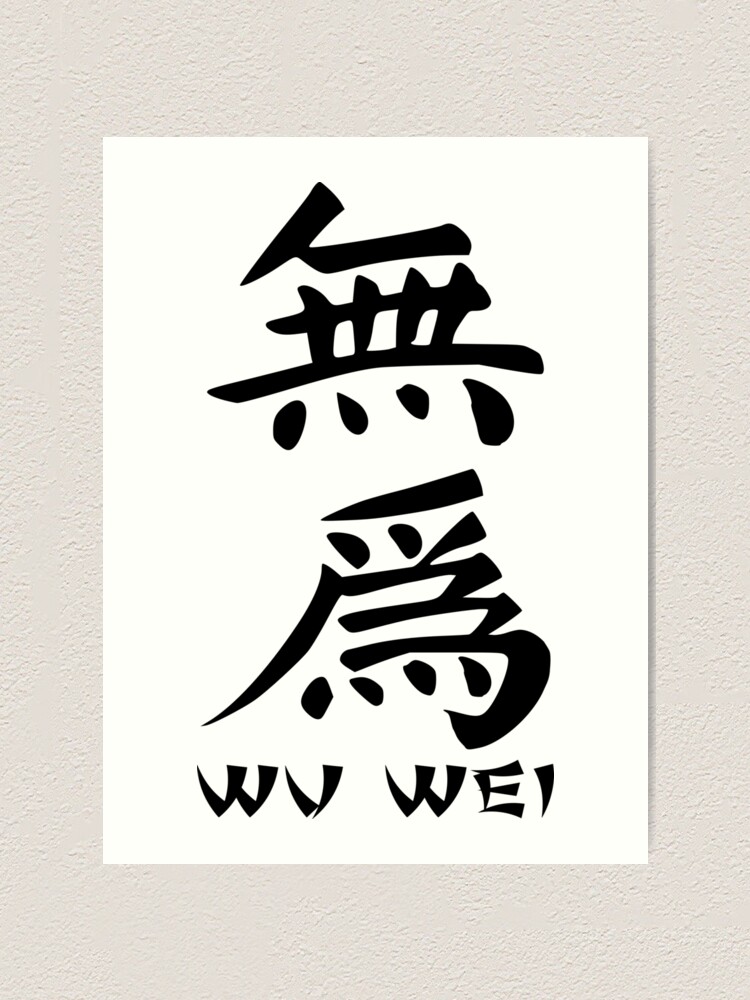
The closing sentence of verse three. It seems unrelated to the lines that come before it. Those lines are an utter puzzle to me, so I focus on the familiar: a restatement of Wu Wei. There’s much more for me to consider on this topic. I sense an invitation to go deeper, to grapple further.
Practice non-doing, non-intervening, non-controlling, non-forcing. How many ways can I think of to say it?
Is it alright not to intervene when a person, a group, or a situation is crying out for justice? Is it alright not to do something to try to save a life? Everything will fall into place? Often what falls into place seems cruel, unjust, or evil. Is it alright not to resist cruelty, injustice, and evil? Or is there some elusive balance to be found, some middle ground between getting involved whole hog, and non-doing?
I know there are arguments on both sides: violent intervention (as in World War II) or non-violent protest, as in Martin Luther King’s marches. But to do nothing? Not to fight if your country is invaded! Not to peacefully protest the seizure of power and violation of human and civil rights by a corrupt dictator! Not to speak out against racism, sexism, ageism! Not to jump into a river to save a drowning child!
Still, I have done all these things: resisted, spoken out, protested, jumped in—though not into a river— to what avail? Was doing them important even though they brought no change?
Suddenly a way out of this quandary occurs to me. Could the translation of this principle from the original Chinese be the problem here? Not knowing a single word of Chinese, I choose to believe that Lao Tzu was talking about non-forcing, not non-doing. If non-doing can’t be reconciled with justice, perhaps non-forcing offers a different path forward. So, practice non-forcing by following the natural way of things as they fall into place. Much better! But how do we know what the natural way of things is? We are so far from it now.
My attempts to understand this Taoist koan are wearing down my intellectual powers and my wordsmithing skills. I pray for relief, and the phrase “open yourself to the Tao” pops into my mind. Now, I feel my heart unclench, and my body relax. A cool breeze seems to blow through my mind. I let go of the need to know, for sure. I bow to the questions, the dilemmas, knowing we will spar again in the darkness of some future early morning.
Some lines in the Tao Te Ching bring me up short, not because they’re cryptic, but because they’re shockingly simple:
“Things arise, and she lets them come;
things disappear and she lets them go.”
—Stephen Mitchell, Tao Te Ching, Harper Perennial Modern
Classics, 1988
My immediate gut reaction is, “What a passive attitude towards life and the world!”
It seems to recommend no resistance to what is, at a time when what is feels oppressive and unjust. It suggests letting go of what no longer is, never truly was, or what you wish would be. Let things come and when they disappear, let them go. Is this political and emotional quietism?
I know from reading the rest of the Tao Te Ching that this attitude is a central tenet of Taoism—Wu Wei, non-forcing, effortless action. It’s interesting that it appears so early, in verse two, counseling us from the start to align effortlessly with the ebb and flow of the natural world rather than swimming against the current.
The emphasis, however, is on effortlessness, not actionlessness. Later in the manuscript, I know there will be words about right action arising harmoniously, naturally and effortlessly, eschewing force.
These words encourage me to watch, wait, carefully observe, to understand the way of things, the natural flow. They ask me to cultivate patience and responsiveness rather than reactivity. They say, don’t jump to conclusions, give it time, don’t rush to intervene. But oh, habits of a lifetime are hard to change!
Later in Verse 2:
“When her work is done, she forgets it.
That is why it lasts forever.”
—Stephen Mitchell, Tao Te Ching, Harper Perennial Modern
Classics, 1988
Has all my work, all my striving, come to anything? At death, I’ll have to let it go. Will anyone remember it? Should I forget it too, as this verse counsels? What does it mean that work done and forgotten lasts forever? Does it endure in some hidden, mysterious way? I wrote a blog post a while ago on the Butterfly Effect—the way the tiniest flap of a butterfly’s wings can change things on the other side of the world. Is that what lasting forever means?
I know the message of these lines will return later in the text, counseling me to do whatever I discern as my authentic work in any situation and then let go of the outcome.
I also know that Taoist teachings, like Zen koans, employ paradox—action through non-action, strength through softness, lasting impact through forgetting. And so I stop trying to figure out what the text means and let the words fall like gentle rain on the thirsty ground of my heart.
The Source, the Tao, is darkness—the birthplace of everything. We come from it, and we return to it. It is the non-being from which our being arises. Close your eyes. Go inside your own dark center and draw near to the center of all.
“Free from desire, you realize the mystery.
Caught in desire, you see only the manifestations.
Yet mystery and manifestations
arise from the same source.”
—Stephen Mitchell, Tao Te Ching, Harper Perennial Modern
Classics, 1988
Desire is the human condition. So, I, always desiring, am caught among the manifestations, while longing for the mystery. The ultimate desire is to be free from desire itself. How impossible that seems, but only then can I comprehend the mystery. Only then can I realize it; only then is it realized in me. Pass through the gateway; enter the darkness. Perhaps understanding waits there.
I wake up in the darkness. It’s two in the morning. Are you awake too?
It’s dark inside and around me. The sheets are cool, like darkness itself. I lie there, listening. The house is still. Yet I’ve been struggling in my dreams to persuade, convince, free myself from something, or resolve something, and it feels impossible. There is no way out. I am trapped. I know the only answer is to surrender, but I don’t know how. I’m on the verge of passing through the gateway into complete darkness. If I take that step, will I realize the mystery?
“Yet,” that freeing word! “Yet,” that promise of release and deliverance! Ah, “Mystery and manifestations arise from the same source.” And that source is darkness; blessed, holy, enfolding—the gateway to all understanding. Abide in the darkness, realize the mystery.
The Tao Te Ching, the classical Chinese foundational text of religious and philosophical Taoism (pronounced Daoism), is believed to have originated around 300 BCE and is traditionally attributed to the sage Lao Tzu. Its title translates as “The Book of the Way and its Virtue.” Taoism centers on living in harmony with the Tao — the natural, spontaneous, underlying way of the universe.
The Tao Te Ching has eighty-one chapters, or verses, most of them shorter than half a page, making them excellent texts for reflection or meditation. I think of the verses, or lines within them, as koans, paradoxical sayings that encapsulate a truth which cannot be grasped through logical reasoning.
I’ve been reading the Tao Te Ching daily for several years—one verse each day, sometimes the same verse for several days in a row. After reading, I close the book (the Stephen Mitchell translation) and reflect on what the words mean in my present situation. Often, a line or two will stand out, and I focus my reflection on those. Sometimes the verse as a whole speaks to me. When I finish reading verse eighty-one, I begin again.
I don’t fully understand the sayings in the Tao Te Ching and the wisdom behind them, but I catch glimpses of reality and hints of the truth. I try to apply the wisdom I glean to whatever is happening in my life at that moment, so each time I read them, they mean something slightly different. I seek to understand and apply them through meditation and writing.
So, here, for the next eighty-one days, are my brief reflections on the Book of the Way and Its Virtue. I share them in the hope they may resonate with your personal experience and encourage you to seek The Way yourself. If your reflections lead you to other or contradictory insights, please share them with me and my readers by making a comment.
Because I don’t quote the entire verse in my blog post, I encourage you to get a copy of Stephen Mitchell’s book and follow along.
One instance of serendipity in exploring “death” as my One Word for 2026 is my retirement community’s simultaneous decision to host a 13-session, yearlong program on death and dying for our residents. The timing was ideal for me. The program provides the practical and social perspective for my emotional and spiritual probing.
I’ve been so impressed by the presenter’s sensitive and comprehensive treatment of end-of-life matters and planning that I asked if she would be willing to talk with me in depth about how she got into this line of work and what it means to her. She obliged, and after a lively hour together, I ended up with a ten-page interview transcript, which I have distilled into this blog post.
~~~~~~~
“You’re going to die. Why not die well?” asks the headline on the home page of Leona Oceania’s website, Die Well Death Education.
Leona Oceania
Good question. If we must die, who doesn’t want to die well? And what might dying well look like?
If anyone can make learning about death, dying, and our options for a good death downright compelling, it’s Leona. Previous attempts to discuss human mortality in my community had been poorly attended, and the conversation shy and stilted. However, this time, from the start, Leona packed the room.
Her appeal, at least for me, and I suspect for others, is threefold: she knows her stuff and is an eloquent communicator; she’s passionate about her mission to educate; and she sets a frank and open tone that emboldens her audience to ask questions they have not previously dared ask and discuss topics they have formerly avoided.
Like many others zealous about their vocations, Leona was awakened and inspired at a young age by a deeply personal experience that set her on the path to the work she loves. Though she had always been fascinated by death and puzzled by others’ unwillingness to talk about it, her biological father’s death from lung cancer in 2003 was her wake-up call. In her words:
“He was getting all the treatments, and it was not benefiting him in any way. I knew a little about hospice, and that it was a beneficial thing, so I suggested it and got a very negative reaction initially from the rest of the family. Ultimately, though, he did end up at home in hospice, and it was an amazing experience for everybody, though it was sad and overwhelming. He was young, only 54 when he died.
“I remember the critical moments that really set me on this path. He had a hospital bed in his living room, and his five brothers and sisters, my half-sister and I, were there. It was just the family in and out, but people were staying there and being with him. Eventually, he was unresponsive for about two or three days and was obviously getting closer to the end. It was January, and it just kind of organically happened that one of my uncles built a fire in the fireplace, which was right at the foot of his hospital bed. We all came into the room, mostly because the fire had been made, and we were sitting around. Wayne, my biological father, hadn’t been conscious for days. Suddenly he opened his eyes and looked directly at every single one of us. And then he closed his eyes, and he died. Wow. It was just amazing. It was sad, overwhelming, but also incredibly beautiful. I had never experienced that before, and it set me on the path to learning more about death. It was a pivotal experience. Once I started sharing about it and asking questions, I learned that others had similar experiences.”
Shortly after this occurrence, her grandfather, who knew of her interest in death, alerted her to the death café movement, and she began attending one in Portland, Maine. Her enthusiasm and desire to learn caught the attention of the Portland café’s founder, who, when she was moving in 2019, asked Leona to step in as facilitator. Seven years later, the café is still going strong, and Leona is still facilitating it and others in Maine. From the cafés, she learned about the End-of-Life Doula movement and signed up for online training. Things came together at the beginning of COVID in 2020 when she was laid off from her regular job and had extra time to devote to doula, home funeral guide, and life legacy training, all online. She had become a hospice volunteer just before the pandemic began, so she stayed in touch with her client through letters during the lockdown.
Once COVID lifted, she decided to dip her toe in the water to see whether a community-based death education program might be of interest. Through a colleague on the Funeral Consumers Alliance of Maine board, she contacted Portland’s West End Neighborhood Association and offered a program. It went well, so she offered another at her local library in Cape Elizabeth, then at the Scarborough Public Library, and she was on her way. After that, instead of convincing groups to host her, organizations recruited her. The Die Well Death Education brand was launched, and her programs are well received and well attended, with highly engaged participants.
Last year she presented one hundred programs, and this year she already has about 100 lined up. I asked Leona if this has become a full-time job, from which she earns a living. Her answer was halting: “Am I doing this full time? Yes, but I am still doing my regular job as well…Has this been, how do you say, lucrative? No.”
You see, Leona strongly believes the program must remain free for attendees.
“There are a couple of reasons for that. A, it’s hard enough to get people to talk about death without charging them money for it. And B, once you charge money, it seems to change the whole dynamic into something I don’t really want it to be. And then it also immediately excludes a whole bunch of people that need the information just as much as anybody else. So that’s not a very good business model. Most of the venues I present at are libraries or places already operating on a limited budget. So, even what I ask for as a fee is a stretch for them, but what I get for a fee doesn’t even scratch the surface of materials.”
Leona provides a purple folder of materials for each participant filled with information essential to preparing an end-of-life plan: advance directive, declaration of final disposition, information on wills, contact lists, financial information access, password access, death certificate, medical aid in dying (MAID), legacy work, obituaries, hospice, end-of-life doula offerings, living wakes, funerals, body disposition, and death cafés.
Some have suggested that she do away with the printed materials and direct attendees to online resources, but in her experience it’s important for folks to have the information readily at hand.
“…We live in such a death-phobic society, and nobody talks about this stuff. I come along and throw all this information at people. It’s overwhelming to begin with, but it’s also easy to be engaged with the topic and have good intentions to move forward with your end-of-life plan while you’re sitting in the room…but as soon as you go home, you lose the impetus… If you must go online and print all the documents, it’s easy to procrastinate. Whereas if you go home with the purple packet and it’s lying on your counter or someplace, and you see it, it’s easier to say to yourself, ‘I really should do that.’ So that’s the primary reason why I provide the printed material. That’s another non-negotiable for me: I think people need to walk away with information in their hands to motivate them to do the work.”
She also provides multiple flavors of delicious cake in the form of skulls, just one way she lightens the mood during the presentations.
A couple of people financially support Leona’s death education work, and she’s recently begun the application process for non-profit status. That will enable her to form an advisory board, apply for grants, seek tax-deductible donations, and perhaps eventually become a paid employee. But it’s a long road ahead and still very much a labor of love. She says, “I feel one thousand percent that this is what I am supposed to be doing.” She doesn’t know anyone else, especially in Maine, who is doing this work the way she is. Others give sporadic presentations on special topics, but she knows of no other comprehensive program. She’s always learning. When participants ask questions, she researches the answers and incorporates them into her program, which is, consequently, always evolving.
Leona has been extremely gratified by the response to her death education offerings.
“I have been so pleased with how much positive feedback I’ve gotten. I think people are really grateful and energized to learn they have more options than they thought. People get really engaged… It’s just been so positive, rewarding, and motivating. One woman—I love this story—raised her hand and said, ‘Why don’t we know this stuff?’”
I asked Leona if she thought some of her success could be chalked up to American society becoming more open and receptive to talking about death.
“That could be possible,” she opined. “I think COVID changed a lot of things for people. But I tend to think my approach also leads to success because I don’t tiptoe around it. I don’t use soft words; I just talk about it, and I’m upfront, and I try to bring levity to it.”
I also asked what age groups make up her audience. She says attendees tend to be on the older side, but she’s also had people in their twenties and even some teenagers.
“…when I do these programs, it’s an offering to everyone. It kind of drives me a little crazy when people want to bring me in only for an elder series. I’m fine with that, but in my head, this is for everybody. I think that the sooner you know this information, engage with your mortality, think about it, and prepare for it, the sooner you can put it aside and live your life in a freer, more meaningful way.”
Leona tries to avoid offering her personal views on death and mortality during her presentations. She sees herself as an information provider and a conversation facilitator. But there is one almost universal experience that she sometimes speaks about:
“I’ve seen it, and I’ve heard about it, consistently, the fact that people who are actively dying very often talk to or about people that have died before… And that’s consistent across cultures, religions, countries, and social groups. I’ve seen it over and over. There’s something to that, but I don’t know what it is. I’m not a religious person…I just feel that we’re made of energy, and that energy goes somewhere when we die. It brings me a lot of comfort, but I don’t know exactly what it means. So, long story short, I do not bring my own stuff to the conversation… I’m always intrigued to hear about what other people feel or think.”
What is most rewarding about this work? Leona says it’s twofold: one, getting the information into people’s hands, planting the seeds, letting them know about their options, and two, giving them tools for dealing with death at the bedside. She says,
“…if someone is bedside in a dying experience, they may remember things they can do to help the person that’s dying or themselves, to neutralize the fear of what’s happening…If you don’t know what to expect, it can look kind of scary, and it can seem like a terrible thing when it’s not.”
Of course, the overwhelmingly positive response to her program is also rewarding. “It’s all come together in a way that I never imagined. I’m doing the thing I really wanted to do.”
“What advice do you have for others interested in pursuing a career in death education?” I asked.
“There should be more of what I am doing. You can’t do it all by yourself. I don’t want a monopoly on it. I think the way I am doing it is kind of unique. Maine Death with Dignity does community presentations on medical aid in dying. There are obituary-writing workshops and legacy workshops, but I’m doing it all in one…People are so hungry for this information when it’s presented in a digestible way. I would love to see more of what I am doing.”
Talking with Leona, who is extremely well-informed about everything related to death and hungry to learn even more, was an exceedingly upbeat way to end my reflections on the Five Remembrances (see previous posts in this series). You could say she is passionate about death—well, really, about dying well and helping others make the decisions and take the actions that make that possible.