
Love in All Seasons

“Farewell to thee! but not farewell
To all my fondest thoughts of thee:
Within my heart they still shall dwell;
And they shall cheer and comfort me.”

—Anne Brontë

One morning, a couple of years ago, as I accompanied my dog on his first walk of the day along a well-worn trail through the woods near my home, I was surprised by something I had not noticed before. I saw a path, intentionally bordered on either side by clean barkless branches, which led away from the beaten track over dead leaves, broken sticks, and brown ferns shriveled by frost.

 It was the height of tick season in Maine, so I hesitated to step into the underbrush, trailing my dog on his lead, but my eyes followed the branch borders of the path deeper into the woods.  There, on a stick wedged between two conjoined tree trunks, something brown and out of place dangled.  I couldn’t believe my eyes, so I had to get closer to be sure. 

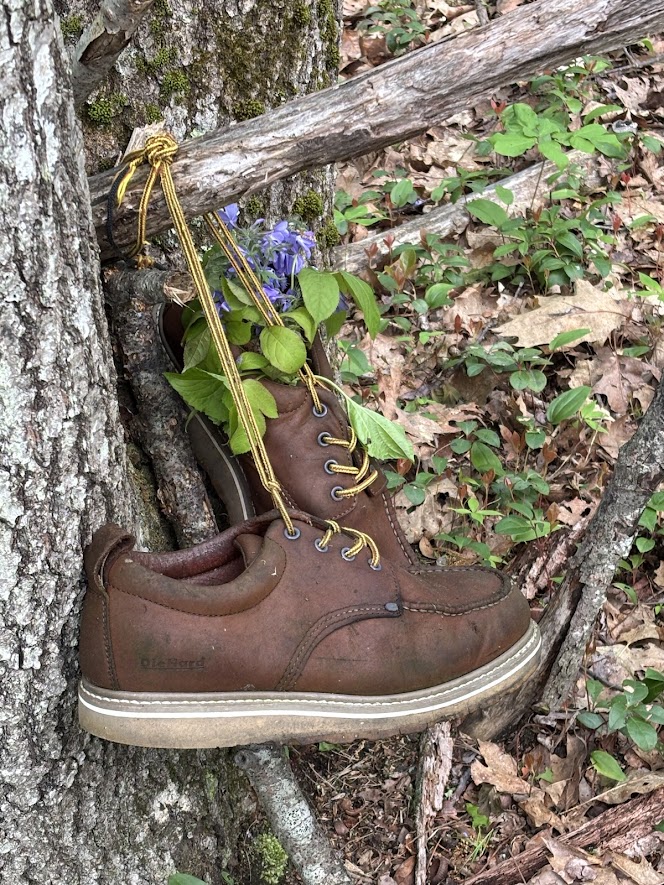
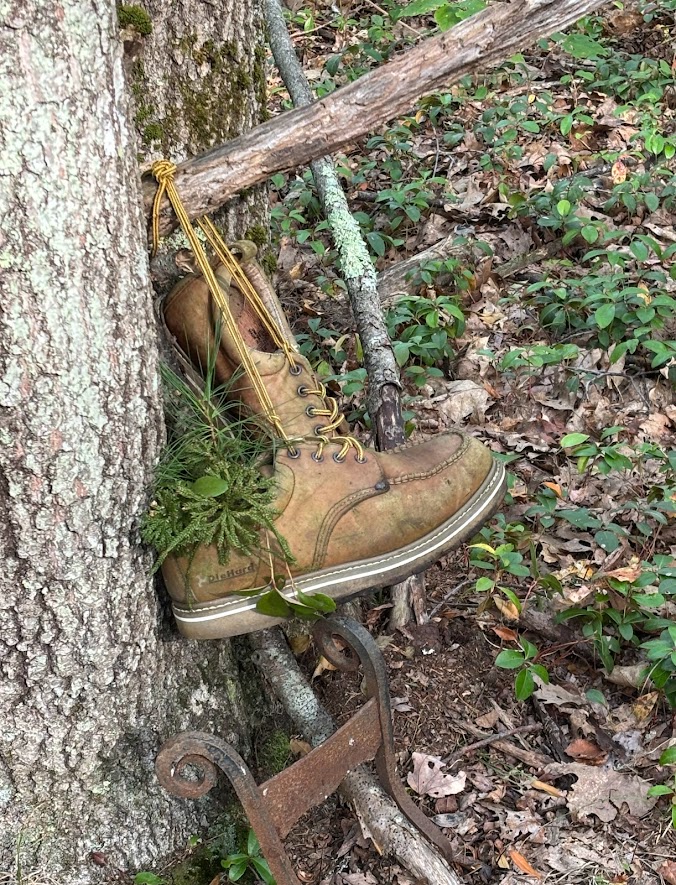
Taking a deep breath and hoping no deer ticks would crawl up my legs or bury themselves in my dog’s curious muzzle, I stepped onto the path and gingerly picked my way about twenty paces into the woods.  My eyes had not deceived me.  A sturdy pair of men’s walking shoes hung by their laces, artfully draped over the stick. What could this mean?  Who would leave their shoes behind in the woods?  These lace-ups still had a lot of life in them.

Something prevented me from touching them—some intuition that this was a holy place.  I took a picture of them, and retraced my steps, my dog tugging me back to our usual route. However, the image of the shoes stayed with me for the rest of our morning walk, and the place where they hung became the destination for frequent pilgrimages in days to come.

After several visits, I began to suspect that these were my neighbor Simon’s shoes, and that they had been lovingly arranged in the woods where he frequently walked, his camera dangling from his neck.  Simon had died several months before, and I surmised that his widow deposited the shoes in a setting he loved near their home, where she could visit them often to commune with her husband.  I took the risk of asking her if I had guessed correctly, and she, blushing but shyly pleased that someone else had discovered her memorial, confirmed it. 

Over the last couple of years, my pup and I have visited Simon’s shoes countless times.  Cynthia, Simon’s wife, adds bits of flora to mark the seasons—sometimes delicate wildflowers in spring, ferns in summer, red, yellow, and golden leaves in fall, and, of course, winter provides its own decoration. Each time I set out on my pilgrimage, I look forward to discovering these simple but artful adornments.

All I know of Simon are these shoes and the few memories of her beloved husband that Cynthia has shared with me. By the time the couple moved into my neighborhood, he had already begun to decline.  I would pass him on my afternoon walks and receive a silent smile in response to my cheerful hello.  He was, by then, not much of a conversationalist, especially with strangers.  His soft-spoken words were sparing, but the few I heard were direct and gentle. 

I marveled that the memorial shoes were in such good shape.  According to his wife, Simon had worn them on hikes all over Europe and America.  Once, on a walking trip in Ireland, amid a powerful wind and rainstorm, he and Cynthia took refuge in a farmhouse along their way.  The family welcomed them to warm up and dry off at the hearth. So, Simon propped his feet in front of the open fire, scorching the soles of his shoes before he realized what was happening. Thrifty as he was, he saw no reason to replace the singed footwear. Like his shoes, Simon was humble, loyal, and resilient.

Simon’s memorial shoes, their constancy, adaptation, and beauty in every season, have become an icon for me.  A symbol for the humility that embraces and accepts what is, even when the reality is absence. Gradually, these old shoes will succumb to the elements and disintegrate, but not before they have taught many passersby a profound lesson.  We continue after death, transformed surely, but ultimately, reunited with the elements that made us, enlivened us, warmed us, fed us, cleansed us, and sheltered us. Finally, we come home.

Simon and Cynthia are not the real names of my neighbors.

Practicing for the Big Let Go: Love

To view the images in this post, click Read on Blog

I have mentioned here before that I meet monthly on Zoom with a group of women who talk about our experiences of aging and our musings on death. We explore our stories, insights, discomfort, and fear about the inevitable decline of our bodies and the certain end for us all. A few weeks ago, we had a courageous discussion about dying, our own and that of those we love. Not surprisingly, most of us expressed more fear about the possibility of a painful, demeaning, drawn-out dying process than about the moment of death and what, if anything, comes after it. We ventured onto the delicate topics of Death with Dignity and Physician-Assisted Death, which is legal in some countries, including Canada, where I was born.

I told the story of my Canadian cousin’s husband’s death. I’ll call him Leigh and her Meredith. He suffered for years from debilitating cancer, which was diagnosed just after his retirement when they had planned finally to begin their travel adventures together. Leigh, supporting and delighting in Meredith’s wanderlust and love of natural beauty, encouraged her to go exploring on her own and with their daughters. He enjoyed her travels vicariously and enthusiastically. However, as time went on, she traveled less as he needed more care and experienced frequent hospitalizations for treatment and long energy-less periods confined at home.

Though he tried his best not to be a burden for his family and patiently bore the symptoms of his disease, it troubled him that Meredith’s life centered around him and his ups and downs. He recognized her profound sadness as she watched him suffer, helpless to alleviate it, and worried about how she would cope with what they had good reason to believe would be a painful and degrading end. As the pain increased and his energy ebbed, recognizing his own and Meredith’s exhaustion and the toll his suffering was taking on her, he decided to apply for MAID, Medical Assistance in Dying. Canadian law provides this option for individuals who are terminally ill or in intolerable pain.

Together, Leigh and Meredith navigated all the legal requirements and preparations and finally arrived at the day of his death. Meredith and both of their adult children gathered around his hospital bed, said their goodbyes, and expressed their love and gratefulness for each other. Medical personnel administered the necessary medications, and quietly and peacefully, Leigh went to sleep and then ceased to breathe. Meredith experienced the meticulously planned and compassionately orchestrated end as a gift of love Leigh gave to himself, her, and their daughters. Years later, she still speaks movingly of this gift and her memories of their last intimate moments together. She says Leigh was right; a horrible end would have been much more difficult for both of them to endure and for her to recover from. Instead of her beloved in agony, her last memory of him is tender and peaceful.

I did not tell the story of my mother’s death in that morning’s discussion group. In her early eighties, she was diagnosed with pancreatic cancer after a long period of ignored symptoms and then months of waiting for tests and doctors’ appointments. The specialists said that her only hope of survival was a drastic surgery in which her abdominal organs would be removed from her body to make the tumor on her pancreas accessible for excision. Then, they would replace the organs, and everyone hoped everything would work properly again. It was a risky option back then for even a younger, more fit person, but it was a long shot for someone in their early eighties. By demonstrating determination and pestering her doctors, she got them to agree to perform the surgery, even though success was extremely uncertain. She wowed them on the pre-surgery stress tests, proving that she was strong enough to withstand the operation, but as the day approached, she was anxious and irritable. 

One evening, I asked her why she was willing to put herself through such trauma for perhaps just a few more years of extended life when she could not count on a full recovery or high-quality health. She responded without hesitation, as though she had already asked herself that very question and was certain of the answer. “It’s for your father,” she said. “He will be too lonely when I die. But don’t tell him.” I didn’t press her further. She and my dad did not have an overtly romantic relationship. I can’t remember her ever expressing feelings of love to anyone. On the contrary, she tossed criticism liberally in all directions. But they had been married for more than fifty years, and their lives were so intertwined that she knew her death would be his undoing. 

She had the surgery. The team opened her up and saw an abdomen riddled with cancer, so they closed her and sent her to recovery. The surgeon told us the outcome and gave a prognosis of one to three months. She lived through the night and, early the next morning, experienced massive internal bleeding, was taken back to surgery, and died of heart failure. My father’s sobbing heartbreak is seared into my memory, as is the sight of his forlorn, defeated figure standing outside her empty bedroom at home that evening.

I’m not sure if my mother ever told my father that she loved him, but she knew how much he loved her, and she was willing to endure a horrendous surgery out of compassion for him—her gift of love. He lived for five lonely years after her death, making the best of each day but missing her profoundly. It was tough to watch.

Another member of the aging-and-death discussion group shared a glimpse into a recent awakening. She’s been seeking understanding of love, what it is, how it feels, how it manifests, for quite some time. Recently, she and her husband were walking during an outing. He is older than she and is slowing down slightly. She found herself dropping back to match his slower pace and wondering at the tender willingness she felt as she did so. Could this be love, she asked herself—some facet of love? 

As I draw nearer to my own inevitable death—The Big Let Go—I ask myself what will be most important to me, and I know instantaneously and completely that it will be love. Everything else will fall away, and the only important activity will be loving—giving and receiving it. Knowing this, shall I start to practice now? Let go of all but love, in every moment and situation, and lean into loving—fall into it, and trust it utterly.

Dignity or Indignity

I frequently visit a long-term care facility near my home. My dog and I go once a week to offer pet therapy to the residents. We walk from room to room, greeting the patients who pet the dog, smile at his simple tricks, and feed him treats as a reward. Occasionally, I also serve as a hospice volunteer in this facility, watching with someone who is dying through the dark hours of the night. For one reason or another, I’ve spent a good deal of time visiting nursing homes in Maine and Massachusetts, and this facility, in my experience, is one of the best. From an outsider’s point of view, it is clean and well-managed, with a full complement of services and a clientele that seems satisfied with their care. The staff is friendly to my dog and me, speaks kindly to the patients and treats them with gentleness.

            Still, even in this seemingly best-case scenario, there are sometimes heart-breaking and gut-wrenching situations. Recently, nearing the end of a morning visit with my dog, I approached a patient we know well, who loves the little pup and whose attention he welcomes. She was sitting in her wheelchair in the hallway outside her room, looking anxious. I asked her what was bothering her, and she said she had been waiting for a long time for someone to take her to the bathroom. The young social worker who had just left her side had gone in search of a nursing aide to assist her. “It’s so hard,” she said, “when one gets old and bladder control is not what it used to be, and you call and call, and no one comes. Things have gotten worse,” she said. “One waits longer and longer now.” I expressed my sympathy and felt frustration rising in my chest. I also noticed a high-pitched wailing coming from the room opposite hers.

Someone else was also in distress. The room had a barrier across the door with a large stop sign in the center, indicating that only authorized personnel could enter. These detachable and portable barriers became common at the height of Covid outbreaks. “Help! Please help!” came the weak plea from the bathroom inside the room, but I could not go in to see what the matter was. I surmised the resident, whom we also know well, had been sitting on the toilet for a long time and was in discomfort or pain. The social worker approached again and reported that a nurse would be along shortly, after she finished putting another patient in bed. Timidly, I pointed toward the Stop sign and asked if she knew someone else needed help. She looked daggers at me, I guessed, for interfering, so I said goodbye to our friend in the wheelchair and walked on, frustrated, sad, and embarrassed for all of us.

The next day, when talking about aging with a group of healthy women in their sixties and seventies, I told this story and commented that this sort of indignity may await us all. I believe this common occurrence in senior care facilities is not the fault of nurses or other staff, social workers, or families, I argued, but the result of an ageist society that does not value the lives of those who are no longer financially or physically productive. An uncomfortable silence, a few somber nods of recognition, and a change of subject followed my candid expression of opinion. Understandably, no one wanted to discuss toileting in nursing homes or dwell on the possibility of finding ourselves in similar situations down the aging road.

I wrote about the indignities of the senior healthcare system in an extended series on The Elderly and End-of-life Care in 2017 when I launched this blog. Things have not changed since then, and because of further staffing shortages, they have worsened in many ways.

This kind of indignity may await all of us. More and more of us are living into our nineties because of medical advances producing life-prolonging disease treatments and cures. The healthcare system is stretched beyond measure, caring for an ever-increasing percentage of seniors in our population. We take advantage of every possible means to prolong our lives. Covid has decimated the ranks of healthcare professionals, and the greed of insurance and drug companies complicates matters further. I frequently hear my contemporaries say that the system is broken. They can’t get direct face time with their primary care doctors, or appointments with specialists, or get their prescriptions promptly. Doctors and nurses are quitting in frustration or from burnout. In-home care is exorbitantly expensive, and the agencies that deploy homecare workers are limping along with a few staff members. Of course, the financially secure have it far better than low-income people. That goes without saying, but no matter how financially secure you are, your dignity will be in jeopardy if you can’t get someone to take you to the bathroom.

Or will it? In these recent posts, I’ve been encouraging us to think about practicing for The Big Let Go—death. I’ve been recommending we consider learning to let go in small ways in ordinary daily situations to be ready to let go in a big way at the end of our lives. Am I suggesting that we must let go of our dignity? No. I am proposing that we consider where our dignity truly resides.

Does our dignity depend on how others treat us, or is it reflected in and demonstrated by how we treat others? My friend waiting for assistance to go to the bathroom was calm, polite, and sad but not angry, even though she faced the indignity of potentially soiling herself while she waited. The other patient, pleading for assistance from her bathroom, said, “Please.” Can we learn to relinquish the external signs of dignity while holding on to our inner poise, beauty, and self-esteem? And how can we practice doing that today?

How do we respond when someone wounds our dignity in small or large ways? Can we still insist upon the outward recognition of everyone’s dignity while more highly valuing intrinsic worthiness, integrity, humility, and courage as the essence of our humanity?

We may not all end up in situations like the patient in the wheelchair waiting for assistance with toileting. We may be lucky enough to die suddenly or in the comfort of our homes, surrounded by those who love us and tend promptly and respectfully to all our needs. We may live an active and independent life, avoiding physical dependency on others to the end. But if we don’t practice letting go of external signs of respect while holding fast to inner dignity, we may lack the necessary interior resources to draw upon as we approach The Big Let Go.

Practicing for “The Big Let Go”

I’ve been using this phrase for some time now. When I drop it into conversation, as in, “I’m practicing for The Big Let Go,” I usually get a puzzled look from the one I’m talking to. When I explain what it means, I get a “You’ve got to be out of your mind!” look. 

So, what is “The Big Let Go?” Well, it’s Death, of course—the most crucial moment of letting go in our lives. Death is when no more alternatives, options, arguments, or excuses exist. Procrastination is impossible; the hope of avoidance is patently hopeless, and you are entirely alone, whether or not a friend or loved one is sitting at the bedside holding your hand. It is the ultimate moment of giving in, surrendering, and trusting—letting go of control and our grip on life.

Some go out fighting, refusing to let go until death steals their last breath. That’s usually not a pretty or dignified exit, which is what we all want, whether we say so or not. How often have you heard someone say they hope they die peacefully in their sleep? And speaking of sleep, it’s a perfect opportunity for practicing letting go—or death, to put it bluntly.

What does it mean to practice something? The Oxford Dictionary defines practice as “repeated exercise in or performance of an activity or skill to acquire or maintain proficiency in it.” Synonyms are training, rehearsal, repetition, drill, and warm-up. Practice makes perfect, we say flippantly. Practice is mundane and often drudgery; perfection is sublime and unachievable. The child practices the piano faithfully to win an invitation to play at Carnegie Hall; you practice your golf swing to win the office tournament. I practice drawing to become an artist or throwing pots to become a potter. We practice silent restraint so that our angry words don’t hurt others, or we practice listening attentively and openly to understand one another.

Practice develops skills and changes habits. It can change your life, even set you free from addictions and compulsions. In a sense, we are what we practice—from the mundane (I brush and floss my teeth meticulously to have a healthy, attractive smile) to the sublime (I practice meditation daily to be in touch with my true self and reality.)

The notion that one might practice letting go throughout one’s life to be good at it when the time for death arrives is, for many, weird and morbid. It may be so for those who see death as a tragedy, a loss, something to be resisted and put off. But in all faith traditions and reports of near-death experiences, death is portrayed either as a moment of release, culmination, reward, or welcoming, or, conversely, of terror and punishment, depending on what one has practiced in life.

Buddhists are encouraged to think of death frequently to be ready for it and for what it can teach them about how to live before it arrives. Charnel Ground meditation involves imagining or observing the gradual dissolution and decay of the body to internalize the truth that all things are impermanent—everything changes and passes away.

Buddhistdoor.com 12-16-02

Christian reflection on death focuses more on reward or punishment and is encouraged to put the fear of God, the ultimate Judge, into its adherents. According to theologians, Jesus died and rose again to save us from death and damnation.

https://www.goodreads.com

But in general, and particularly at this time in history, we ignore death until it becomes unignorable, and then we lament it. So, how counter-cultural is the notion of practicing to do death well—gracefully, peacefully, with joy and dignity—instead of hanging on for or to dear life? Can one practice gently relinquishing, letting go, releasing, and opening to the unknown daily to prepare for The Big Let Go?

Pema Chodron, in her book How We Live, is How We Die, quotes a verse from a Tibetan Buddhist teacher, Dzigar Kongdrul Rinpoche,


“When the appearances of this life dissolve,
May I, with ease and great happiness,
Let go of all attachments to this life
As a son or daughter returning home.” (p.22)

I find this image of a child returning home enormously comforting. It conjures up memories of long day trips when I was young, perhaps to visit relatives or friends or the beach. Days full of play and food would end with a car ride homeward in the dark. We kids would fall asleep in the backseat, lulled by full stomachs, the hum of the car engine, and the rocking of the seats beneath us. Then, when we finally arrived home, we’d be carried inside, undressed, and put to bed in the safety and familiarity of our rooms. What ease and great (sleepy) happiness! 

Or imagine the scene of the Prodigal Son in Jesus’ parable. The dirty, starving, ashamed son returns home to a father’s generous welcome, greeted with a feast, new clothes, and the warm embrace of forgiveness. What ease (relief) and great happiness!

Death may not resemble either of these images, but I believe it is a return to the source of all life. If death is a return to our source, it is impossible to do it without letting go of our attachments to this life—a tall order indeed. It involves letting go of our attachment to our youthful good looks, our health and strength, career and family successes, fame, financial security, mental acuity, friendships, loves, regrets, anger, fear, and failures. I could go on.

Since dropping these far-reaching and self-defining attachments is a momentous task, I believe it is worth practicing now for the challenge ahead of us. For some time, I have been trying to recognize small and large opportunities for letting go in my daily life—letting go of people, outcomes, feelings, memories, hopes, expectations, opinions, and judgments. When I encounter an opportunity for letting go, I try to notice what it feels like in my body, first to hold on and then to let go. Viscerally, the experience of holding on is tight and painful; letting go is a feeling of “ease and great happiness.”

            Over the next few posts, I will explore some everyday experiences of letting go, keeping in mind that you, like I, may want to develop a skill that will stand us in good stead when The Big Let Go arrives. Will you reflect and practice with me?

Noticing Respect in 2022

“Is treating someone respectfully fundamentally different from respecting him, her, or it?”

I posed this question in my first blog post in 2022, and I return to it in my last. (Though technically, it’s 2023 already, today is New Year’s Day Observed on the iPhone calendar.)

In the last year, I have reflected on, written about, and invited your comments on various instances of respect—situations I have encountered in daily life that have caused me to examine the meaning of respect more closely. For example, I wrote about respecting others through an open, honest, invitational style of communication embraced by Maine’s CDC Director, Dr. Nirav Shah, as he interacted with the people of our state during the height of the COVID pandemic.

I shared the “Just Like Me” practice of recognizing that everyone, even those whose ideas and actions are sometimes antithetical to our own, has many of the same human attributes, desires, hopes, fears, sorrows, and losses as we do. This practice encourages points of identification to generate empathy and nurture even the tiniest grain of respect. In “Respect Amid Conflict,” I wrote about two principles crucial to navigating conflict respectfully: understanding oneself and seeking to understand the other, ferreting out one’s deepest motivations and underlying assumptions, and keeping an open heart and mind about the experience and perspective of the other.

In “Respect in Extremis,” I reflected on respecting the essence of a human being when accomplishments, attractiveness, and self-control are stripped away at the end of life. In the article titled “What Is,” I illustrated the habit of noticing and accepting the ordinary miracle of each moment, welcoming and flowing with it instead of resisting and wishing things were different. In “Two Tales About Respect,” I explored how experiencing disrespect from another may tap into our lack of self-respect. I also exemplified how inner doubt and confusion about the right thing to do in a situation can cause one to act disrespectfully toward others.

The three posts about my friends Jack and Vicky dealt in depth with their experience of years of homelessness, followed by a brief period of stable housing, Vicky’s severe illness, and ultimately their deaths within two weeks of each other. The articles, telling the story of our friendship, were my memorial gift to honor them. Their backgrounds and life experience and mine were dramatically different, yet we came to understand, respect, and love one another.   And finally, “Respecting Limitations and Letting Go.” Recognizing and accepting our limitations and those of others is a lesson we must all learn as we grow older. Learning to let go when the time is right will prepare us for the end of life when we must ultimately let go of everything.

So, back to the original question: “Is treating someone respectfully fundamentally different from respecting him, her, or it?” I’m currently living in a divisive atmosphere. There are many perspectives on the problem we share, but for clarity, I think I can safely say that two slightly porous camps have emerged. Each wants respect from the other. Each desires to be heard, understood, honored and treated kindly and politely. Trust has been damaged, and respect is frayed and floundering. 

But can we treat each other respectfully, even if each camp has done and said things that have damaged the esteem we formerly felt for one another? And would respectful words and actions move us toward restoring genuine respect? Would they help us navigate this situation, repair the divisions, and solve the problems? 

And what would treating each other with respect look like, even if we are not feeling it? We could begin with the old gem, “Do unto others as you would have them do unto you.” That might include giving everyone the benefit of the doubt, not presuming to understand all the complicated nuances of the situation or the difficulties others face. Listen and communicate. Recognize defensiveness in yourself, but don’t act out. Don’t say hurtful things, be gentle, and practice courtesy. Don’t avoid one another (downcast eyes, looking away) but take risks to build genuine relationships. Listen; communicate. Keep things in perspective by remembering to be grateful. Notice the good and speak up about it. Keep working at the solution, don’t give up or bail. Listen and communicate directly, face-to-face, and eye-to-eye. Behave respectfully, and you may earn respect.

So, I would posit that treating someone respectfully is not fundamentally different from respecting that person. Famously it is said you can’t make peace; you have to be peace. You can’t create respect; you have to be respect.

Respect In Extremis

In Extremis definition: at the point of death, at death’s door, breathing one’s last, not long for this world.

When I launched this series in January, I said I wanted to notice “simple, modest, authentic examples of respect among people I interact with daily.” Here’s what I have been noticing.

######

I stand outside the closed door, leaning against the opposite wall, halfway down the corridor in a skilled nursing facility. Soft light, quiet female voices, and the occasional deep moan escape into the darkened hallway from behind the door. It is midnight; a passing nurse pauses before me and raises a questioning eyebrow. 

“I’m a hospice volunteer waiting to sit with, uh, keep vigil with Mr. X.”

 “They’re changing him, giving him his meds, and making him more comfortable.” 

I nod. “I’ll wait here ’til they’re finished.” Nurses handling one’s naked body, even at the point of death when we imagine inhibitions have dissolved, is one thing. Having one’s wasted body exposed to a perfect stranger, whether or not you are aware of her presence, is another. I assume modesty does not dissolve at the end of life and do not intrude until Mr. X is dry, clean, settled, and covered up to his chest with a light sheet and warm cotton blanket.

When I step into the room, the remaining nurse gently touches the unconscious man’s shoulder.

“Does that feel better, Sir? I will give you a little more medicine to help you breathe more easily. I’ll just put a couple of drops inside your cheek. That’s it.” She positions the dropper inside his gaping mouth and slowly rubs his throat below his jaw. “Good, now swallow if you can.” He does.  

Before leaving the room, she fills me in on what she knows about her dying patient—his former profession, family members who kept vigil earlier, and his interests. Then, she points to various objects in the room—the essential things his wife wants him to have near at the end: Classical CDs, a small CD player, a book of poetry, and photos. “I’ll be back to check on you in an hour, Sir,” she whispers close to his ear before gliding through the half-closed door. 

The room is dark, the dim light from the adjoining lavatory casting shadows around the bed. I put some Bach in the player, turn the volume low, place a straight-backed chair next to the bed, collect the book of poetry, and sit. I touch Sir’s lower arm through the sheet and introduce myself, giving my first name and saying I will be sitting with him for a few hours. His breathing does not change as I touch him or speak. He is deep in and far along on the journey to the end of his physical life. I quietly read poem after poem, pause for a few minutes of silence between them, and watch Sir breathe. Soon his breath becomes ragged and uneven; it occasionally stops for up to thirty seconds and then begins again, shallow and irregular.

Over the next few hours, the kind nurse comes and goes several times, always speaking softly and respectfully to Sir, touching him gently, and telling him in advance about every act of care she will perform. No callousness, no surprises, no assuming he is no longer entirely there. I watch her ministrations with awe, a tear coming to the corner of my eye at witnessing such tenderness.

######

My friend is slumped in her hospital bed, several floors up in a massive building on Boston’s Beth Israel Deaconess campus. She is declining rapidly. The plan is to release her home to hospice care the following day. Today, she shares a room with a mystery woman behind a drawn curtain. During my less than an hour stay, nurses come and go from the room every few minutes. 

My friend is on a breathing machine called a BIPAP, a form of non-invasive ventilation therapy. She can watch its monitor, see the oxygen level in her bloodstream, turn it off when it reaches the desired level, and remove the oxygen mask from her face. But a nurse must come to turn it back on again and reposition the mask to seal it around her mouth and nose. This procedure happens four or five times while I am there. The nurse’s calm composure, concerned smile, and respectful tone astonish me.

The patient behind the curtain is worried that she has not received the proper dosage of her medication. Another nurse repeatedly and patiently explains the doctor’s orders, the times she was medicated, and when she is next due. Finally, after about 20 minutes, the patient thanks her and apologizes for being such a nuisance. The nurse responds, “Not at all; this is important. You should always question us if you feel something is amiss.”

While the BIPAP breathes for my friend, she closes her eyes and rests. She removes the mask when she can breathe on her own, and we talk about her difficult life, sadness, fear of pain, and death. She praises her husband for the care he has given her over the last several years. We say we love each other and are grateful for our friendship. We hold hands in silence. When her eyes are closed, I gaze at her—the whole picture of her crumpled body amid bunched-up sheets, her swollen hands, and her weary face. I think, someday, this will be me.

The nurse returns and gently repositions my friend’s oxygen mask, punches buttons, and the BIPAP whirrs again. Then this guardian of my friend’s humanity glides back into the hallway and on to answer the next call bell—respect in motion.

######

For those who die after a long decline in health, the dissolution of respectableness can be one of the most challenging aspects of the journey. Gradually we lose many of the attributes that once earned us respect, approval, and acceptance. As the looks wither, the brain slows and dims, and control of bodily functions dissolves, power over external forces diminishes. We are no longer the sisters, mothers, professionals, neighbors, philanthropists, or activists we once were; no longer the persons others, and we ourselves, considered worthy of respect. In extremis, we will rely on pure, unearned, free respect. Will it be offered? Can we give it now, in anticipation?