Change and Loss

AI-generated image

“All that is dear to me and everyone I love are of the nature to change. There is no way to escape separation from them.”

The Fourth Remembrance would appear, at first glance, to contradict a core Buddhist principle, the concept of interbeing: the interconnectedness and interdependence of all things. The notion that we inter-are with everything seems difficult to reconcile with this remembrance’s stark prediction that we will inevitably be separated from the things and people we hold dear. 

While the Fourth Remembrance purports to be about the core Buddhist principle of impermanence, or constant change, it speaks to me of the fundamental paradox at the heart of the human experience—love and loss. We remain essentially unbreakably interconnected and interdependent despite change and separation.

The paradox becomes more accessible when viewed through the lens of letting go. The first four remembrances are all about letting go. The first three, letting go of youth, health, and life itself. The fourth, letting go of everything we hold dear and often cling to: people, relationships, situations, possessions, habits, and ideas.

So, why must we let go? Why must we suffer separation? Because everything changes, including me. For instance, relationships change. The person I met and fell in love with last year is different this year, and I don’t love him as much or at all. Or I’m different, and he doesn’t love me.

Possessions deteriorate. The house I bought six months ago has been invaded by carpenter ants and is disintegrating, the lawn has weeds now, and the basement is damp when it rains. Time to consider selling?

Circumstances evolve or devolve. The job I thought was a perfect fit for my talents has turned into a nightmare since the new supervisor arrived.

Habits intensify and may become unhealthy. The glass of wine each evening to relax has become two, then three, then four, and it is no longer helping me to relax; now I can’t sleep.

Beliefs and ideas harden and narrow our perspective. My creative idea for solving a problem in my community has become an obsession, and I can’t see the situation from any other perspective. My mind is closed. I’ve become part of the problem instead of the solution.

Letting go is difficult, often painful. Feelings of sadness and loss linger, sometimes forever. Letting go can cause or contribute to a wound that may stubbornly resist healing. Holding on, though, can also cause suffering. The choice can seem like a no-win proposition. We can feel trapped between the pain of holding on and the sadness of letting go.

If, indeed, loss is unavoidable, how do we live with that reality? Are we meant to love at all? If so, how do we love when everything we love is constantly changing? By accepting that loss is inherent in love?

The  Tao Te Ching offers some profound but practical advice.

If you open yourself to loss,

you are at one with loss,

and you can accept it completely.

(Verse 23, Stephen Mitchell translation)

To open to loss, one must open to risk—the risk of loving, valuing, or holding dear. One must be open to caring, vulnerability, and desire. These emotions are big risks. They carry the potential for getting hurt. You cannot let go of something you are not holding on to. You cannot lose something you have not gained, or at the very least desired. Holding something dear—even lightly or slightly—must inevitably lead to letting go. If it doesn’t, it will lead to suffering. The Fourth Remembrance does not recommend loving less; rather, it recommends accepting change and loss. The Tao speaks of loss as something worth opening to, worth accepting, becoming one with.

Why might that be so? Like the other remembrances, the Fourth is not a belief, but an observable or experienced truth. Change, and therefore separation or loss, happens to everyone. We know this from personal experience. Accepting it unites us with reality and with all other sentient beings. Therefore, loss is one way our interbeing, our connection to others, is revealed.

Losing or letting go also creates an opening for something new. As terrifying as this opening may appear, as sad as it may feel, it is the way forward, the only way. While letting go might provide an opportunity for something better, more importantly, it allows us to remain responsive to reality. The Fourth Remembrance does not ask us to stop loving, but to love without expecting permanence, to let what we hold dear rest in open hands, to receive what comes, accept the loss of what goes, and be fully present to what is here now.

Questions for reflection: Is the price of love loss? Can we love deeply without clinging? Does knowing something is temporary make it more or less precious? Am I being asked to let go of something or someone?
In the Twinkling of an Eye

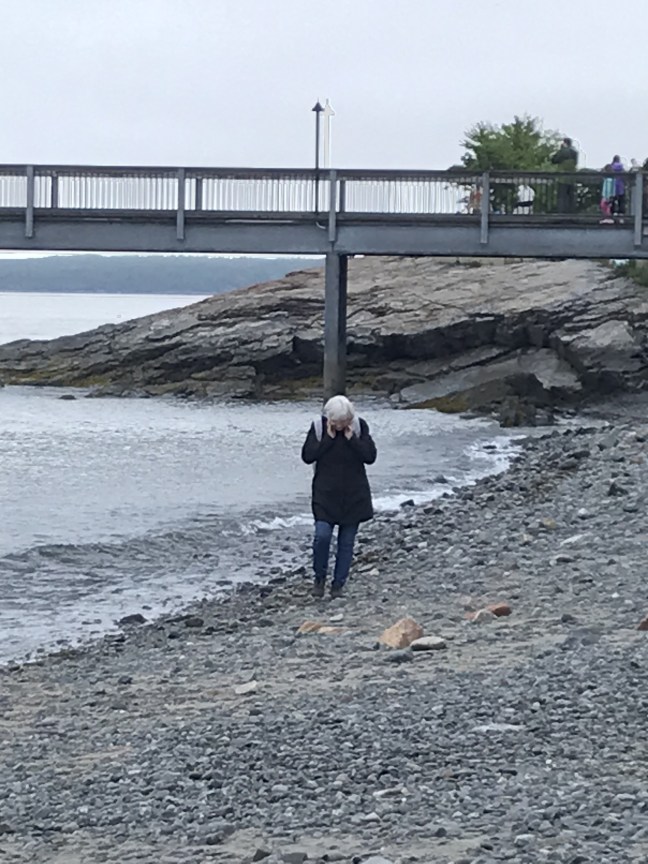
I’m sitting on the small beach in downtown Bar Harbor, Maine, on a cool, showery day in late June. My sister, Ann, visiting me from Nova Scotia, has just arrived on the CAT, the ferry between Bar Harbor and Yarmouth. We’ve walked the main street, popping in and out of shops, and are now killing a little time before having lunch at a nearby Italian Restaurant—she’ll tell anyone how much she loves pasta!

Ann saunters down the short stretch of rocky beach, eyes trained on the ground before her, searching for elusive beach glass and unusually shaped and colored beach stones. I’m wearing my navy Sketchers with white soles, and I don’t want to get them wet and dirty, so I have decided to sit still on a large stone at one end of the beach and wait for Ann to carry out her meticulous search. 

A few feet away sit two fortyish women, also perched on large stones, chatting easily about summer clothing they have purchased or hope to purchase. A few children—I’m not paying attention—ranging in age from about eight to perhaps sixteen, wander back and forth from their mothers to the water’s edge. A teenage boy settles beside one of the women and sorts through the wet stones at his feet. 

All this is happening within my peripheral vision. I’m staring off into space, focusing on my private thoughts, so I only half see what happens next in the twinkling of an eye. The teenager picks up a stone, large enough to fill the palm of his hand, and raises his arm to toss it into the water. He pulls his arm back, but instead of throwing forward, he loses his grip on the stone, and it flies sideways, out of his control.

I hear a crunch, like a finger poking through an eggshell, then a gasp and an “Oh my God!” I focus my attention on the group.  One of the women clutches her head in her hands, bright red blood spreading through her quickly matting hair and dripping between her fingers. Her face is pink and blotchy, and she is rocking back and forth, gasping for breath. 

“Mom! I’m so sorry. I’m sorry! Mom! Mom!” the boy pleads in a hushed but urgent voice. His mother doesn’t answer. She’s trying desperately to master the pain. The second woman and the children cluster; they whisper urgently to one another, asking what to do. The woman at the center of the circle is silent, rocking. I sit still, saying nothing, willing them to know what to do next. I’m tempted to pull out my phone and dial 911, but I wait. This is their crisis; let them handle it. I have no right to intrude, at least not yet.

“Can you walk? Let’s get you off the beach,” says the other mother. She and the boy lift the injured woman, holding her under one arm and by the other elbow, wrapping arms around her waist. She leans on them, and they slowly and jerkily shuffle toward the parking lot just a couple hundred yards away. As they trudge, the uninjured mother pulls her phone out of her bag, and I hear the beep, beep, beep of the dial tone.

I watch them go, then turn to see that Ann, oblivious to this scene, has almost completed her beachcombing and is ready for lunch. When she approaches, I tell her what’s happened, emphasizing the eerie sound of the stone connecting with the woman’s skull. We talk about how a day, and sometimes a life, can change in a moment—from a relaxed vacation at the seashore to a head injury that may have traumatic and lasting effects. As Ann and I leave the beach for the restaurant, the ambulance arrives, sirens wailing, lights flashing. That family’s day has changed irreversibly, without warning or intent, in the twinkling of an eye.

I cannot get this incident out of my mind for the rest of the day. I wonder how the woman feels, whether she is still in the emergency room or if the injury was serious enough to put her in ICU. Or was it just a minor cut, and she is already back at the B&B with her husband, family, and friends, sipping a cocktail before dinner?

That night I lay in bed before sleep, musing on life’s fragility, insecurity, and uncertainty even in the calmest and most seemingly benign situations. When we wake up each morning, we never know what the day will hold—celebration or grief, joy or tragedy, safety or danger, a new beginning, or a sudden end. I carry my reflections to the extreme, as I am wont to do, and imagine what it must have been like for Jews to wake up in the morning in Auschwitz, wondering if they would eat the usual wormy porridge, freeze while pointlessly hauling heavy rocks, or die in a shower of gas. Or would they see a smile from a fellow prisoner handing them a scrap of bread or hear the sound of the tramping boots of friendly soldiers opening the gates to deliver them from hell?

How do we live with such overwhelming uncertainty? We pretend that it doesn’t exist, that we know what to expect and what the future holds. We forget or do not allow ourselves to remember that circumstances, large or tiny, change in the twinkling of an eye.

After our recent trip to Italy, where my partner spent five days in the hospital with acute asthmatic bronchitis, I grumbled about the time and effort of filing the trip insurance claim to recover the extra medical, food, and accommodation costs. I slogged irritably through the tedious paperwork and bureaucracy, expecting it to drag on for many months. One morning, I determined I could no longer avoid filing what the instructions told me were the last pieces of information necessary to complete the claim. I logged on to the insurance website to do so, frustrated, bored, and tired of it all. Lo and behold, in the twinkling of an eye, my mood and my day changed. The claim status page announced that the company had mailed checks for nearly $1000 more than I had originally claimed. “Hallelujah!” I shouted. We never know, do we?

It’s a truism, and while we are tired of hearing it, the only way to live with uncertainty is to accept it and face it, moment by moment, trusting that we will have the inner and outer resources to meet whatever arises. Let’s not pretend, though, that the unpredictability and changeableness of life are not uncomfortable. Let’s be real. However, the more we try to resist the constantly changing nature of our existence, the more certainty and control we try to establish in our minds or circumstances, the more anxiety we bring to ourselves. The more expectations we entertain, the more disappointment, dread, and suffering we invite.

“Let go, accept, and surrender” are hard words to hear or say—challenging attitudes to adopt. But they, like all new habits, become easier with practice. Embracing life just as it is, moment by moment, can lead to the only security and confidence we will ever know in the face of our groundlessness. All occasions are opportunities for understanding and insight. There is a kernel of goodness at the heart of everyone and everything.

The only truth we can hold onto as things constantly change in the twinkling of an eye is the promise given to St. Julian of Norwich in the 14th century, “All shall be well, and all shall be well, and all manner of thing shall be well.”

Year-End, My One Word – Rest

As the year winds down for those doing One Word practice, many of us have turned our attention to discovering or choosing a new word for 2021.  Because Carolyn, whose blog has guided my practice this year, has been hosting a lively and inspiring conversation about selecting new words, it’s been tempting to let rest fade away quietly in December.  But I am a dutiful sort, and I know I owe rest a debt of gratitude and a summation of its impact on my life this past year.

It’s taken me nearly six years of retirement to settle into a slower, more mindful, less frantic pace of life.  Old habits die hard—the tendency to say yes and get involved before really thinking, in particular. But 2021 has offered me more open space and more free time, and the word rest has lent focus for settling into a new mode of living. 

These days, in both winter and summer, I routinely wake up at around four a.m. and, unable to go back to sleep, get up and begin my day while it is still dark and silent.  I’ve watched and photographed many glorious dawns, sat completely still in my cozy den with my dog beside me and a cat on my lap, just breathing and listening to the silence. So, each day begins gently and quietly. 

There is always at least one long, slow-paced walk early in the day, amid the beauty of green summer foliage or among stark bare winter branches.  I delight in the dog’s excited sniffing, in watching the trees sway, or searching for wildflowers. I try to get outside my head on these walks and observe what is happening around me. Just watch and listen.

After that, work—connecting, communicating, planning, writing, gardening, cleaning, errands, appointments.  Following the teaching of the Buddhist monk, Thich Nhat Hanh, I try to do each task mindfully. Of course, it’s going to take many more years of practice to be as aware and attentive as I aspire to be, but I’ve noticed tiny incremental improvements over the last six years, and that gives me hope.

For instance, I now sit down to eat meals most days, departing from my previous practice of grabbing bites between tasks or standing at the kitchen counter and spooning food into my mouth, often coughing after swallowing each mouthful. In summer, I may eat breakfast and lunch in the garden; a pair of clippers and a watering can close at hand so that I can roam from bush to flower, watering, and pruning as needed. When I first sit down at dinner time,  I pause and become fully present in the room, at the table, to the person(s) across from me and the food before me.  I give thanks and smell the delicious odors.  I try to put my fork down after each bite and concentrate on chewing and swallowing.  I still eat more quickly than anyone else at the table, but slightly more slowly than I used to do.

Swimming has gotten slower, and I spend more time luxuriating in the hot tub and the sauna after my swim.  I often take short naps, sometimes only 20 minutes, but they are deliciously relaxing and bring balance. Though I’ve not read nearly as many books as I would like, I’ve read more than in past years. 

These settling changes have come about gradually and naturally, but my mental and spiritual exploration of the word rest has influenced and provided new motivation for them. Using resources provided by Carolyn, monthly check-ins have enabled me to probe the meaning of rest for myself and the world around me.  Definitions, synonyms, word associations, visual images, sounds, and watching others have opened new doorways to understanding.  

For instance, I spent significant time contemplating balance, juxtaposing effort and rest using this image.  I would not know what rest is without exerting effort, and vice versa.

The Roots and Fruits image of a tree with many branches helped me hold all my discoveries about rest together, organically and systemically.

The Foundation and Building Blocks diagram teased out basic concepts intrinsic to my experience of rest.

Living with rest for the last year, reflecting on its meaning, has been not so much an attempt to change as an experience of noticing—observing the gradual transformation happening within me. With intention and practice, with patience, acceptance of failure, and beginning again, I’ve come to a more restful way of being.  Watching the process brings joy. Discerning progress, however small, gives hope.

I still have a long way to go.  My habits are tenacious.  But I am not leaving rest behind.  Indeed, I’ve chosen next year’s word(s) to take me further along the path to accepting, letting go, and resting.

Links to my previous posts on rest in 2021.

One Word – With All Due Respect

REST – My One Word – Mid-Year Check-In – With All Due Respect