Love in All Seasons

“Farewell to thee! but not farewell
To all my fondest thoughts of thee:
Within my heart they still shall dwell;
And they shall cheer and comfort me.”

—Anne Brontë

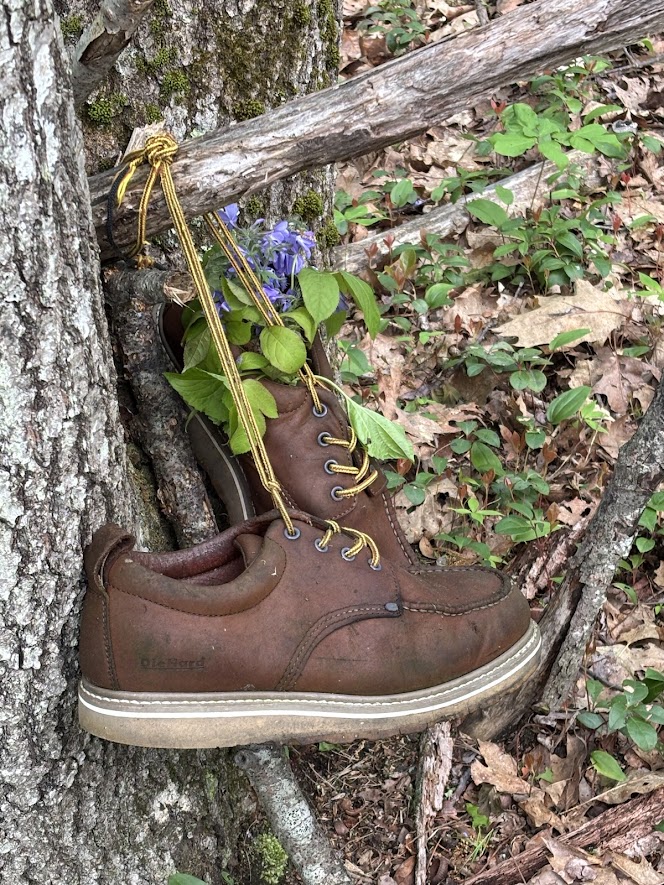
One morning, a couple of years ago, as I accompanied my dog on his first walk of the day along a well-worn trail through the woods near my home, I was surprised by something I had not noticed before. I saw a path, intentionally bordered on either side by clean barkless branches, which led away from the beaten track over dead leaves, broken sticks, and brown ferns shriveled by frost.

 It was the height of tick season in Maine, so I hesitated to step into the underbrush, trailing my dog on his lead, but my eyes followed the branch borders of the path deeper into the woods.  There, on a stick wedged between two conjoined tree trunks, something brown and out of place dangled.  I couldn’t believe my eyes, so I had to get closer to be sure. 

Taking a deep breath and hoping no deer ticks would crawl up my legs or bury themselves in my dog’s curious muzzle, I stepped onto the path and gingerly picked my way about twenty paces into the woods.  My eyes had not deceived me.  A sturdy pair of men’s walking shoes hung by their laces, artfully draped over the stick. What could this mean?  Who would leave their shoes behind in the woods?  These lace-ups still had a lot of life in them.

Something prevented me from touching them—some intuition that this was a holy place.  I took a picture of them, and retraced my steps, my dog tugging me back to our usual route. However, the image of the shoes stayed with me for the rest of our morning walk, and the place where they hung became the destination for frequent pilgrimages in days to come.

After several visits, I began to suspect that these were my neighbor Simon’s shoes, and that they had been lovingly arranged in the woods where he frequently walked, his camera dangling from his neck.  Simon had died several months before, and I surmised that his widow deposited the shoes in a setting he loved near their home, where she could visit them often to commune with her husband.  I took the risk of asking her if I had guessed correctly, and she, blushing but shyly pleased that someone else had discovered her memorial, confirmed it. 

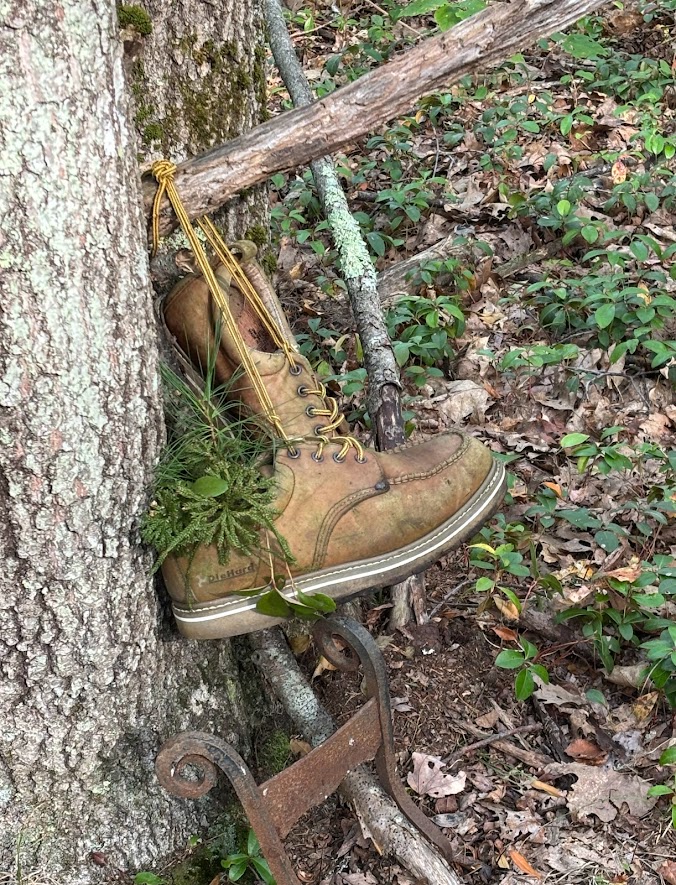
Over the last couple of years, my pup and I have visited Simon’s shoes countless times.  Cynthia, Simon’s wife, adds bits of flora to mark the seasons—sometimes delicate wildflowers in spring, ferns in summer, red, yellow, and golden leaves in fall, and, of course, winter provides its own decoration. Each time I set out on my pilgrimage, I look forward to discovering these simple but artful adornments.

All I know of Simon are these shoes and the few memories of her beloved husband that Cynthia has shared with me. By the time the couple moved into my neighborhood, he had already begun to decline.  I would pass him on my afternoon walks and receive a silent smile in response to my cheerful hello.  He was, by then, not much of a conversationalist, especially with strangers.  His soft-spoken words were sparing, but the few I heard were direct and gentle. 

I marveled that the memorial shoes were in such good shape.  According to his wife, Simon had worn them on hikes all over Europe and America.  Once, on a walking trip in Ireland, amid a powerful wind and rainstorm, he and Cynthia took refuge in a farmhouse along their way.  The family welcomed them to warm up and dry off at the hearth. So, Simon propped his feet in front of the open fire, scorching the soles of his shoes before he realized what was happening. Thrifty as he was, he saw no reason to replace the singed footwear. Like his shoes, Simon was humble, loyal, and resilient.

Simon’s memorial shoes, their constancy, adaptation, and beauty in every season, have become an icon for me.  A symbol for the humility that embraces and accepts what is, even when the reality is absence. Gradually, these old shoes will succumb to the elements and disintegrate, but not before they have taught many passersby a profound lesson.  We continue after death, transformed surely, but ultimately, reunited with the elements that made us, enlivened us, warmed us, fed us, cleansed us, and sheltered us. Finally, we come home.

Simon and Cynthia are not the real names of my neighbors.

Tea Bag Wisdom – Self Respect

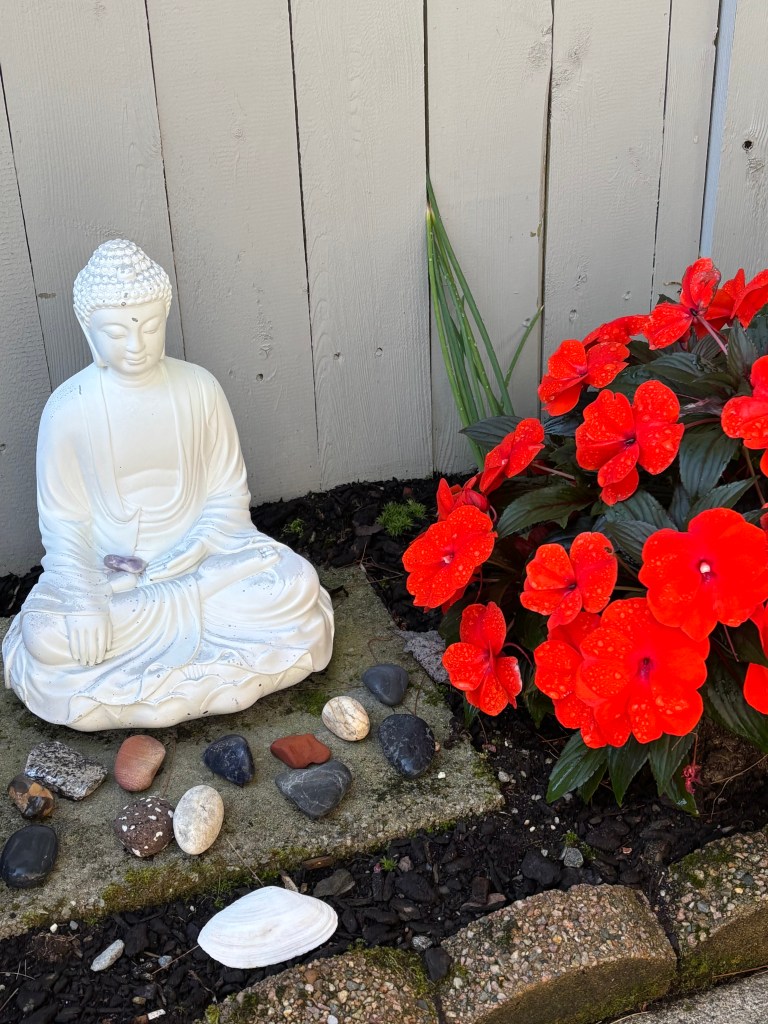
I drink Yogi Tea every morning, first thing, right after I feed the animals and take the dog out for his first sniff and tinkle of the day. Just after I ring my meditation bell, turn on three tea lights in front of my Buddha statue, and sink into my seat on the couch, facing the window overlooking our garden. I take a sip of Yogi tea, a deep breath, set my timer for twenty minutes, and come home to myself.

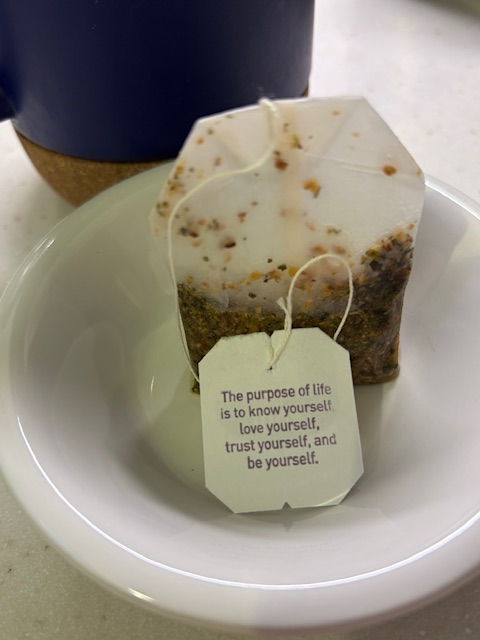
The other morning, as the cats were chowing down and my electric kettle was bubbling, I opened a new tea pouch and pulled out a fresh bag of ginger tea. As I unwound the paper tag attached to the bag by a thin thread, I was astounded to see this message: “The purpose of life is to know yourself, love yourself, trust yourself, and be yourself.”

I’m fond of the word ‘gobsmacked,’ which is British slang for being astonished. I was gobsmacked that the universe had sent me such a message, first thing on a July morning in the politically, socially, and personally turbulent summer of 2025. Right away, I knew it was a message that needed some unpacking, so I settled into my meditation posture—the dog tight to my left thigh, the Maine Coon cat spread across my lap. The black and white cat was, of course, doing his aloof morning meditation on chipmunks, squirrels, and birds at the screen door that opens onto the patio. I took a sip of ginger tea and began.

Know yourself. No problem for me, the most introspective creature on-the-planet, as my friend Bruce would say. Self-examination is my middle name, has been since birth, for good or ill. For most of my life, self-examination has meant self-critique. I have a more than passing familiarity with all my faults, bad habits, propensities, temptations, mistakes, and the karma that results from them. However, genuine self-knowledge or self-awareness has only emerged in later life as I learned to meditate and look deeply at the roots of my motivations—my fears, attractions, and repulsions. That self-awareness, though more true, is also softer, as I’ve allowed self-compassion to touch and soothe the wounds uncovered by my x-ray inner eye. It felt good to have my ingrained habit of self-reflection validated as part of life’s purpose by the Yogi Tea Messenger. Part of myself is okay. Phew! That’s a relief!

Love yourself. My stomach twisted in a knot, and I knew this was not going to be an easy one to delve into. I make this deeply personal revelation only because I suspect there may be a few of you out there who share my experience, and I want you to know that you are not alone. Since early childhood, I have sensed that I am, at my core, a flawed person. There is something wrong with me that makes me do bad things, or, at least, fear that I will do bad things. I think this sense may have come from my mother, and I am certain my Baptist upbringing with its emphasis on original sin reinforced it. I long ago forgave my mother, but I will never forgive St. Paul and the Christian Church for instilling the hideous notion that I was born full of sin. Buddhism, which I’ve gravitated towards in recent years, teaches that we each contain both good and harmful seeds in our store consciousness and can learn to nurture the former rather than the latter.

But let’s not get too theoretical here. Loving myself is challenging! And I don’t believe I am alone with this challenge. Understanding what self-love is and how to practice it will take me the rest of my life and then some, and I’m getting a very late start. But, while breathing evenly and gently as the ten-minute meditation bell chimed, I remembered the self-compassion I congratulated myself on developing as I’ve aged. Let’s start there, add a little self-forgiveness, tenderness, thanksgiving—whatever else might water those tiny seeds of goodness the universe has planted in me. I recalled my connection to all the beauty around me and recognized that I am made of the same stuff. Soon, I thought, I may have enough confidence in my basic goodness to…

Trust myself! Again, the passage of time, also called aging, is of some help here. It teaches lessons of humility but also repeatedly validates my intuition, my gut, or bodily intelligence. As I’ve looked back over my life, I’ve seen instances where I had a premonition, an insight, or an inner sense about the reality of a situation, the right course of action, or an action to avoid. Sometimes I heeded the hint, and other times I ignored the impulse.   But time and again, what my body intuited was revealed as events unfolded. I pay more attention to my un-rational intelligence these days. The more self-aware I am, the more I accept and love myself, the more I can trust myself to make the right choices, the life-giving, kind, and just ones. And I understand these three—self-awareness, self-love, and self-trust as inextricably linked, forming the foundation on which I can…

Be myself. What a sense of relief and ease washed over me as I entered the home stretch of that morning’s meditation. I paid attention to my body, as I set my imagination free to envision what it might be like to be who I truly am, instead of who I or others expect me to be. I noticed a sense of effortlessness. Straining and striving melted away, replaced by an unhurried settledness. A pervasive feeling of well-being and wholeness refreshed my tired mind and body. Yet, on the horizon, I saw the tremendous responsibility of freedom dawning, and I experienced a charge of fear, like a tiny electric shock—joy and sadness, pain and pleasure co-arising and interdependent.

The meditation bell chimed three times, signaling the end of twenty minutes. I breathed out, letting go, and lingered for a few moments longer in the silence and stillness. Then I lifted my cup and took a long, full gulp of still-warm tea while reciting the Tea Messenger’s morning wisdom one more time: “The purpose of life is to know yourself, love yourself, trust yourself, and be yourself.”

Practicing for the Big Let Go: Love

To view the images in this post, click Read on Blog

I have mentioned here before that I meet monthly on Zoom with a group of women who talk about our experiences of aging and our musings on death. We explore our stories, insights, discomfort, and fear about the inevitable decline of our bodies and the certain end for us all. A few weeks ago, we had a courageous discussion about dying, our own and that of those we love. Not surprisingly, most of us expressed more fear about the possibility of a painful, demeaning, drawn-out dying process than about the moment of death and what, if anything, comes after it. We ventured onto the delicate topics of Death with Dignity and Physician-Assisted Death, which is legal in some countries, including Canada, where I was born.

I told the story of my Canadian cousin’s husband’s death. I’ll call him Leigh and her Meredith. He suffered for years from debilitating cancer, which was diagnosed just after his retirement when they had planned finally to begin their travel adventures together. Leigh, supporting and delighting in Meredith’s wanderlust and love of natural beauty, encouraged her to go exploring on her own and with their daughters. He enjoyed her travels vicariously and enthusiastically. However, as time went on, she traveled less as he needed more care and experienced frequent hospitalizations for treatment and long energy-less periods confined at home.

Though he tried his best not to be a burden for his family and patiently bore the symptoms of his disease, it troubled him that Meredith’s life centered around him and his ups and downs. He recognized her profound sadness as she watched him suffer, helpless to alleviate it, and worried about how she would cope with what they had good reason to believe would be a painful and degrading end. As the pain increased and his energy ebbed, recognizing his own and Meredith’s exhaustion and the toll his suffering was taking on her, he decided to apply for MAID, Medical Assistance in Dying. Canadian law provides this option for individuals who are terminally ill or in intolerable pain.

Together, Leigh and Meredith navigated all the legal requirements and preparations and finally arrived at the day of his death. Meredith and both of their adult children gathered around his hospital bed, said their goodbyes, and expressed their love and gratefulness for each other. Medical personnel administered the necessary medications, and quietly and peacefully, Leigh went to sleep and then ceased to breathe. Meredith experienced the meticulously planned and compassionately orchestrated end as a gift of love Leigh gave to himself, her, and their daughters. Years later, she still speaks movingly of this gift and her memories of their last intimate moments together. She says Leigh was right; a horrible end would have been much more difficult for both of them to endure and for her to recover from. Instead of her beloved in agony, her last memory of him is tender and peaceful.

I did not tell the story of my mother’s death in that morning’s discussion group. In her early eighties, she was diagnosed with pancreatic cancer after a long period of ignored symptoms and then months of waiting for tests and doctors’ appointments. The specialists said that her only hope of survival was a drastic surgery in which her abdominal organs would be removed from her body to make the tumor on her pancreas accessible for excision. Then, they would replace the organs, and everyone hoped everything would work properly again. It was a risky option back then for even a younger, more fit person, but it was a long shot for someone in their early eighties. By demonstrating determination and pestering her doctors, she got them to agree to perform the surgery, even though success was extremely uncertain. She wowed them on the pre-surgery stress tests, proving that she was strong enough to withstand the operation, but as the day approached, she was anxious and irritable. 

One evening, I asked her why she was willing to put herself through such trauma for perhaps just a few more years of extended life when she could not count on a full recovery or high-quality health. She responded without hesitation, as though she had already asked herself that very question and was certain of the answer. “It’s for your father,” she said. “He will be too lonely when I die. But don’t tell him.” I didn’t press her further. She and my dad did not have an overtly romantic relationship. I can’t remember her ever expressing feelings of love to anyone. On the contrary, she tossed criticism liberally in all directions. But they had been married for more than fifty years, and their lives were so intertwined that she knew her death would be his undoing. 

She had the surgery. The team opened her up and saw an abdomen riddled with cancer, so they closed her and sent her to recovery. The surgeon told us the outcome and gave a prognosis of one to three months. She lived through the night and, early the next morning, experienced massive internal bleeding, was taken back to surgery, and died of heart failure. My father’s sobbing heartbreak is seared into my memory, as is the sight of his forlorn, defeated figure standing outside her empty bedroom at home that evening.

I’m not sure if my mother ever told my father that she loved him, but she knew how much he loved her, and she was willing to endure a horrendous surgery out of compassion for him—her gift of love. He lived for five lonely years after her death, making the best of each day but missing her profoundly. It was tough to watch.

Another member of the aging-and-death discussion group shared a glimpse into a recent awakening. She’s been seeking understanding of love, what it is, how it feels, how it manifests, for quite some time. Recently, she and her husband were walking during an outing. He is older than she and is slowing down slightly. She found herself dropping back to match his slower pace and wondering at the tender willingness she felt as she did so. Could this be love, she asked herself—some facet of love? 

As I draw nearer to my own inevitable death—The Big Let Go—I ask myself what will be most important to me, and I know instantaneously and completely that it will be love. Everything else will fall away, and the only important activity will be loving—giving and receiving it. Knowing this, shall I start to practice now? Let go of all but love, in every moment and situation, and lean into loving—fall into it, and trust it utterly.

What Now? Reprise

It’s been over a month since I posted here and over two since I wrote the first “What Now?” article. Honestly, I don’t know what to think or say about anything these days. I’m tongue-tied. That’s as it should be, counsels the Tao te Ching: “Those who know, don’t talk. Those who talk, don’t know.”

Each morning, sometimes before and sometimes just after my meditation time, I read Heather Cox Richardson’s daily newsletter, Letters from an American. I choose to follow her rather than some other news commentator because I like her framing of current events in the context of history, and she’s a Mainer from near my home. Her newsletter and listening to the occasional few minutes of NPR while driving are my meager attempts at awareness of significant events in our country and the world. Like many of my friends, I feel a responsibility to be aware but cannot cope with more intense and in-depth exposure to the news. It is too depressing, frightening, and immobilizing.

As I’ve grown older, I’ve identified and clung to specific anchors that steady me in times of turmoil like this one—help me rise and fall with the tides but keep me from drifting in rough currents. Some anchors are rituals or repetitive practices that calm and focus me. Some are objects or words that inspire or guide me. I’m always looking for symbols that help me make meaning and keep me steady. 

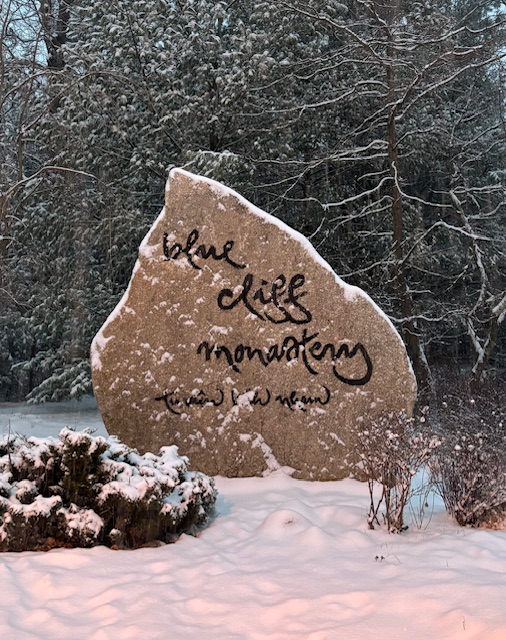
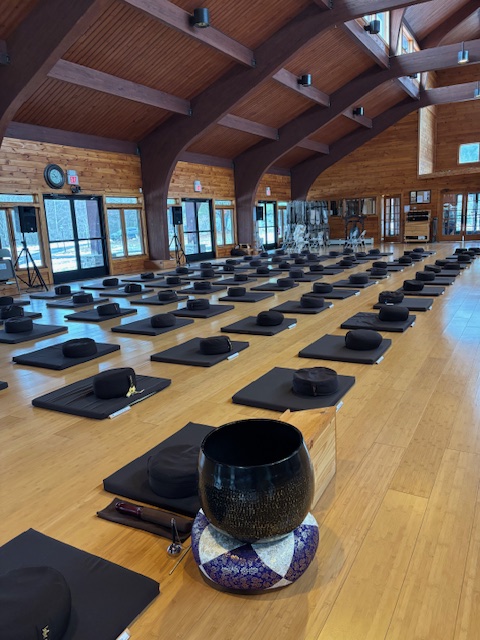
A few weekends ago, I visited Blue Cliff, a Vietnamese Buddhist Monastery in upstate New York. The monks and nuns who live there practice the Thich Nhat Hanh Buddhist tradition. That weekend, they were celebrating the third anniversary of his death, or “continuation” as they call it. Besides a few American Buddhists from Maine, Vermont, and elsewhere, dozens of Vietnamese Americans from the New York-New Jersey area came to meditate, chant, hear Buddhist teachings, and eat delicious Vietnamese food. I was fascinated by the rituals and chanting, curious about the customs, and delighted by the food. It wasn’t the sort of silent, secluded retreat I typically seek or enjoy, but it had a simplicity, pageantry, and wisdom that moved me deeply.

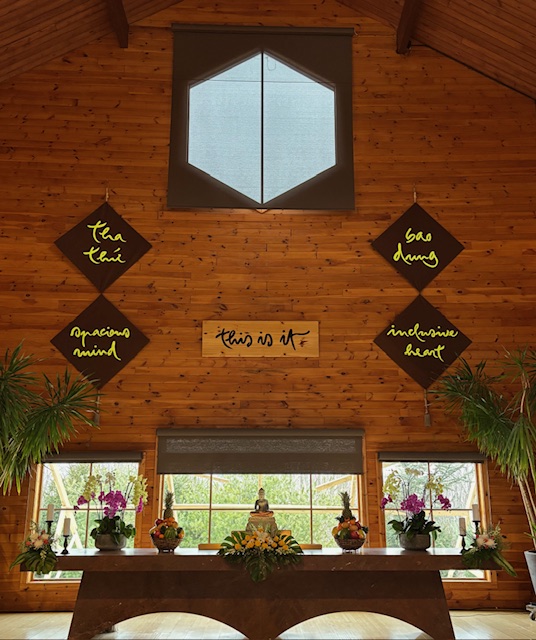
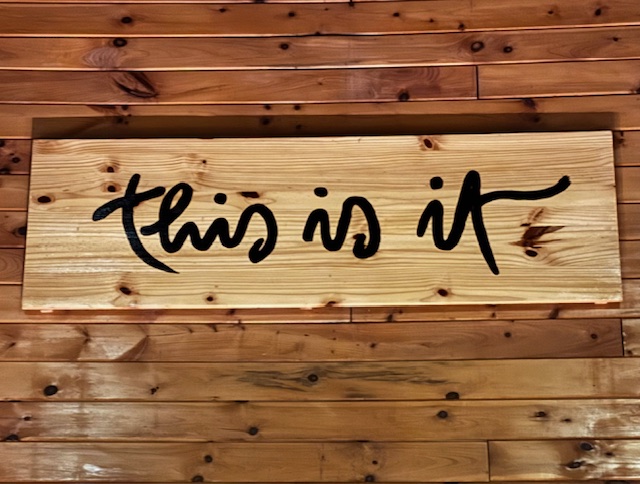
One of the most potent takeaway images from the weekend was this wooden calligraphy panel that focused the eyes immediately upon entering their exquisitely designed meditation hall.

I was awestruck the moment I saw it—so profoundly true and precisely the message I needed to receive, an anchor I could cling to. This Is It. This moment, this place, this situation, this country, this world—this is all there is. So, stop wishing for this to end, for something else to come, to be somewhere else, to be rescued from this current calamity. This is it—the only thing you have to work with, the only reality, your only opportunity. So, embrace it, celebrate it even. Open your eyes, ears, and heart, let the right action arise within you and proceed from you, and let go of the burden of the outcome. This is it. Nothing more, nothing less, nothing other.

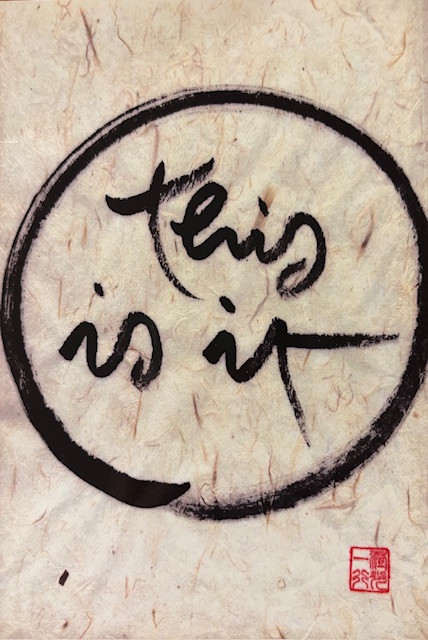
For an hour on Sunday afternoon, their gift shop was open for guests to browse and shop. I went looking for a token of the message I had received and found this simple postcard in Thich Nhat Hanh’s calligraphy. I purchased it and brought it home to place in the window opposite my meditation seat so, as candles flicker beneath it and the sun rises behind it each morning, I can look at it and beyond it to what is outside my window.  

This Is It—the only time and place I have. I am surrounded by the only people I can respect and love. This is the only moment when I can recognize beauty, speak the truth, be kind, and do justice.

The Relief of Letting Go

My friend, Jim, is a crotchety nonagenarian. He has been crotchety his entire life, more or less charmingly so in his youth but annoyingly intensifying as he has grown older. Like many his age, he has consigned everything modern to the rubbish heap and glorified everything he remembers of the good old days. As he has aged, he has grown more self-centered, believing his views are the only correct ones, his tastes are the most tasteful, and his ways of doing things are the only sensible ways. Some of his ways of doing things involve growing his hair and beard long, eating sausage for breakfast every morning, and devouring an entire quart of ice cream at a sitting.

Jim’s health has been gradually declining, and he is less able to care for himself. The decline is noticeable to everyone who sees him regularly, but he won’t admit it. He insists that he can live independently, make all his own decisions, and do so ad infinitum. He believes he does not need to change anything about his life and has gruffly rebuffed all attempts to hire caregivers or suggestions he move to a more supportive living situation.

A little while ago, Jim fell and broke his collarbone. Overnight, he could no longer cook his breakfast sausage, pull up his pants and put on his suspenders, write his checks, or accurately sort his medications. His family bravely and good-naturedly stepped in and did what they had wanted to do for quite some time. They took over his finances, cleaned up his apartment, sent him for a haircut, and insisted he move to assisted living, at least for a month of respite care, until his collarbone healed and he could be reevaluated for independent living. He did not enthusiastically embrace this plan, but surprisingly, he acquiesced more quietly than expected. 

When I visited him in his new efficiency apartment, I was amazed at the transformation. He was more cheerful than I had seen him in years. The boundaries of his life had shrunk to a one-room studio, with a huge closet containing a few of his clothes, a TV with minimal channels, three meals a day served in the facility’s dining room, medications delivered and taken on time, and lively interactions with the staff. They take him for who he is and chide and prod him in a no-nonsense fashion. He mentions a couple of them fondly. He is less isolated than he was when living alone, though he still stays in his room most of the time.

I ask him how he’s doing, and he jokes about not knowing what will happen to him, so he doesn’t bother thinking or worrying about it. One of his children has taken over his finances, and he has no idea how the bills are being paid or how much money is in his bank account. His life has become simpler. The staff takes him to meals, helps him to bathe and dress, and transports him to doctor’s appointments. They do his laundry and give him his pills. He just goes with the flow. Finally, after months of resistance, he has learned to use his cell phone because it is now the only way to stay in touch with family and his few remaining friends. It’s all okay, he says lightly.

I reflect back to him that he seems more peaceful, and he doesn’t disagree. I float the notion that he has let go of control of his life and seems happier for it. He shrugs and chuckles. Once his respite stay is up, if he becomes a permanent resident of this assisted living facility, I think he will do so without a fight. I could be wrong, but I doubt it. His surrender and his letting go are a relief for all of us—his family, his friends, and Jim himself. Even if temporary, Jim’s transformation is one more proof to me that miracles happen.

Of Tulips and Letting Go

In the fall of 2023, I purchased a package of twenty-four tulip bulbs from White Flower Farm. I planted them in the mid-November chill of Mid Coast Maine, hoping they would grace my front yard with some cheerful color come spring. Tulips and daffodils, like every other perennial, are always a risk in our frigid northern climate. I lose several plants yearly, no matter how carefully I bed them down for the winter. As I planted the bulbs, I remember saying to myself and others, “If this doesn’t work out, that’s it; no more attempts at my advanced age to improve the garden.”

Spring comes late in Maine, and I expectantly examined the front garden for weeks in April before I noticed the tiniest of green shoots poking through the brown soil. The steadily growing leaves, coaxed on by days of drenching rain and the occasional few hours of sunshine, cheered me tremendously. Leaves but no stems, though. My experience with daffodils has been that after the first year of blooms, I usually get nothing but leaves in subsequent years, no flowers. I feared the tulips would go the way of the daffs. But no, gradually, hearty green stems with tightly sealed blossoms shot up from the parting leaves. I counted. All twenty-four bulbs had produced a bud. I was amazed and gratified. Now, all I had to do was wait until the sunshine coaxed the buds into bloom. Or so I thought.

This spring, my household hosted a family of four chipmunks on and under our patio. We, the cats, and the dog watched, mesmerized as they scampered around, under, and over the patio furniture with acorns stuffed in their cheeks. They dug a neat burrow at the edge of a flower bed and, we imagined, created a warren of tunnels beneath it with living, pantry, and sleeping quarters branching off the main thoroughfare. These fantasies tickled us. Mom, Dad, and the two kids settled into their new home, slithering in and out of it many times a minute. We were delighted with their antics and those of their cousins, the grey squirrels, who are also abundant this spring. Last year was a mast year (a boom season) for acorns, so squirrels and chipmunks multiplied exponentially. Our side garden was a rodent carnival.

Meanwhile, out front, I noticed, one by one, the unopened tulip blossoms disappear, and their green leaves torn and tattered. Oh no! It must be the chipmunks and squirrels! But they don’t eat all tulips, apparently, because my neighbor’s yard was a riot of red, orange, and yellow flowers, as were many other gardens in our community. My heart sank. After all that work, waiting, and hoping, these entertaining little creatures, without regard for human labor, had stolen my joy.

I gave myself a little talking to: “They’re just flowers, they’re ephemeral anyway. They weren’t that expensive, so the loss is no big deal. You told yourself if this didn’t work, you wouldn’t try again, so just let it go!” Nevertheless, I googled how to prevent squirrels from eating tulips and found a recommendation to try cayenne pepper. We had none in the house, so I sprinkled red pepper flakes around the base of each plant instead. Completely ineffective. 

Having given up on a riot of color like my neighbor’s, I considered how I might redeem the situation. I know so little about flowers and gardening that I had no idea what might happen if I cut the few remaining tightly closed tulip flowers and put them in water indoors. Even this modest experiment was fraught with risk. One of our cats eats flowers, so I had to hide my vase with the unopened tulips in the bathroom. Talk about letting go of my dream of a pretty bed of tulips in the front garden! I was making do with a few tiny green buds on the bathroom vanity behind a closed door. But somehow, the joy was just as sweet when I opened the door to these delicate blooms one morning.

This experience, in all its silly simplicity, speaks to me of the wisdom of letting go. Because so much is beyond our control and everything is constantly changing, creating any plan, investing any effort, and expecting or hoping for any particular outcome are risky business. We do all three continually, of course; they come as naturally as breathing. However, the pervasive visceral tension we carry proves that we live in a constant state of risk—risk of loss, failure, or disappointment. Any time we wake up to this reality is a moment of potential change. Missing tulip blossoms can speak to us of the groundlessness of our existence. They may carry the gift-wrapped message of surrender. Opening a bathroom door to behold pale reflections of pink and white flowers can offer a lesson in revision and redemption.

And how closely married are delight and destructiveness – chipmunk and squirrel antics on one side of the coin and flower devastation on the other. Imagine the deliciousness of tulip petals to a squirrel’s palate! Consider my sober, reasonable resolution not to waste time and money planting tulips again. The whole funny, frustrating, messy situation can be profoundly instructive if I let go and let it be so.

We never know what exquisite new vista the portal of disappointment will offer us or what ultimate peace might issue from the surrender of letting go.

Dignity or Indignity

I frequently visit a long-term care facility near my home. My dog and I go once a week to offer pet therapy to the residents. We walk from room to room, greeting the patients who pet the dog, smile at his simple tricks, and feed him treats as a reward. Occasionally, I also serve as a hospice volunteer in this facility, watching with someone who is dying through the dark hours of the night. For one reason or another, I’ve spent a good deal of time visiting nursing homes in Maine and Massachusetts, and this facility, in my experience, is one of the best. From an outsider’s point of view, it is clean and well-managed, with a full complement of services and a clientele that seems satisfied with their care. The staff is friendly to my dog and me, speaks kindly to the patients and treats them with gentleness.

            Still, even in this seemingly best-case scenario, there are sometimes heart-breaking and gut-wrenching situations. Recently, nearing the end of a morning visit with my dog, I approached a patient we know well, who loves the little pup and whose attention he welcomes. She was sitting in her wheelchair in the hallway outside her room, looking anxious. I asked her what was bothering her, and she said she had been waiting for a long time for someone to take her to the bathroom. The young social worker who had just left her side had gone in search of a nursing aide to assist her. “It’s so hard,” she said, “when one gets old and bladder control is not what it used to be, and you call and call, and no one comes. Things have gotten worse,” she said. “One waits longer and longer now.” I expressed my sympathy and felt frustration rising in my chest. I also noticed a high-pitched wailing coming from the room opposite hers.

Someone else was also in distress. The room had a barrier across the door with a large stop sign in the center, indicating that only authorized personnel could enter. These detachable and portable barriers became common at the height of Covid outbreaks. “Help! Please help!” came the weak plea from the bathroom inside the room, but I could not go in to see what the matter was. I surmised the resident, whom we also know well, had been sitting on the toilet for a long time and was in discomfort or pain. The social worker approached again and reported that a nurse would be along shortly, after she finished putting another patient in bed. Timidly, I pointed toward the Stop sign and asked if she knew someone else needed help. She looked daggers at me, I guessed, for interfering, so I said goodbye to our friend in the wheelchair and walked on, frustrated, sad, and embarrassed for all of us.

The next day, when talking about aging with a group of healthy women in their sixties and seventies, I told this story and commented that this sort of indignity may await us all. I believe this common occurrence in senior care facilities is not the fault of nurses or other staff, social workers, or families, I argued, but the result of an ageist society that does not value the lives of those who are no longer financially or physically productive. An uncomfortable silence, a few somber nods of recognition, and a change of subject followed my candid expression of opinion. Understandably, no one wanted to discuss toileting in nursing homes or dwell on the possibility of finding ourselves in similar situations down the aging road.

I wrote about the indignities of the senior healthcare system in an extended series on The Elderly and End-of-life Care in 2017 when I launched this blog. Things have not changed since then, and because of further staffing shortages, they have worsened in many ways.

This kind of indignity may await all of us. More and more of us are living into our nineties because of medical advances producing life-prolonging disease treatments and cures. The healthcare system is stretched beyond measure, caring for an ever-increasing percentage of seniors in our population. We take advantage of every possible means to prolong our lives. Covid has decimated the ranks of healthcare professionals, and the greed of insurance and drug companies complicates matters further. I frequently hear my contemporaries say that the system is broken. They can’t get direct face time with their primary care doctors, or appointments with specialists, or get their prescriptions promptly. Doctors and nurses are quitting in frustration or from burnout. In-home care is exorbitantly expensive, and the agencies that deploy homecare workers are limping along with a few staff members. Of course, the financially secure have it far better than low-income people. That goes without saying, but no matter how financially secure you are, your dignity will be in jeopardy if you can’t get someone to take you to the bathroom.

Or will it? In these recent posts, I’ve been encouraging us to think about practicing for The Big Let Go—death. I’ve been recommending we consider learning to let go in small ways in ordinary daily situations to be ready to let go in a big way at the end of our lives. Am I suggesting that we must let go of our dignity? No. I am proposing that we consider where our dignity truly resides.

Does our dignity depend on how others treat us, or is it reflected in and demonstrated by how we treat others? My friend waiting for assistance to go to the bathroom was calm, polite, and sad but not angry, even though she faced the indignity of potentially soiling herself while she waited. The other patient, pleading for assistance from her bathroom, said, “Please.” Can we learn to relinquish the external signs of dignity while holding on to our inner poise, beauty, and self-esteem? And how can we practice doing that today?

How do we respond when someone wounds our dignity in small or large ways? Can we still insist upon the outward recognition of everyone’s dignity while more highly valuing intrinsic worthiness, integrity, humility, and courage as the essence of our humanity?

We may not all end up in situations like the patient in the wheelchair waiting for assistance with toileting. We may be lucky enough to die suddenly or in the comfort of our homes, surrounded by those who love us and tend promptly and respectfully to all our needs. We may live an active and independent life, avoiding physical dependency on others to the end. But if we don’t practice letting go of external signs of respect while holding fast to inner dignity, we may lack the necessary interior resources to draw upon as we approach The Big Let Go.

Cherished Outcomes

If you want to accord with the Tao,

Just do your job, then let go.

The Tao Te Ching, translated by Stephen Mitchell

I’m a planner, but I’m not naïve enough to think that meticulously planning something will make it turn out exactly how I want it to. Decades of experience have taught me that control is an illusion—a dear one. Still, planning is in my bones, and I might as well embrace it as part of who I am. Planning, like everything, has its shadow side and its bright side. The shadow side is about clinging—to outcomes. The bright side is about creativity, fruition, and letting go.

Giving myself fully and genuinely to a task or project without getting attached to the final product is one of my biggest challenges. How does one go all-in on something without being wedded to the result? I care; therefore, I plan. I do everything possible to ensure the desired outcome has its best chance.

I’m talking about passion—giving everything you’ve got, then offering your beloved creation to the world and letting go. Huge risk, right? Like nursing an injured baby seal that has beached itself. You painstakingly feed it, protect it, and watch it regain its strength, then set it free with absolutely no expectation that you will ever see it again or faith that it will survive beyond your sightline as it heads out into the deep. Or, like a parent raising a child, I imagine, since I have never raised one.

A friend of mine advocates “holding things lightly,” meaning, I think, that caring passionately and relinquishing control are both essential to being fully alive. It is possible to be committed to an outcome and hold it lightly, ready to let it go. Challenging but possible.

Scientists tell us we are hard-wired for planning. Research has shown that some areas of the brain, known as the default mode network, carry out this planning function. They

become active when our attention is not occupied with a task. These systems function in the background of consciousness, envisaging futures compatible with our needs and desires and planning how those might be brought about….Human brains have evolved to do this automatically; planning for scarcity and other threats is important to ensure survival….Our background thinking is essential to operating in the world. It is sometimes the origin of our most creative images.”  Why we are hard-wired to worry, and what we can do to calm down (theconversation.com)

So, we will plan no matter what, and sometimes planning, when unhooked from worry, can be a very creative and valuable form of flow state. If I am going to plan, I want to give it my very best effort. I want the idea and the plan for its execution to be as detailed as possible, take as many contingencies as conceivable into account, and be thoroughly tested, broadly vetted, and profoundly considered. I want to be wholly absorbed, plan passionately, launch my plan confidently and enthusiastically, and then let go of the outcome!

Why? Because no matter the outcome, whatever happens—success, disaster, or somewhere in between—is an opportunity for learning, growing, transforming, and embracing reality just as it is.

Sometimes, when I meditate, my mind is pulled toward a problem that captivates me or a situation that needs resolution. I try to turn away from the flow of thoughts and return focus to my breathing once, twice, three or more times. Finally, I will sigh and let my mind have its way, go with the flow. Sometimes, the most fitting solutions emerge from giving my default mode network free reign. I’ve learned, though, not to act on these plans immediately but to let them mull and mature for a while and to be willing to let go of them, to change my mind.

During my 71 years, life has required me to let go of hundreds of cherished outcomes for multiple carefully laid plans. It’s gotten easier as I’ve begun to notice a pattern of unexpected gains amid losses, of auspicious signs amid clouds of disappointment. Gradually, I’ve become more curious about than afraid of the unknown final outcome of life—my life.

This past week, the Christian Church celebrated Ash Wednesday, the day of the year when we look death straight in the eye and remember that we all came from dust and will ultimately return to it. “Remember that you are dust, and to dust you shall return.” One of the ministers at the Episcopal Church in my town told me that some clergy are now reciting the words, “Remember that you are stardust, and to stardust you shall return,” when they imprint the sign of a cross in ashes on their members’ foreheads. The words point to our smallness and our greatness and are a sparkling reminder that we have always been and will always be part of the immense universe. How I cherish that outcome!

Open or Shut

In the last post, I wrote about practicing for the ultimate let go at death by letting go regularly in daily life. The notion is that we get better at letting go the more we do it. Before further exploring the wisdom of letting go, I want to explore a phenomenon that often accompanies it—the experience of shutting or closing down.

Letting go implies some degree of attachment or clinging. Releasing our hold on something is frequently a viscerally painful experience. Relinquishing our illusion of control can seem almost impossible. We think we’ve done it, but our controlling behavior insidiously creeps back in. Letting go of cherished hopes and expectations brings feelings of loss, disappointment, and grief. Setting free those we love can feel like ripping our hearts out. Letting go can provoke anxiety and fear—a sense of lostness, vulnerability, and meaninglessness. All of these feelings, I suspect, are also common as we approach death. The supreme challenge in letting go is to stay open, receptive, and hopeful instead of closing or shutting down and donning the protective armor of fantasy, cynicism, or denial.  

Let’s bring it closer to home with an example. You offer an idea to a group of your peers. It’s an idea born of years of experience and hours of careful thought about the problem you’re all trying to solve. Your group has struggled with this problem for a long time and made no progress. Your idea seems bold and a little far-fetched, perhaps intuitive rather than logical, but you can think of no other way. Not only does the group reject your suggestion without seriously considering it, but they ridicule you for offering such a risky proposal. They are sure you’re mistaken.

Okay, you think, just let it go. This suggestion is the best I have to offer; now, I must let go and let whatever happens happen. You relinquish control and wait, but not with a feeling of open anticipation and hopefulness. Instead, you shut down, you can’t stay open to the ideas of others, and you can’t entertain any new ones of your own. You may feel rejected and withdraw physically or emotionally. You close down—put on a defensive armor that blocks your participation in life’s miraculous, ever-changing flow.

Authentically staying open after genuinely letting go is one of the most elusive of human responses. Three orientations may promote this precious openness. They were suggested to me by the poet and philosopher David Whyte, the Buddhist nun Pema Chödrön, and the Christian saint Julian of Norwich. I can’t decide if these attitudes have a hierarchy of value, so I will offer them alphabetically by first name.

David Whyte. Recently, a friend told me about his book Consolations, first published in 2015 but which I had not encountered before a couple of weeks ago. It is a series of reflections on the meaning of various words. Oddly enough, his reflection on silence is the one that gives me a clue about how to stay open after letting go.

“Reality met on its own terms demands absolute presence, and absolute giving away…a rested giving in and giving up; another identity braver, more generous and more here than the one looking hungrily for the easy, unearned answer.” [Page 116]

“…braver, more generous, and more here.” The ability to remain bravely and generously present in the reality of each moment brings about the stance of openness. It is much easier, perhaps only ever possible, to welcome what is happening here and now.

Julian of Norwich. An anchoress in the Middle Ages, Julian famously wrote in her Revelations of Divine Love, “All shall be well, and all shall be well, and all manner of thing shall be well.” The phrase expresses a generalized hope that everything will ultimately turn out not only okay but well and beautifully. Specific hope for a particular outcome may be doomed to disappointment, but general hope in the goodness of life and death enables one to stay open after letting go.

Pema Chödrön. One of Chödrön’s prevailing themes across all her writing is learning to be comfortable with the natural human condition of groundlessness—accepting and familiarizing oneself with uncertainty and feeling safe amid constant change. Buddhists call it impermanence, one of the Three Universal Truths of Buddhist philosophy—safety without control.

So, as I write and we think together about letting go without shutting down or closing up, can we draw on the wisdom of these three guides and remain open in the here and now, with a sense of cosmic hope and ultimate safety? Let our imagination peel back the layers of our chests and gently open our hearts to the miraculous mystery that letting go will reveal.

Practicing for “The Big Let Go”

I’ve been using this phrase for some time now. When I drop it into conversation, as in, “I’m practicing for The Big Let Go,” I usually get a puzzled look from the one I’m talking to. When I explain what it means, I get a “You’ve got to be out of your mind!” look. 

So, what is “The Big Let Go?” Well, it’s Death, of course—the most crucial moment of letting go in our lives. Death is when no more alternatives, options, arguments, or excuses exist. Procrastination is impossible; the hope of avoidance is patently hopeless, and you are entirely alone, whether or not a friend or loved one is sitting at the bedside holding your hand. It is the ultimate moment of giving in, surrendering, and trusting—letting go of control and our grip on life.

Some go out fighting, refusing to let go until death steals their last breath. That’s usually not a pretty or dignified exit, which is what we all want, whether we say so or not. How often have you heard someone say they hope they die peacefully in their sleep? And speaking of sleep, it’s a perfect opportunity for practicing letting go—or death, to put it bluntly.

What does it mean to practice something? The Oxford Dictionary defines practice as “repeated exercise in or performance of an activity or skill to acquire or maintain proficiency in it.” Synonyms are training, rehearsal, repetition, drill, and warm-up. Practice makes perfect, we say flippantly. Practice is mundane and often drudgery; perfection is sublime and unachievable. The child practices the piano faithfully to win an invitation to play at Carnegie Hall; you practice your golf swing to win the office tournament. I practice drawing to become an artist or throwing pots to become a potter. We practice silent restraint so that our angry words don’t hurt others, or we practice listening attentively and openly to understand one another.

Practice develops skills and changes habits. It can change your life, even set you free from addictions and compulsions. In a sense, we are what we practice—from the mundane (I brush and floss my teeth meticulously to have a healthy, attractive smile) to the sublime (I practice meditation daily to be in touch with my true self and reality.)

The notion that one might practice letting go throughout one’s life to be good at it when the time for death arrives is, for many, weird and morbid. It may be so for those who see death as a tragedy, a loss, something to be resisted and put off. But in all faith traditions and reports of near-death experiences, death is portrayed either as a moment of release, culmination, reward, or welcoming, or, conversely, of terror and punishment, depending on what one has practiced in life.

Buddhists are encouraged to think of death frequently to be ready for it and for what it can teach them about how to live before it arrives. Charnel Ground meditation involves imagining or observing the gradual dissolution and decay of the body to internalize the truth that all things are impermanent—everything changes and passes away.

Buddhistdoor.com 12-16-02

Christian reflection on death focuses more on reward or punishment and is encouraged to put the fear of God, the ultimate Judge, into its adherents. According to theologians, Jesus died and rose again to save us from death and damnation.

https://www.goodreads.com

But in general, and particularly at this time in history, we ignore death until it becomes unignorable, and then we lament it. So, how counter-cultural is the notion of practicing to do death well—gracefully, peacefully, with joy and dignity—instead of hanging on for or to dear life? Can one practice gently relinquishing, letting go, releasing, and opening to the unknown daily to prepare for The Big Let Go?

Pema Chodron, in her book How We Live, is How We Die, quotes a verse from a Tibetan Buddhist teacher, Dzigar Kongdrul Rinpoche,


“When the appearances of this life dissolve,
May I, with ease and great happiness,
Let go of all attachments to this life
As a son or daughter returning home.” (p.22)

I find this image of a child returning home enormously comforting. It conjures up memories of long day trips when I was young, perhaps to visit relatives or friends or the beach. Days full of play and food would end with a car ride homeward in the dark. We kids would fall asleep in the backseat, lulled by full stomachs, the hum of the car engine, and the rocking of the seats beneath us. Then, when we finally arrived home, we’d be carried inside, undressed, and put to bed in the safety and familiarity of our rooms. What ease and great (sleepy) happiness! 

Or imagine the scene of the Prodigal Son in Jesus’ parable. The dirty, starving, ashamed son returns home to a father’s generous welcome, greeted with a feast, new clothes, and the warm embrace of forgiveness. What ease (relief) and great happiness!

Death may not resemble either of these images, but I believe it is a return to the source of all life. If death is a return to our source, it is impossible to do it without letting go of our attachments to this life—a tall order indeed. It involves letting go of our attachment to our youthful good looks, our health and strength, career and family successes, fame, financial security, mental acuity, friendships, loves, regrets, anger, fear, and failures. I could go on.

Since dropping these far-reaching and self-defining attachments is a momentous task, I believe it is worth practicing now for the challenge ahead of us. For some time, I have been trying to recognize small and large opportunities for letting go in my daily life—letting go of people, outcomes, feelings, memories, hopes, expectations, opinions, and judgments. When I encounter an opportunity for letting go, I try to notice what it feels like in my body, first to hold on and then to let go. Viscerally, the experience of holding on is tight and painful; letting go is a feeling of “ease and great happiness.”

            Over the next few posts, I will explore some everyday experiences of letting go, keeping in mind that you, like I, may want to develop a skill that will stand us in good stead when The Big Let Go arrives. Will you reflect and practice with me?