Love in All Seasons

“Farewell to thee! but not farewell
To all my fondest thoughts of thee:
Within my heart they still shall dwell;
And they shall cheer and comfort me.”

—Anne Brontë

One morning, a couple of years ago, as I accompanied my dog on his first walk of the day along a well-worn trail through the woods near my home, I was surprised by something I had not noticed before. I saw a path, intentionally bordered on either side by clean barkless branches, which led away from the beaten track over dead leaves, broken sticks, and brown ferns shriveled by frost.

 It was the height of tick season in Maine, so I hesitated to step into the underbrush, trailing my dog on his lead, but my eyes followed the branch borders of the path deeper into the woods.  There, on a stick wedged between two conjoined tree trunks, something brown and out of place dangled.  I couldn’t believe my eyes, so I had to get closer to be sure. 

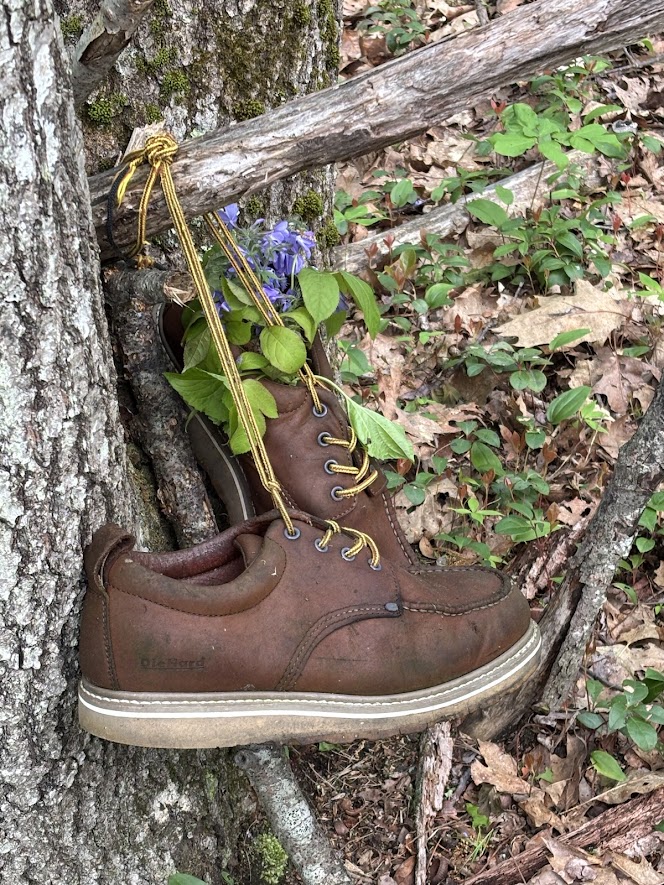
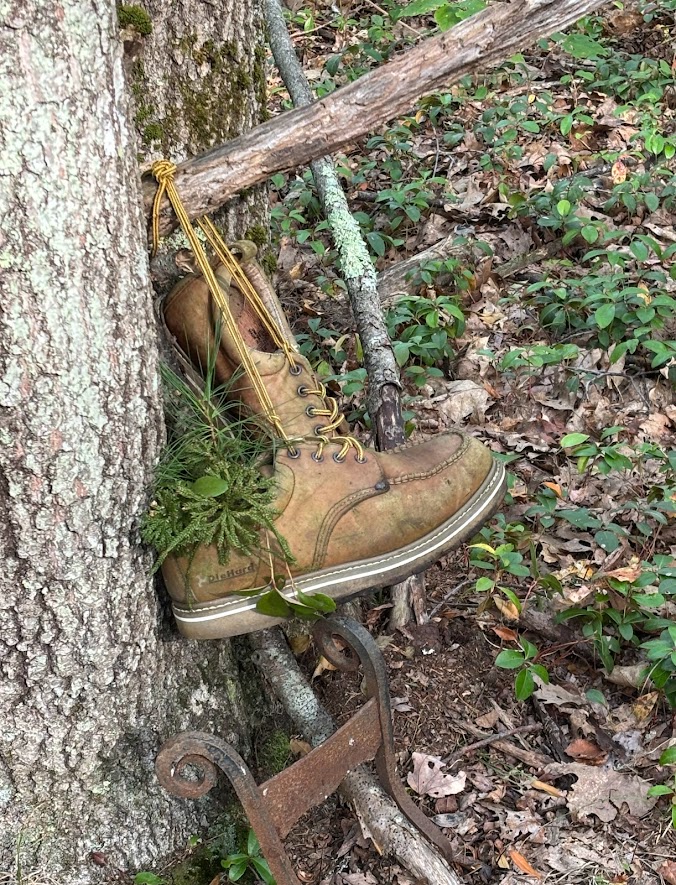
Taking a deep breath and hoping no deer ticks would crawl up my legs or bury themselves in my dog’s curious muzzle, I stepped onto the path and gingerly picked my way about twenty paces into the woods.  My eyes had not deceived me.  A sturdy pair of men’s walking shoes hung by their laces, artfully draped over the stick. What could this mean?  Who would leave their shoes behind in the woods?  These lace-ups still had a lot of life in them.

Something prevented me from touching them—some intuition that this was a holy place.  I took a picture of them, and retraced my steps, my dog tugging me back to our usual route. However, the image of the shoes stayed with me for the rest of our morning walk, and the place where they hung became the destination for frequent pilgrimages in days to come.

After several visits, I began to suspect that these were my neighbor Simon’s shoes, and that they had been lovingly arranged in the woods where he frequently walked, his camera dangling from his neck.  Simon had died several months before, and I surmised that his widow deposited the shoes in a setting he loved near their home, where she could visit them often to commune with her husband.  I took the risk of asking her if I had guessed correctly, and she, blushing but shyly pleased that someone else had discovered her memorial, confirmed it. 

Over the last couple of years, my pup and I have visited Simon’s shoes countless times.  Cynthia, Simon’s wife, adds bits of flora to mark the seasons—sometimes delicate wildflowers in spring, ferns in summer, red, yellow, and golden leaves in fall, and, of course, winter provides its own decoration. Each time I set out on my pilgrimage, I look forward to discovering these simple but artful adornments.

All I know of Simon are these shoes and the few memories of her beloved husband that Cynthia has shared with me. By the time the couple moved into my neighborhood, he had already begun to decline.  I would pass him on my afternoon walks and receive a silent smile in response to my cheerful hello.  He was, by then, not much of a conversationalist, especially with strangers.  His soft-spoken words were sparing, but the few I heard were direct and gentle. 

I marveled that the memorial shoes were in such good shape.  According to his wife, Simon had worn them on hikes all over Europe and America.  Once, on a walking trip in Ireland, amid a powerful wind and rainstorm, he and Cynthia took refuge in a farmhouse along their way.  The family welcomed them to warm up and dry off at the hearth. So, Simon propped his feet in front of the open fire, scorching the soles of his shoes before he realized what was happening. Thrifty as he was, he saw no reason to replace the singed footwear. Like his shoes, Simon was humble, loyal, and resilient.

Simon’s memorial shoes, their constancy, adaptation, and beauty in every season, have become an icon for me.  A symbol for the humility that embraces and accepts what is, even when the reality is absence. Gradually, these old shoes will succumb to the elements and disintegrate, but not before they have taught many passersby a profound lesson.  We continue after death, transformed surely, but ultimately, reunited with the elements that made us, enlivened us, warmed us, fed us, cleansed us, and sheltered us. Finally, we come home.

Simon and Cynthia are not the real names of my neighbors.

The Art of Life

Boston, South Station Bus Terminal, Peter Pan Bus Line, August 15, 2024.

Anxious, tired, embarking on an unfamiliar journey. I sit—rolling suitcase parked in front of me, heavy backpack drooping from my thin shoulders, iPhone in hand with QR code for boarding queued for use—trying to take up as little space as possible in the waiting area and the world. My fellow travelers are as silent, anxious, and self-absorbed as I am—our noses all pointed towards our screens, lost in texts, music, or internet searches, earbuds contributing further to our intentional isolation.

I look up as a dark-clad figure passes the window before me, separating the waiting area from the boarding dock, where the bus will arrive in minutes. The man lopes gracefully, quietly pulling a large utility cart behind him. He pays no attention to the passengers waiting on the other side of the window, and none of us pay him any mind either.

I’m only vaguely aware of his presence until he removes a long pole from the cart and attaches a dripping, soapy white window scrubber, which he draws from the bowels of the cart with the dexterity of a magician pulling a bouquet out of a hat. What rivets my attention in these first moments is the fluidity with which he attaches the scrubber to the pole. He presents himself to the first in a row of grimy windows, and, with a well-rehearsed and measured flourish, swishes the plush tool back and forth on the dirty glass, his body flowing with the movement of his arm, the bubbles on the panes lining up in precise rows each about twelve inches wide.

I am watching an artist at work, and now I cannot look away. He dances along the row of windows, spreading suds over the top half of each, covering the entire set in under a minute, pausing briefly to examine and correct his work here and there with another stroke or two. From my side of the window, I can’t imagine what flaw in his artistry he has detected and repaired. Then, plop goes the scrubber back into a bucket in the innards of the cart, and out from behind him, a pocket perhaps, he draws a squeegee, flips it in the air, and catches it with precision. 

Almost before the bubbles on the windows burst, his arm sweeps, with delicate pressure, back and forth across the surface of each pane, creating a clarity I would not have believed possible. He brings the blade to the exact edge of the glass and deep into each corner so that no drip or smudge remains. He stands back and examines his work with the refined eye of an art critic, seems to judge it satisfactory, and then repeats the entire process with the bottom half of each windowpane, his laser attention, poised relaxation, and complete dedication to excellence not wavering for a single second.

I sit, mesmerized by this performance, feeling that I am in the presence of a master who has studied his craft intently with an innocent dedication to excellence. No one else lifts their head from their phone.

The incoming bus arrives, the driver emerges, and a few passengers debark. They retrieve their luggage from the underbelly of the still-humming giant, and the outgoing passengers crowd the door to the boarding platform. The window artist gently places two tall yellow hazard pillars on the concrete platform to alert wayfarers to wet pavement. He adjusts them several times, looking around carefully to judge where an oblivious traveler might place an unwary foot. Then he steps aside, at ease in his invisibility.

I’m in the middle of the line of those embarking, and in the bustle of QR code scanning, luggage stowing, and seat choosing, I lose track of the window artist; my anxiety about decision-making and getting things right blinds me again. But once we pull out of the station onto the southeast expressway, I take a few deep breaths, reconjure the window washer image, and secretly smile behind my N95 mask.

I feel the gods have smiled on this journey, fortuitously begun by watching another human give his very best to an ordinary act of labor, transforming it into a labor of love, a dance of dignity, and an icon of respect for self and others.

Everything is an Opportunity for Waking Up

Heedful of the 15-mile-an-hour speed limit, I drive carefully through the empty streets of my retirement community on an ordinary day. Suddenly, I see something extraordinary.  

A Great Blue Heron presides regally on the left side of the road. Holy s_ _ t! I whisper to myself as I pull cautiously to a stop. The bird is immense, nearly as tall as I am. It looks at me intensely, slowly turning its small head atop its slender curved neck so that one eye can focus on my fire engine red car a mere twenty feet away. Its black legs equal nearly half its height. A pale blue-grey, aerodynamic cluster of chest feathers and folded wings perch atop them. The neck flows upward from this central mass and is crowned by a proportionally small head and a disproportionally long, pointed beak. The bird stares calmly; I stare, slack-jawed and awestruck. Moments pass, each of us immobile. Then, gracefully, the heron lifts one thin pole of a leg, revealing four equally skinny toes, three in front and one in back, bends its miniature knee backward, and steps over the low wooden barrier on the side of the road. It follows with the second leg and glides elegantly down the steep bank littered with fallen oak leaves, broken branches, and rotting tree trunks toward a shallow pond.

Wanting more, I push the gear shift into “park,” slide out of the car and grab my iPhone from my right back pocket. I walk quickly but fluidly—not to frighten the bird—to the side of the road and look down the bank. The heron has already reached the pond and is moving deliberately through the water on its stick legs. It is well camouflaged by autumn golds and browns—bare branches, yellowed leaves, and black water. Its body feathers blend with the trees, and its legs, neck, and pointed beak are almost indistinguishable from the willowy saplings around it.   The Great Blue appears to be the forest gliding through itself.

The terrain is too steep and cluttered with woodland debris for me to descend on the same route as the bird, so I swing around to the right and take the familiar path to the pond, clicking pictures of the heron whenever it emerges into view through the underbrush. Click, click, click. (None of the shots are any good; it turns out later.)

Finally, he stands still at the edge of the pond. I do, too. I am entranced—all glowing eyes and beating heart. I don’t know how to take in such exquisite beauty, powerful fragility, and deep composure. The heron and I are alone together. From my perspective, I am the admirer, and he is the admired—there is no space in my mind to consider his perspective.

For several minutes, neither of us moves. Then I think, I have to tell someone! Quietly and slowly, I turn and walk back to my car, still idling by the side of the road, the driver’s door open. I slip my phone back into my pocket, drive the remaining minute to my front door, and burst in, “There’s a Great Blue Heron in the pond!”

Sarah Faith is impressed and immediately Googles “Great Blue Heron” on her iPad, reading aloud to me the information the search engine pulls up. It is a large bird with a wingspan of 5.5 to 6.6 feet and a height of 3.2 to 4.5 feet. It hunts alone but nests in colonies, usually in tall trees near water sources. It feeds mainly on fish but also eats other aquatic animals, insects, and rodents, and it can eat up to two pounds of fish per day.

In Native American tradition, it is associated with good luck and loyalty. In Christianity, it represents perseverance and patience. In Celtic tradition, it heralds renewal and calmness in challenging situations. It symbolizes the characteristics of balance, strength, clarity, and connectedness.

The facts, myths, and omens wash through my ears and into my brain. Google encourages me to consider my encounter with this bird a fortuitous event. But I’m only half paying attention, impatiently, to the information. I feel a powerful urge to return to the pond as quickly as possible to see if the heron is still there—to feast my eyes on this miracle again. But I don’t go alone. My entrenched sense of responsibility reminds me that my dog needs his afternoon walk, so I leash up the frisky little guy and take him with me, insisting, “No barking!” as we go.

It takes only a couple of minutes for us to reach the pond. Lo and behold, the heron is still there, standing stalk still in the same spot it was ten minutes before. Because it is camouflaged, the dog doesn’t see it, and it is too far away for him to pick up a scent, so while he sniffs the decaying leaves at our feet, I stand and gaze again. The heron is not fishing; it’s waiting. Motionless, we watch each other.

Moments pass, and I have another brilliant idea. I must share this experience with someone likely to appreciate its specialness as I do. I think of my neighbor on the street next to the pond, a woman who loves the forest and its creatures. You stay there, I silently tell the bird, I’ll be right back.

I knock on my neighbor’s door; sure enough, she’s interested in seeing a Great Blue. While she puts her coat on, the dog and I shuffle from foot to foot impatiently. When she emerges from her front door, and we walk toward the pond, we hear a faint drone in the distance. “Leaf blowers!” she exclaims, extremely annoyed. “They ruin this place. They drive me nuts!”

I try to be sympathetic, but I want her to focus on the beautiful bird I am sharing with her. However, the noise from the blowers has ruined it for her, and perhaps for the heron too, because he looks around anxiously after a few more moments and glides upstream toward the footbridge. My neighbor and I decide it’s time to move on and leave him in peace. She invites me to walk in the woods a little longer, and we take the dog for his afternoon stroll together, chatting quietly about the quotidian details of our lives: sleepless nights, failing health, and community news.

Later that afternoon, in a pause between activities, I recall the image of the Great Blue. I’m antsy and annoyed with myself. I sense I’ve missed a profound opportunity for communion and insight. I rehearse the compulsive behaviors that prevent me from being fully present in life: photographing experiences to preserve them, researching facts to understand, seeking to share soul-stirring occasions with others to pursue intimacy, and letting responsibilities deflect me from my heart’s call. Why could I not simply stand still and look, listen, and open myself? Why could I not be fully aware of the essence of the encounter? Might a veil have lifted? Might I have seen the truth?

The following morning, during meditation, I calm my agitation and recall the image of the Great Blue, as I first saw it, regal, by the side of the road. I breathe deeply and gaze long, feasting on the mental vision with my third eye, the eye of intuition. The bird, in all its majestic peacefulness, revisits me. This time, instead of analyzing it, I recognize it. I know it for who it is—an avatar. The divine source of everything, incarnate in the form of a Great Blue Heron, stands amid an ordinary day. Solitary yet inseparable from the world, it moves effortlessly through beauty, chaos, and debris, self-assured, serene, and unafraid.

In the last few weeks, I’ve repeatedly returned to my mental picture of the Great Blue Heron. Each time, I feel revisited by an inexpressible peace and humble confidence that the bird and I are kin. I am also an avatar, an incarnation, though partial and flawed, of the source of all goodness. Each time the vision of the Great Blue returns to me, I am certain of the indestructibility of this exquisite world, the love from which it is born, and my intrinsic place within it.

Be Kind

I must admit up front that I am nervous about holding my mobile phone against my ear for long periods. Research has not conclusively shown that radio frequencies emitted by cell phones cause cancer, but it has not disproven it either. So, when possible, I place my phone in speaker mode, especially when I expect to get an automated response to my call, like when I call the pharmacy to check on the status of a prescription.

            I did this one morning about a month ago. I touched the various numbers that led me along the path to discovering the status of my order but met with a roadblock on the way, so I went back to the main menu and pressed the number to speak with a pharmacist. A woman came on, and I began to explain the situation to her. Suddenly she interrupted me to bark, “Stop yelling at me!”

            I was flabbergasted since I thought I was talking in a normal voice, so I stammered, “I’m not yelling.”

            “Yes, you are!” 

            “Well,” I hesitated, “I have my phone on speaker, and perhaps the volume is too high; let me turn it down.”

            “That’s not it, you’re yelling. Just answer my question!”

            I meekly asked her to repeat the question, answered it, and was told the prescription awaited pick-up. “Okay,” I whispered and hung up.

            Wow, I thought, she’s having a bad day.

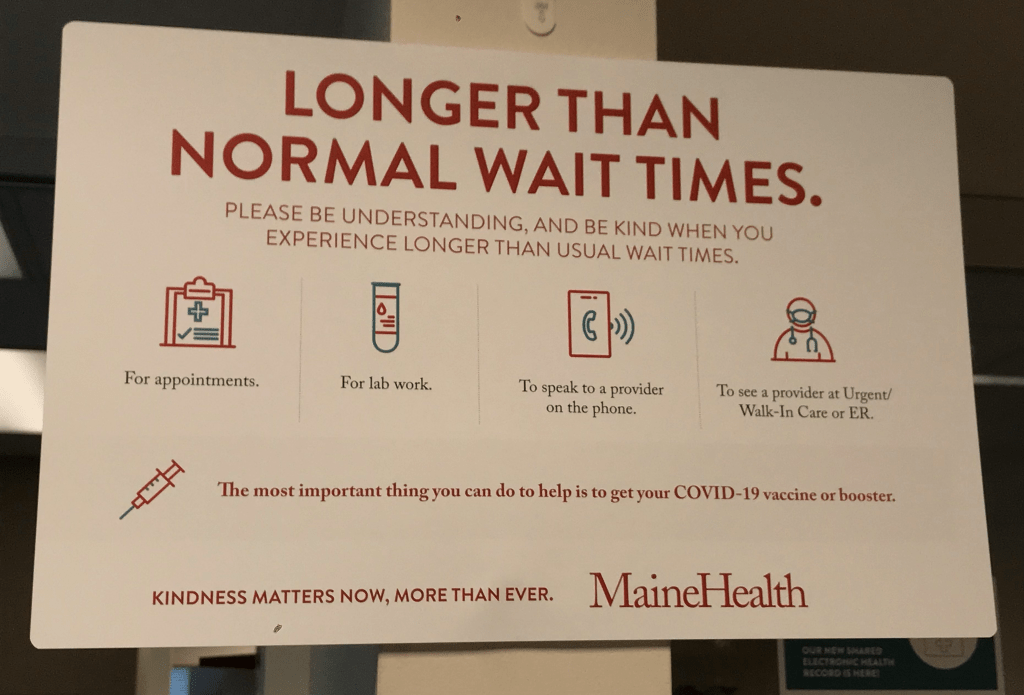
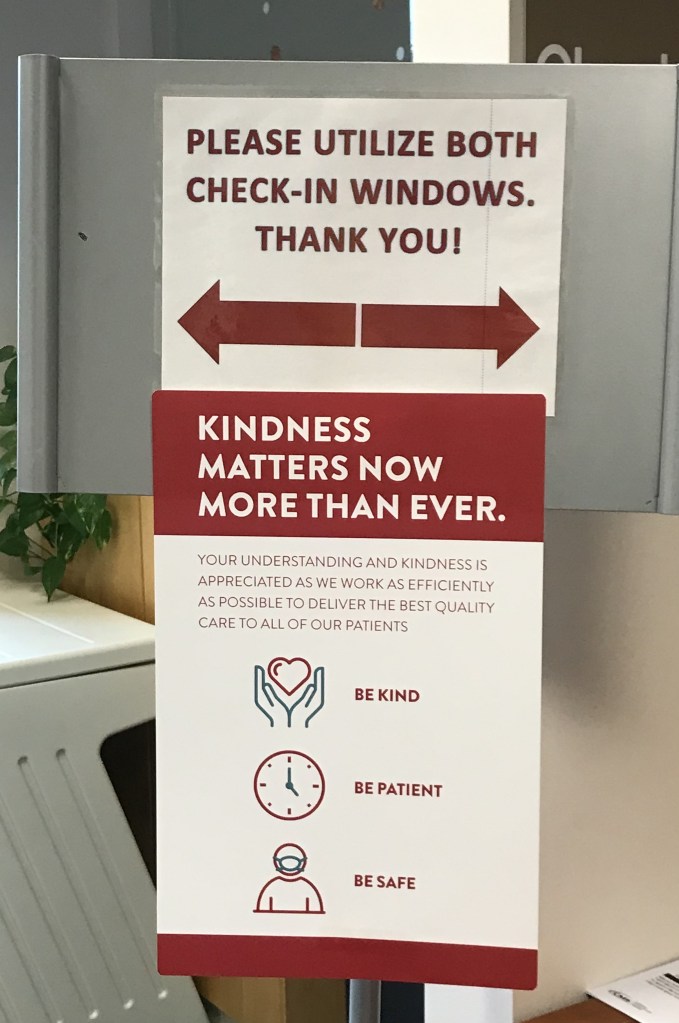
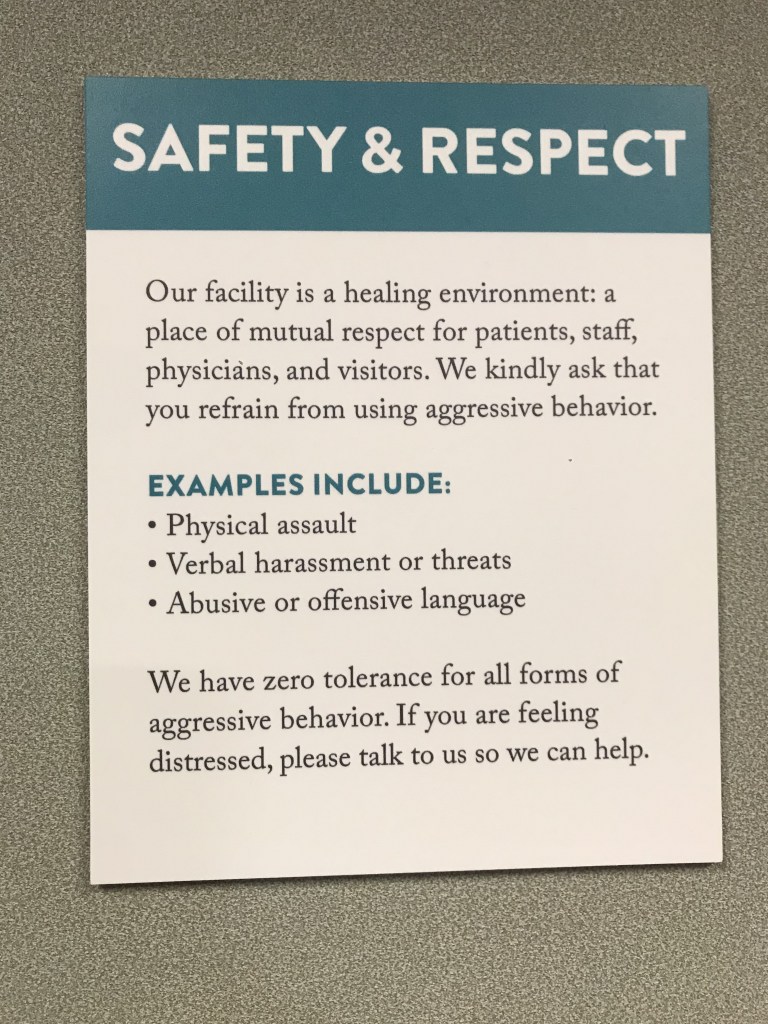
            About a week later, I had an unrelated conversation with a healthcare professional in my community. She asked me if I had noticed the signs posted at the local hospital and in virtually all doctors’ offices asking patients to be kind to staff and one another. I had not paid much attention but had a vague recollection that I had seen such signs and that they were also displayed in yards throughout my town. “BE NICE,” “BE KIND,” they reminded. She noted that these signs were relatively new.

Before the pandemic and the concurrent escalating political divide, such reminders were not as necessary because unkindness, rudeness, anger, and frustration were not as prevalent in public as they are now. People, she reflected, are just not as patient and thoughtful of one another as they used to be, and healthcare professionals, while not the only ones encountering such bad behavior, are some of the most frequently abused. The same essential personnel who risked their lives to come to work during the height of COVID, while many of us avoided public places, are being disrespected and insulted. No wonder they are quitting their jobs in droves, she posited.

            Her words and the encounter with the pharmacist started me thinking about two things:  how little we know about the people we encounter daily and how much we need to give one another the benefit of the doubt in every situation.

            To go back to the pharmacist. She had no idea why my voice was coming through the line so loudly; she didn’t know that my phone was on speaker or that my spouse was hard of hearing, and that I habitually speak in a louder-than-normal voice. I didn’t know whether the call she received just before mine had been an unpleasant encounter with a demanding customer or if she was alone in the pharmacy trying to catch up on a several-day backlog of script orders. We experienced each other as impatient and rude, but did we take a moment to consider each other’s circumstances, limitations, pressures, and challenges? Did we assume the other was a good person, needing patience and kindness, or did we conclude that she was obnoxious, demanding, and unworthy of respect? Did we have the capacity to give each other the benefit of the doubt and try to calm rather than stoke the flames of irritability?

            A couple of weeks after my conversation with the healthcare professional in my community, I went to a specialist’s office at the local hospital. I saw kindness signs posted at every turn of the corridor, in every elevator, and at three different sites within the specialist’s reception area—a desperate plea to patients to calm themselves and treat others respectfully.

            How do we increase our bandwidth for kindness and respect in all the encounters of our daily lives? We can start by getting in touch with our own innate goodness, being kind to ourselves, and understanding where our instinctual and habitual reactions come from. Then, we can assume that the other problematic person is also innately good, dealing with some of the same human challenges we are, and deserves to be cut some slack. And we can imagine walking in their shoes even briefly or shifting to see the situation from their perspective.

Monica Guzman’s book, I Never Thought of It That Way, uses the acronym INTOIT (to capture the title’s notion) and encourages us to be open to INTOIT moments when our perspective is changed, broadened, or softened by seeing things newly through the eyes of another. She encourages us to ask, with genuine curiosity, the fundamental question, “What am I missing?” To acknowledge that the picture in my head is not the complete picture of any person or situation; it’s just my perspective.

We cannot know all the conditions and circumstances that have made someone who they are at the moment we encounter them or why they say and do what they say and do that may aggravate or thrill us. But since we long for understanding and respect, we can infer that they, too, yearn for it, along with grace, kindness, courtesy, and indulgence. As the Dalai Lama says, “Genuine compassion is based on a recognition that others, like oneself, want happiness.”

            Kindness is as kindness does. It is not a warm, fuzzy feeling but a way of being and acting. It is not needed now, more than ever, but now as much as ever. Be kind.

In the Twinkling of an Eye

I’m sitting on the small beach in downtown Bar Harbor, Maine, on a cool, showery day in late June. My sister, Ann, visiting me from Nova Scotia, has just arrived on the CAT, the ferry between Bar Harbor and Yarmouth. We’ve walked the main street, popping in and out of shops, and are now killing a little time before having lunch at a nearby Italian Restaurant—she’ll tell anyone how much she loves pasta!

Ann saunters down the short stretch of rocky beach, eyes trained on the ground before her, searching for elusive beach glass and unusually shaped and colored beach stones. I’m wearing my navy Sketchers with white soles, and I don’t want to get them wet and dirty, so I have decided to sit still on a large stone at one end of the beach and wait for Ann to carry out her meticulous search. 

A few feet away sit two fortyish women, also perched on large stones, chatting easily about summer clothing they have purchased or hope to purchase. A few children—I’m not paying attention—ranging in age from about eight to perhaps sixteen, wander back and forth from their mothers to the water’s edge. A teenage boy settles beside one of the women and sorts through the wet stones at his feet. 

All this is happening within my peripheral vision. I’m staring off into space, focusing on my private thoughts, so I only half see what happens next in the twinkling of an eye. The teenager picks up a stone, large enough to fill the palm of his hand, and raises his arm to toss it into the water. He pulls his arm back, but instead of throwing forward, he loses his grip on the stone, and it flies sideways, out of his control.

I hear a crunch, like a finger poking through an eggshell, then a gasp and an “Oh my God!” I focus my attention on the group.  One of the women clutches her head in her hands, bright red blood spreading through her quickly matting hair and dripping between her fingers. Her face is pink and blotchy, and she is rocking back and forth, gasping for breath. 

“Mom! I’m so sorry. I’m sorry! Mom! Mom!” the boy pleads in a hushed but urgent voice. His mother doesn’t answer. She’s trying desperately to master the pain. The second woman and the children cluster; they whisper urgently to one another, asking what to do. The woman at the center of the circle is silent, rocking. I sit still, saying nothing, willing them to know what to do next. I’m tempted to pull out my phone and dial 911, but I wait. This is their crisis; let them handle it. I have no right to intrude, at least not yet.

“Can you walk? Let’s get you off the beach,” says the other mother. She and the boy lift the injured woman, holding her under one arm and by the other elbow, wrapping arms around her waist. She leans on them, and they slowly and jerkily shuffle toward the parking lot just a couple hundred yards away. As they trudge, the uninjured mother pulls her phone out of her bag, and I hear the beep, beep, beep of the dial tone.

I watch them go, then turn to see that Ann, oblivious to this scene, has almost completed her beachcombing and is ready for lunch. When she approaches, I tell her what’s happened, emphasizing the eerie sound of the stone connecting with the woman’s skull. We talk about how a day, and sometimes a life, can change in a moment—from a relaxed vacation at the seashore to a head injury that may have traumatic and lasting effects. As Ann and I leave the beach for the restaurant, the ambulance arrives, sirens wailing, lights flashing. That family’s day has changed irreversibly, without warning or intent, in the twinkling of an eye.

I cannot get this incident out of my mind for the rest of the day. I wonder how the woman feels, whether she is still in the emergency room or if the injury was serious enough to put her in ICU. Or was it just a minor cut, and she is already back at the B&B with her husband, family, and friends, sipping a cocktail before dinner?

That night I lay in bed before sleep, musing on life’s fragility, insecurity, and uncertainty even in the calmest and most seemingly benign situations. When we wake up each morning, we never know what the day will hold—celebration or grief, joy or tragedy, safety or danger, a new beginning, or a sudden end. I carry my reflections to the extreme, as I am wont to do, and imagine what it must have been like for Jews to wake up in the morning in Auschwitz, wondering if they would eat the usual wormy porridge, freeze while pointlessly hauling heavy rocks, or die in a shower of gas. Or would they see a smile from a fellow prisoner handing them a scrap of bread or hear the sound of the tramping boots of friendly soldiers opening the gates to deliver them from hell?

How do we live with such overwhelming uncertainty? We pretend that it doesn’t exist, that we know what to expect and what the future holds. We forget or do not allow ourselves to remember that circumstances, large or tiny, change in the twinkling of an eye.

After our recent trip to Italy, where my partner spent five days in the hospital with acute asthmatic bronchitis, I grumbled about the time and effort of filing the trip insurance claim to recover the extra medical, food, and accommodation costs. I slogged irritably through the tedious paperwork and bureaucracy, expecting it to drag on for many months. One morning, I determined I could no longer avoid filing what the instructions told me were the last pieces of information necessary to complete the claim. I logged on to the insurance website to do so, frustrated, bored, and tired of it all. Lo and behold, in the twinkling of an eye, my mood and my day changed. The claim status page announced that the company had mailed checks for nearly $1000 more than I had originally claimed. “Hallelujah!” I shouted. We never know, do we?

It’s a truism, and while we are tired of hearing it, the only way to live with uncertainty is to accept it and face it, moment by moment, trusting that we will have the inner and outer resources to meet whatever arises. Let’s not pretend, though, that the unpredictability and changeableness of life are not uncomfortable. Let’s be real. However, the more we try to resist the constantly changing nature of our existence, the more certainty and control we try to establish in our minds or circumstances, the more anxiety we bring to ourselves. The more expectations we entertain, the more disappointment, dread, and suffering we invite.

“Let go, accept, and surrender” are hard words to hear or say—challenging attitudes to adopt. But they, like all new habits, become easier with practice. Embracing life just as it is, moment by moment, can lead to the only security and confidence we will ever know in the face of our groundlessness. All occasions are opportunities for understanding and insight. There is a kernel of goodness at the heart of everyone and everything.

The only truth we can hold onto as things constantly change in the twinkling of an eye is the promise given to St. Julian of Norwich in the 14th century, “All shall be well, and all shall be well, and all manner of thing shall be well.”

Aging Gracefully

Nice phrase. Has a certain ring to it—a kind of quiet aspirational quality. But. But aging is seldom pretty, calm, or comfortable. Though, in some older people, you have probably witnessed a peaceful grace that shines from the inside out.

Consider this:

Today at 7:00 a.m., after my morning swim, I sat in the hot tub at my local Y, soothing sore seventy-one-year-old muscles. As I aimed the jets at painful spots and rested amid the frothing water, I again observed a scene I had watched many times before. A ninety-ish gentleman emerged from the nearby therapy pool, gripping the rail and stepping up one watery step at a time. Close behind him came a similarly aged woman in a black bathing suit, also taking it slow and easy. The man grabbed the cane he had stowed in a large blue bucket at the top of the steps, jabbed it soundly at the damp poolside tile—clack, clack, clack—and shuffled gingerly over to his walker, a black rollator with brakes and a storage compartment below a vinyl seat. He grabbed the rollator, swung it around, and I noticed it had a helium “Happy Birthday” balloon attached. Sweet, I thought.

The woman, who I assumed was his wife, was now at the top of the steps, so he grabbed a low-tech aluminum walker with two wheels in front and small plastic ski-like slides on the back and pushed it to the edge of the pool so she could steady herself with it. Then he picked up a faded bath towel from the seat of his walker and handed it to his wife, who deliberately unfolded it and spread it gently over his wet back. The woman then removed her cane from the plastic bucket, clutched it and the walker handles, and they hobbled slowly off together in the direction of the family changing room.

I had watched this scenario—shall I call it a carefully choreographed dance—and marveled at its unwavering precision at least a dozen times before as I soaked in the hot tub. Each knew exactly what to expect from the other; no instructions were given, and no questions were asked. This morning, the gracefulness of their movements, the serenity of their faces, and the harmony of their interdependence struck me anew, and the phrase “aging gracefully” rose in my mind.

For the last nine months or so, I have regularly joined a group of women about my age on Zoom to discuss aging. The conversation has ranged from how we are experiencing the physical and mental effects of aging to our concern for aging spouses and friends, worries about giving and receiving care, and our fears about losing our capacities and our impending death. It’s been a rich conversation, and I believe we have learned much from one another. I think I can safely say that each of us aspires to age gracefully but fears we will not.

A wise Buddhist Nun, Pema Chödrön, has written a book about the dying process called, How We Live is How We Die. I highly recommend it, even if you are only 45. I think she would agree that the same applies to aging: how we live is how we age. Gracefulness is a habit—“a settled or regular tendency or practice, especially one that is hard to give up.” Good habits, like problematic ones, are acquired over time by returning to and reinforcing a pattern of thought, speech, or behavior.

We will not age gracefully unless we live gracefully now. And it is never too late to start practicing and, therefore, reinforcing habits of gracefulness. Who do you want to be when you are 90? Strive to be that person today, tomorrow, and the next day. And when you flounder, gracefully and kindly pick yourself up, throw a warm, dry towel of kindness over your bruised, scared, and diminished ego, let go of self-judgment, and start again on the walk toward the perpetual “changing room” of your life.

Chodron has written another book called, Living Beautifully with Uncertainty and Change. How we respond to the inevitable experience of constant uncertainty and change, the unavoidable human condition, will determine how graceful we become. Like a martial artist—a Tai Chi practitioner, for instance—instead of resisting, we accept what comes, flow with it, and transform ourselves into skillful and graceful old warriors.

It is possible that the aged couple described above hate each other, fight constantly, and are bitter and angry, but I don’t think so. That’s not what shone through their wrinkled faces and bodies. A couple of days ago, I attended my neighbor’s hundred and first birthday party. Another neighbor, a talented photographic artist, snapped photos throughout the celebration and sent the collection to all the guests afterward. Laughing faces, raised champagne glasses, attentive gazes, looks of joyful abandon, kind understanding, quiet admiration. I thanked the photographer for his knack for making old people look beautiful. He responded, “It is because they are beautiful.” He’s right. His lens captured graceful aging in that moment, in that place.

I look forward to my next visit to the hot tub, not just for its soothing effects on my body. I’m longing to see the graceful dance of that beautiful old couple again.

Noticing Respect in 2022

“Is treating someone respectfully fundamentally different from respecting him, her, or it?”

I posed this question in my first blog post in 2022, and I return to it in my last. (Though technically, it’s 2023 already, today is New Year’s Day Observed on the iPhone calendar.)

In the last year, I have reflected on, written about, and invited your comments on various instances of respect—situations I have encountered in daily life that have caused me to examine the meaning of respect more closely. For example, I wrote about respecting others through an open, honest, invitational style of communication embraced by Maine’s CDC Director, Dr. Nirav Shah, as he interacted with the people of our state during the height of the COVID pandemic.

I shared the “Just Like Me” practice of recognizing that everyone, even those whose ideas and actions are sometimes antithetical to our own, has many of the same human attributes, desires, hopes, fears, sorrows, and losses as we do. This practice encourages points of identification to generate empathy and nurture even the tiniest grain of respect. In “Respect Amid Conflict,” I wrote about two principles crucial to navigating conflict respectfully: understanding oneself and seeking to understand the other, ferreting out one’s deepest motivations and underlying assumptions, and keeping an open heart and mind about the experience and perspective of the other.

In “Respect in Extremis,” I reflected on respecting the essence of a human being when accomplishments, attractiveness, and self-control are stripped away at the end of life. In the article titled “What Is,” I illustrated the habit of noticing and accepting the ordinary miracle of each moment, welcoming and flowing with it instead of resisting and wishing things were different. In “Two Tales About Respect,” I explored how experiencing disrespect from another may tap into our lack of self-respect. I also exemplified how inner doubt and confusion about the right thing to do in a situation can cause one to act disrespectfully toward others.

The three posts about my friends Jack and Vicky dealt in depth with their experience of years of homelessness, followed by a brief period of stable housing, Vicky’s severe illness, and ultimately their deaths within two weeks of each other. The articles, telling the story of our friendship, were my memorial gift to honor them. Their backgrounds and life experience and mine were dramatically different, yet we came to understand, respect, and love one another.   And finally, “Respecting Limitations and Letting Go.” Recognizing and accepting our limitations and those of others is a lesson we must all learn as we grow older. Learning to let go when the time is right will prepare us for the end of life when we must ultimately let go of everything.

So, back to the original question: “Is treating someone respectfully fundamentally different from respecting him, her, or it?” I’m currently living in a divisive atmosphere. There are many perspectives on the problem we share, but for clarity, I think I can safely say that two slightly porous camps have emerged. Each wants respect from the other. Each desires to be heard, understood, honored and treated kindly and politely. Trust has been damaged, and respect is frayed and floundering. 

But can we treat each other respectfully, even if each camp has done and said things that have damaged the esteem we formerly felt for one another? And would respectful words and actions move us toward restoring genuine respect? Would they help us navigate this situation, repair the divisions, and solve the problems? 

And what would treating each other with respect look like, even if we are not feeling it? We could begin with the old gem, “Do unto others as you would have them do unto you.” That might include giving everyone the benefit of the doubt, not presuming to understand all the complicated nuances of the situation or the difficulties others face. Listen and communicate. Recognize defensiveness in yourself, but don’t act out. Don’t say hurtful things, be gentle, and practice courtesy. Don’t avoid one another (downcast eyes, looking away) but take risks to build genuine relationships. Listen; communicate. Keep things in perspective by remembering to be grateful. Notice the good and speak up about it. Keep working at the solution, don’t give up or bail. Listen and communicate directly, face-to-face, and eye-to-eye. Behave respectfully, and you may earn respect.

So, I would posit that treating someone respectfully is not fundamentally different from respecting that person. Famously it is said you can’t make peace; you have to be peace. You can’t create respect; you have to be respect.

Respecting Limitations and Letting Go

One of my dreams for retirement was to adopt a dog and train it as a therapy dog. I had owned several cats over my 63 years but never a dog, and I wanted one badly, almost like some women long to have children. I had admired service dogs for many years—their calm, competent demeanor and the trust between them and the people they serve. But I knew I didn’t have the patience or skill to train service dogs. Still, I imagined I could meet the training standards for a therapy dog—well-behaved in public, gentle, reliable, and willing to allow himself to be petted to comfort others. 

So, shortly after retirement, I adopted Digby. I had not planned on getting a puppy, but he was so darn cute I couldn’t resist him. When I met him for the first time, he had just had surgery to repair a broken leg, and he lay on the couch beside me, a huge cone circling his head, licking my hand like crazy, trying to make friends and quell his anxiety. He weighed about ten pounds and was white and apricot, a mix of Pomeranian and Papillon. I thought he would make a perfect therapy dog. His cuteness alone would bring joy to those he visited, and he was small enough to lift onto beds and into laps.

And so, the training journey began. Digby was six months old; still an exuberant, sometimes crazed puppy, and I was sixty-three, inexperienced, with limited energy and patience. The mixture was not quite a recipe for disaster but certainly portended frustration and exasperation for both of us. I could not control his barking, chewing, cat chasing, and peeing indoors for a long time. Likewise, he could not figure out how to please me.

Once we started training classes, I quickly learned I needed training as much as he did. Consistency was my biggest problem. I could not remember to act or react using the same commands in the same order (click, praise, and reward) each time I taught a new behavior. But I persisted, for almost three years, class after class—beginners’ obedience, intermediate, tricks, agility, nose works, advanced obedience, and Canine Good Citizen, repeating some of these classes multiple times. Eventually, he stopped chewing everything in sight and peeing indoors and could walk calmly next to my left knee, which I called “walking nicely.” However, he’s never stopped barking or cat chasing.

Finally, Digby and I made it to the moment of truth, evaluation by a representative of a therapy dog licensing organization in a real live therapy context—a senior healthcare facility. We were both nervous and needed correction and pointers from the evaluator, but after three trials, we were certified. He got his little red heart therapy dog tag, and I got a certificate I could show to volunteer coordinators in settings where we would visit to offer comfort and entertainment. Along the way, I learned that Digby was a performer and a ham. He loved doing tricks to entertain an audience, but he was less comfortable being trotted around from one person to another for pets and cuddles. He loved children and was great at Read to Dog programs in local libraries and schools, but he was terrified of being surrounded by a group of college students seeking the calming presence of a dog during exam week. He was more freaked out than they were. Digby had his limitations, and I had to tailor our volunteer commitments to those.

After discovering his strengths and weaknesses, I focused our therapy work on tricks shows. We offered them to seniors in various healthcare facilities and children at a local library. He loved the mental stimulation, the applause, and the treats he got as rewards. His audiences loved him! “What an amazing little dog!” they clapped and shouted. To keep him stimulated, I taught him more and more tricks, up to 35 or so, and built him an indoor agility course, including a hoop to jump through, a tunnel, a teeter-totter, a ramp for climbing, and poles to weave around. He danced, shook hands, rolled over, crawled, spun, played soccer by rolling a ball through goalposts, and dazzled in many more ways. 

Watch Digby training to roll a ball through goalposts.

Performing together created a special bond between us. I was so proud of the little guy when he turned on a dime and did precisely what I asked, trick after trick, for over half an hour. He looked to me for guidance during the performances in ways he didn’t in other situations. We depended on each other. I loved seeing him succeed and bring joy to the audience; he loved my excitement and praise.

But he got older, and so did I.  After nearly four years of performing, Digby’s formerly broken leg began to show some weakness. He barked more during shows (sometimes frightening the children), tired more quickly, and became impatient during some of the tricks. On the other hand, I found it harder to load the heavy agility equipment in and out of the car and set it up in various venues. And it was hard for me to keep up with Digby as he ran around the agility course. I’d often be nervous about his behavior and enormously relieved when he performed well. We’d come home after a show and take a long nap together, both stressed and tired.

It seemed like Digby’s run as a therapy dog performer had been a short one, barely four years, but I decided we needed to retire, for both our sakes. It was a hard decision. I had invested much time, money, and effort in training. But it wasn’t just that; I would also miss the interdependence we had developed as we trained and performed together and the intimacy it brought to our relationship. And he would miss the mental and physical challenges of doing tricks and the admiration of his audiences. I wondered how I would keep him stimulated and exercised, especially during the long, cold Maine winters. When they heard of our retirement, the volunteer coordinators we worked with were disappointed but said they understood.

I tell this rather long story as an illustration of how many of us feel as we age and bump up against increasing limitations—our inability, for one reason or another, to continue doing the things we love or keep longstanding commitments. Sometimes it feels like failure to admit I no longer have the energy, skill, or interest I once had for certain activities. I hate letting others down, and I may experience a sense of diminishment as the circumference of my life shrinks.

I have three choices. I can try to push myself beyond my limits, whine about my losses, or accept and respect my limitations. Like all living things, I am of a nature to grow old, lose my freshness and vigor, decline into poor health, and eventually die. I try to mitigate these inevitable changes as long as I can—exercising to stay healthy and strong, eating well, and staying involved in work or leisure that stimulates my mind and keeps me connected to others. But do I know how to let go gracefully, when the time is right, of things I can no longer do safely or happily? I built my ego around the things I have accomplished, and when those accomplishments fade, who am I? Do I have anything to contribute? Do I matter to those I love or to the world around me? Respecting my limitations and letting go of what no longer serves me is an opportunity to turn inward and get to know who I am at my core—the I who will survive, transcend, and continue beyond the increasing outward limitations and diminishments.

Digby, reputed to be a fantastic trickster, will soon blend into the growing pack of aging dogs taking shorter and shorter walks around our retirement community. And, though it may not happen quickly, I will one day acquire a walking stick to keep me from tottering as he “walks nicely” beside me.  

Accepting and respecting my limitations is an opportunity to learn graceful letting go and practice it daily as I approach the biggest “let go” of all. As Pema Chodron’s recent book says, How We Live Is How We Die.

Homelessness and Respect, Part Three

Photo of Jack and Vicky’s memorial stone in my garden before I added their names.

(Names have been changed to protect privacy.)

A couple of weeks later, Vicky received an ordinary letter via USPS, delivered by a friend whose address she had been using. It notified her that she was eligible for a one-bedroom apartment in a new luxury high rise with a quota of affordable units. The Section 8 voucher would pay for most of the rent, and about 30 percent of her Social Security income would cover the rest. Jack’s name was not on the voucher, so he would not be able to live there legally. He could only stay as a guest for a certain number of nights per month. Vicky was ecstatic, and Jack was relieved but also angry and resentful. I was relieved but outraged by the stupidity of the system. How could it be good or right to split a couple who had been married for many years by housing one and denying it to the other, especially when Jack had been the primary breadwinner and had kept them alive for years? I was confounded.

I vividly remember the day I drove Vicky to the apartment to see it for the first time. The building was new and fresh, the landscaping gorgeous, the apartment small but ultra-modern, clean, with in-unit laundry, hardwood floors, and top-of-the-line appliances. Neither Vicky nor I could believe her luck. The rental agent was respectful and kind as she gave us a tour, helped Vicky sign the lease, and arranged a move-in date. If she had any doubts about her new tenant, she hid them well. Afterward, back in my car, Jack and Vicky argued, and Jack stalked off, acting like he felt abandoned and scared. Vicky’s world was changing, but what would happen to him? Worried but not knowing what else to do, I dropped Vicky back at the motel. The next day she called to say that later that night, Jack arrived at the motel to make up, and again, take one day at a time.

Besides a few items of clothing, some rudimentary cooking utensils and dishware, and the essential papers they must have with them at all times, Jack and Vicky had nothing to furnish an apartment. Feeling exhilarated by our success, the week between lease signing and moving in, I and others who had befriended them at their intersection rustled up some furniture. One provided a dining table and chairs. A couple of the large home furnishing companies in the area had programs for people moving off the street into subsidized housing. We got a free mattress, box spring, and couch through them. A family in my neighborhood was cleaning out their father’s home after his passing and donated end tables and lamps. Financial donations purchased towels and bed linens. From somewhere, a TV materialized. That was an absolute essential, I soon realized, as Vicky, sick and exhausted from years on the streets, wanted to do nothing but watch it all day long. 

After the portion deducted for the rent, the remainder of Vicky’s Social Security check allowed her to connect basic cable service and a telephone landline. Jack continued to panhandle for food and household supply money. When they first became homeless, they had stashed some of their belongings in the basements and garages of friends, so gradually, they reclaimed these. The most significant stepping stone to relative normalcy was getting Vicky’s engagement ring out of the pawn shop.

Vicky and I had fantasized about a housewarming party to thank those who had helped along the way and celebrate their new home. But that was indeed a fantasy. Neither Jack nor Vicky had the energy or self-confidence to interact with a large group. Though relieved to have a home of their own, they were disoriented and would take a long time to adjust to their new life and break the habits of years of homelessness. They would not open a bank account but paid all their bills with cash or money orders. They did not want a donated computer or an email address, believing that would expose them to the scrutiny of state officials, police, and debt collection agencies. They had an apartment but still did not feel safe and secure. It was not yet their home. Watching them during this transition time showed me that homelessness is not just an outward condition but a state of mind; it takes a long time to change deeply ingrained patterns. They had wanted housing for so long, but now they didn’t know what to do with it. Though Jack was allowed to be in the apartment during the day and kept his things there, he was restless, had to be out on the streets, on the move, and couldn’t relax.

Vicky had smoked compulsively since she was a young girl. She had advanced COPD and congestive heart failure and was a cancer survivor several times. As soon as she moved into the apartment, her legs and abdomen began to fill with fluid. She could hardly move, was nauseated constantly, and couldn’t eat or sleep. Because Jack and Vicky were on Mass Health[1] and Vicky qualified for Medicare, they were not strangers to the healthcare system. I insisted that Vicky make an appointment to see her doctor and planned to drive her there. We arranged a date, and when it arrived, she canceled the appointment saying she was too sick to go.

Several cancellations later, and frustrated with her, I finally accompanied Vicky to the doctor. She was in such bad shape that he immediately recommended hospitalization. She absolutely refused. I argued with her, begged, and finally threw up my hands in frustration. Her excuse was that she couldn’t leave Jack alone, or he might start taking drugs again. This was the first time either of them had said anything to me about drug involvement. Perhaps the early naysayers of my friendship with Jack and Vicky had been right. I was shocked and disappointed. Vicky later denied that Jack ever took drugs. She said she had just used it as an excuse to get me off her case. Still, she refused to go into hospital.

Often, I would plan to visit Vicky and Jack in her home and would receive a call at the last minute saying she was too sick to see me. I began to feel she was avoiding me and wondered if she was tired of being grateful for the help I had given. Oddly, I saw less of them now that they were more stable. I had imagined our relationship would evolve from the helper and advocate to friends now that we could see each other without standing around in the cold or oppressive heat.

Finally, I accepted my powerlessness to persuade Vicky to attend to her health issues. She was more stubborn than I. She continued to smoke, though the apartment building was a smoke-free zone. She would get Jack to take her outside in a wheelchair for a smoke several times a day. He pleaded with her to stop, but she would not listen. Part of her desire to avoid hospitalization, I was convinced, was her addiction to cigarettes and the knowledge that she would not be able to smoke in her hospital bed.

Jack stayed in Vicky’s apartment during the day when he was not panhandling and as many nights a month as allowed within the guest rules. Neither would tell me where he went on those nights he was not with her. Gradually, as he experienced more hernia and hip pain and cut back on the panhandling, he spent more time indoors. Eventually, they disregarded the rules entirely, and he lived with her in the apartment, and after a few years, they mustered the courage to put his name on the lease. The building management saw them as stable and reliable renters and overlooked the rules. Vicky kept trying to get him on the Section 8 voucher, but as far as I know, she was never successful.

I moved further from them the summer after they moved into their home. I left the state to live in a retirement community three hours away. But we exchanged phone calls regularly, and when I returned to the area to see other friends, I visited Jack and Vicky too. 

Now that she had an apartment, Vicky seemed to be in touch with her children again after years of estrangement. I had always been puzzled why her sons didn’t help their mother and stepfather when they were homeless. She never said whether or not her children had helped, and I didn’t want to pry. I can only imagine what I have heard about homelessness and family dynamics applied in this situation. Family members try to help out initially but tire of repeated requests for assistance, resent the drain on their own, often limited resources, and are ashamed of their relatives who cannot pull themselves together and get work and housing. Unable to fix the situation, they avoid their homeless relatives.   I do not know if this was the case with Vicky and her sons. I know she loved them deeply but seemed to expect no assistance from them. She was excited to hear from them on the rare occasion they called, usually to announce the birth of a new grandchild. She would call me all excited to pass on the family news. 

Over the next couple of years, Jack finally had hernia surgery, two hip replacements, and cataract surgeries. He gained weight, took his social security income early, signed up for Medicare, and began to take better care of himself. He stopped panhandling (I believe) and bought a used car. After one visit, I gave him a seat cushion to cover the upholstery tear in the driver’s side seat. He drove me to my next destination when I left their home after a two-hour visit. During that short drive, I felt an easy camaraderie. I marveled at how far he had come. Life seemed relatively normal for him now.

As Jack got stronger, Vicky got weaker. Instead of resisting hospitalization, she was continuously in and out of the hospital to drain the fluid that rapidly built up in her body. Sometimes her stays were thirty days or longer. She might be home for only a few days when Jack would find her unconscious on the couch and call 991 for another trip to the ER and ICU. I talked to both of them by phone and sent them cards and flowers. Vicky was determined to fight for her life. The doctors had begun to speak to her about hospice, but she wouldn’t hear of it. She wanted with all her might to go on living. I wondered how she could consider her life worth living with all its pain and suffering, and she admitted she was exhausted. But she talked about praying that God would miraculously preserve and heal her.

As I watched hospital stay after hospital stay, where she often spent a week in ICU, I thought it ironic that the social safety net was working for Vicky for the first time. I felt sure if it had started supporting her earlier when she and Jack first became homeless, the state may not now be paying hundreds of thousands of dollars in medical expenses for her care.

When she was at home, the social service system provided a caregiver who bathed her, washed her long hair, and did light housekeeping. Jack learned to cook with Vicky’s verbal instruction, carried her from the living room couch, where she spent all day and night, to the bathroom, and did what he could to take care of her. It wore him down, but he would say when I asked how he was doing, “What can I do? It is what it is.”

By now, my spouse accepted my friendship with Jack and Vicky. After each phone conversation, I would report the specifics of their lives, and she shared my concern for them. She no longer feared they would take advantage of me. Other friends would ask, from time to time, how Jack and Vicky were doing. Their movement from homelessness to a stable, somewhat secure home life was considered a success story. People rejoiced for them. Though Vicky was very sick, she wouldn’t die on the streets.

As I watched Vicky’s life ebb away, I thought more about the root causes of the long years of homelessness that destroyed her health and contributed to her imminent death. I knew only a few details about her early life, but what I knew indicated that violence, abuse, and instability had rocked its foundations from the beginning. Her chaotic childhood prevented her from developing the inner psychological resources to cope with illness, job loss, financial insecurity, and homelessness in later life. She lacked the habit of staying organized and focused, of planning for the future. Impulse control was missing, and she was often volatile and verbally abusive. Accessing the social safety net, as full of holes and weak as it is, requires discipline and patience, and Vicky’s early life did not foster those qualities. And she did not have the support of friends and family at the beginning of the slide into homelessness. No one stepped in to hold her up while she got her feet under her again. 

I knew less about Jack’s past. He didn’t mention his family, other than Vicky. Instead, he talked proudly of the work he had done for an interior design business at one time. I’m convinced he had come to think of panhandling as a job, if not a profession. He earned the money he received; I don’t believe he thought of it as charity. The physical effort of standing and walking back and forth for hours on end and the mental effort of reading traffic patterns, recognizing familiar vehicles, and interpreting drivers’ attitudes, absorbed all his energies. He was good at it. He built relationships with his clients by offering something positive to their daily commute experience—a kind inquiry into their health and wellbeing, a comment on the weather, a reflection on what was happening worldwide. He was alert and engaged as he worked hard and long, giving it all he had.

Though Jack and Vicky argued frequently, they loved and relied on one another. Vicky took responsibility for filling out paperwork and making the necessary calls to keep them connected to social services and managing the household once they were in an apartment. Jack went out into the world to earn what he could and make the meager purchases that kept them alive. Jack was Vicky’s second husband and not the father of her children, but she said he had embraced and taken care of them. They were a team, pooling their talents and sticking together no matter what. As she got sicker and finally gave in to hospice care, Vicky had nothing but praise for the loving care Jack offered her. She could be a difficult patient, but he never wavered.

#

On the 40th day after Jack went silent on me, I received an email message through the then-defunct Go Fund Me account. It was from one of the other commuters, who had befriended Jack and Vicky, helped them financially and with donations of household items, and stayed in touch with them over the years since they moved into their home. It read, “As you probably know, Jack and Vicky have passed away, so if you wanted any money left in this account to go to her son and granddaughter, please contact me,” and gave a phone number. 

I couldn’t believe my eyes! Vicky dead, yes, I had been expecting that, but Jack too! How could that be? A deep sense of loss washed through me.  I called immediately, but the emailer was in the middle of dinner and couldn’t talk. When we spoke the following day, I expressed my shock, and she shared the few details she knew about their deaths. Jack died of a heart attack on July 2, and Vicky thirteen days later on July 15. Like me, this friend had left multiple messages on voicemail toward the end, and Jack’s brother had retrieved them and called back with the news. “It’s a love story,” the woman said. “Jack would have cared for Vicky forever, one day at a time, and Vicky was not going to let go of life while Jack needed her.” I agreed. Jack and Vicky were so intertwined and interdependent that it was impossible to imagine what kind of life Jack could have made for himself after Vicky’s passing.

The woman gave me the address of one of Vicky’s sons, and I intend to send my condolences and ask if or where Jack and Vicky are buried. I found a beautiful smooth beach stone and have written their names on it. I will place it among the flowers in my garden as a reminder of my friends. I loved them and felt loved by them, and I am grateful for what they taught me about resilience, hope, and caring about others whose lives are very different.

They offered me a window into the world of homelessness I would never have encountered otherwise. I’m grateful for the brief glimpse they provided because it showed me that the problem is far more complex than I had imagined. Everyone’s story is different. Homeless people can’t be lumped together in one category or put in one box. I wanted to tell Jack and Vicky’s story to honor their strength, resilience, and dignity. It’s my way of paying tribute to them and their accomplishments against all odds. I feel sad about how we—those with resources, security, and social connections—have misunderstood, avoided, and even vilified people like them. Their deaths have made me sad, and I miss them.

You might imagine that being Jack’s and Vicky’s friend and a participant in their move from unhoused to housed spurred me on to involvement in a movement to address systemic homelessness, but it did not. I’ve never been one for espousing causes. I’m better at getting to know and helping individuals, and I recognize that quality in myself. And now, when my energy is running out, I find myself wanting to tell stories. The overarching theme of this blog is respect, and I respect Jack and Vicky. They were worthy of far more respect than they received. I want to show them to you and invite your respect also.


[1] MassHealth provides health benefits and help to pay for them to qualifying children, families, seniors, and people with disabilities living in Massachusetts.

Homelessness and Respect, Part Two

(Names have been changed to protect privacy.)

I retired in January, and almost six months passed before I heard from Jack. In mid-June, my phone rang, and an unknown number popped up, so as usual, I let it go to voicemail. When I played the message, I heard a raspy female voice identifying herself as Vicky,  Jack’s wife, asking for my help, my financial help. They were, she said, on the verge of being thrown out of the motel and needed money to pay off their room fee debt. Could I help, even a little? I had been dreading receiving such a call. It fulfilled my spouse’s concerns about being taken advantage of by a homeless couple. Still, I felt I shouldn’t turn my back on Jack and Vicky. I had not forgotten Jack during the months I had not seen him, and I wondered why their financial situation had gotten worse. At the time, I considered myself a Christian and routinely asked myself what Jesus would do in challenging situations. I was convinced he would not turn his back on Jack and Vicky.  I called Vicky back and arranged to meet them in the motel parking lot. When I arrived on a hot June day, she hobbled out of the motel toward me, reeking of cigarette smoke. She was as thin as a rake, had long, full, dark-grey hair pulled up in a ponytail, and very few teeth.

“Where’s Jack?” I asked after we had introduced ourselves. I had made a point of telling her I wanted to see them both. 

“He’s inside,” she responded, “too embarrassed to come out. He didn’t want me to call you, but we had no choice.”

“Go ask him to come out, please.” So, she did.

Jack appeared with her a few minutes later. Hands shoved in his jeans’ pockets; eyes cast downward.

We chatted for a few minutes before I handed over the hundred dollars I had settled on giving them. They thanked me profusely. Vicky said she knew my birthday was coming up soon. That felt a little scary, but I must have told Jack my birthdate years ago, and he had told her. She said she was good at remembering stuff like that and that hers was in September. We figured out that we were the same age. Jack was about seven years younger. I told them they couldn’t make financial requests a regular thing because my income was less in retirement. I didn’t mention that my spouse was opposed to me giving them any money. She promised they wouldn’t. I asked for a receipt from the hotel documenting their payment, so Vicky went in and handed over the cash, returning a few moments later with a receipt on hotel letterhead, and I went on my way. On my birthday, I received a voicemail from Vicky wishing me a happy day.

That summer, the department of highways decided to change the traffic pattern at Jack’s intersection, making it a traffic circle. This change had a dramatically negative effect on his income. For a couple of months before construction began, police started enforcing “no panhandling on state highways” laws and forced him and others off this turf to prepare for the work crews. Jack had to find a new intersection. He chose one about a mile away, further from the motel, with less traffic and, therefore, less lucrative. So, he had to work even longer hours, and Vicky started helping. She could hardly walk from leg and hip problems, and her COPD tired her quickly. She had to take a taxi from the motel to the intersection, which added an expense and cut their profits. They fell further behind in their payments to the motel and asked again if I could help. I felt between a rock and a hard place.

I had been bringing them food, toiletries, cookies, and other treats I made, as well as handing out ones and fives, but I felt very uncomfortable about this second large financial request. So, I consulted a friend who does a lot of social justice work and, as an economist, understands the systemic roots of homelessness. She was sympathetic but had no simple solutions. However, she had two suggestions—connect them to housing assistance resources and consider a Go Fund Me campaign to raise money for them more broadly. Neither proposal was uncomplicated. I knew nothing about housing resources and expected the learning curve to be steep. I didn’t even know where to start, and I knew doing the research and making the right connections would take a lot of time. Nevertheless, Jack and Vicky’s situation was urgent, and there was no other route to permanent housing.

As for Go Fund Me, the mailing lists for their campaigns come from one’s personal email contact list. I would put my reputation and trustworthiness on the line by soliciting funds for a homeless couple. What if they misused the funds I raised? I risked embarrassment, at the very least.

I was nervous, but I presented both suggestions to F and D, who were not enthusiastic about the potential success of the first, but relatively comfortable with the second. I learned they had been in the housing assistance system for a long time, encountered barriers at every turn, and were disillusioned and frustrated by the bureaucracy and the people who operated it. They were hesitant but ultimately okay with asking my friends for money through Go Fund Me, even though it would compromise their privacy by displaying their circumstances and pictures on the internet. Nevertheless, they were desperate and felt they had no other choice.

Jack had developed a painful hernia by this time and needed surgery. That provided the specificity required for fundraising. I launched the Go Fund Me campaign with a goal of $2,000 to pay the motel bills so Jack could take time off to have the surgery and recuperate. Money started coming in, not pouring in, but there was a steady stream. I was encouraged and humbled by the trust and generosity of my circle of friends and others I didn’t know, who were moved by Jack and Vicky’s story.

We raised about $1,900, and I withdrew the funds from the account and handed them over to Jack and Vicky, who promptly gave them to the motel and provided me with a receipt. But Jack did not have his surgery and continued panhandling. They were further behind in the payments than they had let on, and he had to keep walking and begging to avoid eviction. I was frustrated and annoyed at both of them for not being upfront with me. The situation was unsustainable, their source of income was drying up, and both were getting physically weaker. We had to put more energy into finding permanent housing.

With a great deal of cynicism about the process, Vicky gave me all the information she had collected about housing assistance, all their personal data, their social security numbers, and the contact numbers of some of the social service people they had dealt with over the years. I started making phone calls and waiting for callbacks. It was slow and discouraging. When I did get a callback, I met with cold skepticism from the social workers. Yes, they knew Jack and Vicky and their complicated situation. They said it was hard to work with the couple because they often didn’t show up for appointments, answer phone calls or submit the necessary paperwork in a timely way. But sure, they’d meet with them again if I could get them to an appointment.

I confronted Vicky about their failure to meet the requirements for housing assistance. She angrily showed me the other side of the picture. Sure, they missed appointments. The Section 8 housing voucher they were seeking must be in Vicky’s name because Jack had a criminal record and was ineligible. (I didn’t ask what he had done, and she didn’t offer that information.) Vicky was often sick and found it very hard to use public transportation to appointments. They couldn’t afford taxis to the housing office, which was miles away. They didn’t return voicemails because they didn’t have the money to add minutes to their cell phones. And the social workers didn’t answer voicemail messages either, she retorted. They had no permanent address, so they had mail delivered to the addresses of friends or relatives who sometimes lost it or took so long to bring it to them that they missed deadlines. They were afraid to have it sent to the motel because they suspected the front desk clerk often opened or threw away renters’ mail. They had been working the system for years and were discouraged and disillusioned. Ironically, it seemed to me, to get housing assistance, one needed all the advantages housed folks have: a permanent address, a phone that was always active, stability, good health, a reliable income, and trustworthy friends. Jack and Vicky had none of these. The system didn’t work for them; to me, it seemed backward, convoluted, discriminatory, and broken.

Nevertheless, as they say, we persisted. I started sitting with Vicky to complete paperwork and began driving her and Jack to appointments. At times I got frustrated with Vicky and with the social workers. We’d have a crucial meeting, and Vicky would be too sick to go, or we’d get the paperwork back after weeks of waiting with a demand for more information. Why hadn’t they asked for such and such in the first place? I learned that Vicky had been on several housing lists for years, but nothing had ever come through. Jack and Vicky said the system was unfair. Other homeless acquaintances had gotten housing more quickly and then broken the rules by allowing friends or family to live with them or by living elsewhere and sub-letting the Section 8 apartment. The system was susceptible to fraud. That made all the social workers jaded.

Amid all this, I started getting criticism from, of all places, a member of my church. She had heard about my involvement with Jack and Vicky and living in the neighborhood where Jack panhandled, she believed she had seen him and Vicky at their intersection. She felt that I was incredibly naïve about homeless people. She insisted that all the panhandlers at that particular intersection were addicts who used the money they collected to buy drugs, and she was sure Jack and Vicky were tricking me. She was only trying to protect me, she protested. I admitted to myself that she might be right. Jack and Vicky had told me of acquaintances who had died of overdoses—women and men who went to rehab, got clean, and then OD’d as soon as they were back on the streets. Jack and Vicky did not look, talk, or act like addicts, but how could I be sure? And yet, I told myself, trying not to be judgmental, even if they were, did they not deserve secure housing? How could they ever escape from addiction unless they had it?

My spouse was also suspicious and afraid that I would be drawn into a bottomless pit of need that would consume too much of my time, energy, and resources. Her concern was not unreasonable either. That sort of thing had happened to me before, most recently with my job and our church. We argued about the situation constantly. Feeling out of my depth and unsure about so many things, I tried to walk a fine line between genuine caring and effective involvement and a healthy distance—reminding myself that I should do what I could but not feel responsible for the whole situation.

As fall progressed and the weather got colder, Vicky got sicker. She had to stop panhandling and stay indoors at the motel all day. Jack’s hernia became more painful, and he shuffled more slowly back and forth at the intersection. I felt a kind of desperation, but they seemed resigned. Winters had come and gone before, and they had survived by putting one foot in front of the other. “One day at a time,” Jack would say, or “It is what it is.”

Then one day, Vicky called to say that she had received notice of a hearing at the local housing office. Her case was to be heard by an arbitrator who would make a recommendation to the housing authority. Could I drive her? We made plans for me to pick her up, and we arrived early to get advice from her housing counselor about what to say at the hearing. We were both nervous, feeling as if everything hung on this brief opportunity to be heard. Vicky, who knew she could be offensively outspoken at times, might say the wrong thing and turn the arbitrator against her. 

Four of us—Vicky, the arbitrator, the counselor, and I gathered around a large table. The arbitrator asked Vicky a series of questions about her current homeless situation. The social worker made a bland statement about Vicky’s worthiness. The arbitrator turned to me last and asked why I was there. I responded that I was Vicky’s friend and advocate. She wanted to know a little bit about my background and whether I was likely to continue to help Vicky. I assured her I planned to stick around.  

At the end of the hearing, the arbitrator explained the next steps and when we might hear from the housing authority, and then wrapped up by saying, “Does anyone have anything final to add?” We all looked at each other, and then, shocking myself, I said, “If Vicky doesn’t get housed very soon, she is going to die this winter.” Jaws dropped around the table. No one else said anything, and the arbitrator gathered her files and got up to leave. 

Outside the room, the counselor, Vicky, and I discussed how the hearing had gone. The counselor took me aside and told me that my final remark would probably make or break the case, depending on whether the arbitrator judged it a stunt or the truth. Great, I thought I may have ruined Vicky’s chances. Back in the car, Vicky thanked me with tears in her eyes but admitted that what I had said about her possibly dying scared her. It scared me too. [TO BE CONTINUED]