The Waterwheel

Stay together, friends.

Don’t scatter and sleep.

Our friendship is made of being awake.

The waterwheel accepts water

and turns and gives it away weeping…

Stay here, quivering with each moment

like a drop of mercury.

–Rumi (Sufi mystic and poet who died in 1273)

This Rumi poem showed up in my “A Year with Rumi” Reader on March 20, 2020. On that day, the CDC (Centers for Disease Control) confirmed more than 15,000 COVID-19 cases in the United States. Today, March 26, six days later, there are 68,440 total cases and 994 deaths in our country alone, and 23,199 deaths world-wide. It is impossible to comprehend the totality, the variety, the beauty of the lives these numbers represent.

Rumi’s images of the waterwheel and the mercury speak simply but powerfully to me. I am fascinated by waterwheels.  I can stand for long periods, as if in a trance, as one gathers up and empties water.  I’m not sure if I have ever seen a bead of mercury quivering, but since the image is so clear in my mind, I suspect I have. Rumi’s description of the circular motion of the water wheel speaks to me of receiving and losing, of taking up and letting go. The bead of mercury conjures the idea of endless energy, energy that never dies.  It’s how I like to think of each life – constantly transforming but never-ending energy – intrinsic to the energy that IS.

The Black-Eyed Peas, a rap band (whose lyrics, in general, are too “rough” for me) introduce their album “The Energy Never Dies,” with these lyrics:

Welcome to the END. Do not panic. There is nothing to fear.

Everything around you is changing. Nothing stays the same.

This version of myself is not permanent. Tomorrow I will be different.

The energy never dies. Energy cannot be destroyed or created.

It always is. And it always will be.

This is The END and the beginning.

Forever. Infinite. Welcome.

Strange as it may seem, I find these rap lyrics profoundly comforting.

In the Coronavirus pandemic, indeed, in all the moments of our lives, be they ones of tragedy or joy, is our challenge to receive, to accept what comes, as does the waterwheel? To hold every experience briefly, before it inevitably changes and flows on? We must necessarily let go, even if the letting go is done with weeping? Can we stay here, in each moment, all of us, quivering with the never-ending energy of life, as does a drop of mercury?  

Indeed, friends, our friendship is made of being awake. And we must, as Rumi counsels, stay together and stay awake. May we not scatter and sleep.  Not in this moment. Or the next, or the next…

Coping Tips

For some time, I’ve been meaning to share my friend Carolyn’s blog with my readers. Carolyn is a writer, mother, and philosopher. She publishes twice a week, or more, and I am amazed by her creative, resourceful and wise approach to every situation. She has wonderful tips for navigating all areas of life. AND she will make you smile and laugh! Thank you, Carolyn. I always find something in your posts to stimulate reflection.

https://thehandwrittenthankyounote.com/blog/f/some-sense-of-normal#disqus_thread

Some Sense of Normal

Make Every Word Count

People naturally want to stay in touch during an extended emergency.  Friends who haven’t been in touch for months or years are texting, emailing, and calling one another to make sure loved ones are safe, being cautious, and not “stressing out.”

Yesterday I spent five hours on the computer and the phone answering texts and emails, reading links to articles about the COVID-19 outbreak sent to me by friends, and then forwarding a few of them on to others. I love the people who are reaching out to me. I want to know how they are and to reassure them that my household is well – carefully watched over and shepherded through this situation by our capable and caring retirement community managers. 

The Coronavirus disaster is such a novel experience for me. Never before have I experienced life in a physical or psychological war zone. Being told to distance myself from others is so foreign to my way of thinking that I am intent on using all the technological means at my disposal to calm fears and bridge the physical gap between myself and those I love. Communication is paramount when we feel endangered. But equally important are solitude, silence, deep interior listening, and responding from the authentic center of one’s being.

Our current charged and all-consuming circumstances seem at the moment to demand all my physical and psychic energy. But perhaps I might turn my attention to the long haul because all the experts tell me that is what is ahead. I will have to conserve and possibly even ration my emotional resources as well as my food, hand sanitizer, and toilet paper.  And perhaps I should consider conserving my words as well.  If I don’t, I might spend all my “socially distant days” adding to a multiplicity of predictions, a cacophony of warnings, and a whirlpool of interpretations.  If I get sucked into the center of this informational tornado, I will miss the essence of what is happening to me, to those I love, and to all living beings. 

I have decided to offer a “Diary from a Social Distance” out of a sense that there are clues in this present critical situation to how to live peacefully, joyfully, and compassionately in every circumstance. If only I can be awake enough to find them!

I resolve to ration my words – to make my reflections concise and to the point. Thank you for generously giving your time to read my thoughts and to offer your perspectives.

Diary from a Social Distance

The COVID-19 outbreak in the United States and around the globe has changed, and is continuing to change, our lives, day by day and moment by moment. I’m making a renewed commitment to myself: to be alert to and aware of what is happening in and around me, during this unprecedented (in my lifetime) crisis.

I am calling this new series of reflections “Diary from a Social Distance.” I will share my insights in the hope that while we are being advised to distance ourselves physically from one another, we can actually draw closer together in spirit. May we look deeply and listen generously to ourselves and to each other. I invite you to react to my thoughts, to comment, and to share your experiences and insights. And I thank you for reading!

Amid the Most At Risk

Yesterday was Sunday.  It is always tranquil in our retirement community on Sunday mornings. Outside, the silence is only interrupted by the whoosh of environmentally conscious hybrid vehicles gliding through the 15 mile an hour speed limit. They pick up our residents for church and later return them for Sunday brunch, a weekly dining highlight. 

Yesterday was unusually quiet.  Local churches canceled services as part of the attempt at “social distancing” to prevent contagion by COVID-19.  As I took the dog for our morning walk, I noticed birdsong piercing the hush and our local brook gurgling and clamoring around its stones – sounds that are customarily muted by distant traffic rumblings, even on Sundays.

Digby and I met an older man whom I recognized as a resident, but whose name I didn’t know.  He scuffed laboriously along the drive, holding tightly to the handles of his walker.   As we neared each other, he smiled broadly.  Digby did not bark and seemed at ease, so we crossed the road and approached the man.  His face sported a couple of days-worth of grey stubble.  His smile revealed a set of perfect dentures, his countenance glowed.  “What a beautiful day!”  he remarked.  I agreed. “The winter hasn’t been too hard this year. I haven’t minded it too much.”  Again, I agreed.  Digby stood unusually silent and still beside me. “Spring is more than just a hope,” he continued. “Yes!” I replied.  We beamed at each other then proceeded on our separate ways.  He, with tiny careful steps, and I tugged forward by an enthusiastic pup.

Later, near the end of Digby’s morning rounds in his little princedom, I saw a neighbor leaving her cottage.  We waved and called out greetings.  It was clear she wanted to chat, so the dog and I approached.  Again, Digby was uncharacteristically quiet.  “Isn’t it weird, the quiet,” she said.  “I think the recommended social distancing is very isolating.”  “Do you feel isolated?” I asked.  “Yes.”  We stood more than the recommended six feet apart.  “You are going to the store?”  She was carrying an armful of reusable grocery bags. “Yes, I don’t know what I will find.”  “Probably not toilet paper.”  I joked.  We made a few more comments on how odd and unreal it seemed to be in the middle of a viral pandemic and then wished each other well for the day.  I proceeded home with Digby, and she drove off at 15 miles an hour. 

Something about the contrast in my two encounters tugged at my mind.  The man, at peace, seemingly oblivious of the imminent threat, exulting in the joy of a sun-drenched stroll.  The woman, ill-at-ease, wishing for a different set of circumstances but standing in the fresh air, chatting with a neighbor about her perplexity.

How differently we react to the Coronavirus threat – to the news that we must reconsider and revise our ways of being in the world; we, the elderly in years, who hear repeated warnings that we are most at risk to contract this disease and perhaps die from it.  Behind some old eyes live brains that still think we’re young and strong. Inside some old chests, our hearts contract with caution or fear; in others, they expand with peace and joy, exulting in the precious gift of now: the birds, the brook, the sun.  Grateful for the slow, weak legs that carry us unsteadily through all this beauty. The smile, the friendly greeting, the “small talk” that binds us in our mutual concerns. The joy of noticing and honoring one another for who we are, exactly as we are.

Namaste – the light in me honors the light in you!

Respect amid a Pandemic

Those who try to find something positive amid turmoil, danger, or suffering are often considered Polyanna-ish.  Those who know me know I am not in the least so. I agree that the Coronavirus pandemic is a dangerous, frightening, confusing, and painful situation for people all over the world, and I too would frown on any suggestion that there is a silver lining in such an ominous cloud. 

However, there is an opportunity, and it is the same one offered to us after 9/11, 2001, and which we, for the most part, ignored.

We have the real opportunity (taking advantage of the genuine social isolation thrust upon us) to look deeply into ourselves, the chance to consider the trends in our societies, economies, politics/policies, and religions that have brought us to this moment in history.  There are sages, pundits, analysts, historians, scientists, and psychologists, you will say, who can do this work far better than I/you can – I the ordinary citizen of my town, state, and country, the average inhabitant of this world. True.  But the kind of radical change we need to prevent us from destroying ourselves and our planet must also happen within our hearts.

Our leaders and experts ask us to distance ourselves from others at this time, to withdraw from crowded places, to stay at home.  I respectfully suggest that we take this opportunity to savor a degree of solitude (or at least a slowing of our frantic pace of life) and use it to turn inward and ask ourselves the big questions that we so often avoid.

“Is she going to tell me what those questions are,” you wonder?  No, the questions that are important for you will arise within your own heart, mind, and life if you are quiet, still, and attentive. “There is a time and a season for every activity under the heavens…” (Ecclesiastes 3:1) Is now the time to search our souls?

Last night I was talking on the phone with a close friend who said at the end of our conversation, “We will get through this, I know.  We will be okay.” I agree that most people will come through this present danger and be all right. But will we survive it to be wiser, more compassionate, and more aware of our interconnectedness, and our interdependence? Will we be more grateful for one another, more respectful of our differences, and more aware of the needs of each other and the earth? The magnitude of this crisis, one that many of us in my generation in the United States have not encountered before, will change us.  But how will we be changed?  Will we be more fearful, more distant, more judgmental, more blaming?

Or can we sit quietly, getting in touch with our most authentic, most vulnerable, and tender selves?  And can we acknowledge that others who may be different from us may also embody truth? That others also feel vulnerable and hurt and long for a resurgence of tenderness, respect, and hope.

This morning I read the following in an article entitled, “How Not to Freak Out,”by Judy Lief in Lion’s Roar.

“In any individual life, there are easier and harder times. Circumstances are always changing. They change slowly and inexorably, and they change suddenly and unexpectedly.  Often, we see our own hand in the circumstances we experience, and sometimes we are blindsided by situations beyond our control…

There seem to be only two alternatives: the glass is half full or the glass is half empty. But a glass with water up to the midpoint is not making a statement either way.  It is neither half full nor half empty. Neither is it both half full and half empty.  Such a water glass is not elated by being half full, nor discouraged by being half empty.  It just is: a glass with water in it.

The world just is. It is not a this-versus-that, good-versus-bad world.  It is an interdependent world….”

…a world that is constantly changing and continuously offering us the opportunity to change along with it; to see beauty, to be kind, to offer respect, to adopt new attitudes, and learn new habits. We are sorely in need of some new perspectives and patterns of behavior. We have been brought up short by this pandemic.  Let us take some time to stop, look around us and within ourselves, and listen deeply to the voice of our humanity.

As a child in Sunday School, I sang the hymn “Brighten the Corner Where You Are.”  For most of my life, I have thought its injunction overly simplistic.  Age and experience have taught me to value and embrace the simple. Forgive me for quoting only the verses with which I agree and that serve my purpose.

Brighten the corner where you are!
Someone far from harbor you may guide across the bar;
Brighten the corner where you are!
Do not wait until some deed of greatness you may do,
Do not wait to shed your light afar,
To the many duties ever near you now be true,
Brighten the corner where you are.
Just above are clouded skies that you may help to clear.
Let not narrow self your way debar.
Though into one heart alone may fall your song of cheer,
Brighten the corner where you are.
Here for all your talent you may surely find a need,
Here reflect the bright and Morning Star;
Even from your humble hand the Bread of Life may feed,
Brighten the corner where you are.
-Ina D. Ogdon published 1913

Planting Ourselves Again in the Universe

Uprooted
(photo by Moriah Freeman)

” We must get back into relation, vivid and nourishing relation to the cosmos and the universe….For the truth is, we are perishing for lack of fulfillment of our greater needs, we are cut off from the great sources of our inward nourishment and renewal, sources which flow eternally in the universe. Vitally, the human race is dying.  It is like a great uprooted tree, with its roots in the air.  We must plant ourselves again in the universe.”

          ~D.H. Lawrence, 1931, in “A propos of Lady Chatterly’s Lover”

Stress, Equanimity and a Sense of Humor

Why would an Executive Assistant’s job be stressful?  Isn’t it just a matter of typing most of the day and doing routine tasks like making appointments and booking flights and hotels?  Don’t EA’s have it easy compared to the executive – less pressure, fewer decisions to make?  They just do as they are told, right?

Wrong!  Imagine this. Your boss’ calendar is already full of vitally important meetings when you receive a call from the CEO’s office that an urgent two-hour meeting will be scheduled for sometime the following day. You must clear that day on your principal’s calendar and hold it open until further notice. She is at an off-site (the latest lingo for a planning day away from the office with her team) and unplugged from all technology, so you can’t consult with her to determine who to reschedule when and who to cancel.  So, as an experienced, knowledgeable, intuitive EA you set to work rearranging everything.  This change will affect perhaps an entire month of meetings.  Each person (or their EA) must be emailed or called, and the contacts must be made in priority order.  You will have to wait for responses before contacting the next individual or group.

All the plans for your own workday must be put on hold while you tackle this unexpected rescheduling project.  You will call into play your knowledge of your boss’s preferences and priorities.  You must also be sensitive to the needs and feelings of those you are canceling or rescheduling.  You must have developed an excellent working relationship with their EAs.  You are required to accomplish this project quickly and efficiently while being constantly interrupted by others.  You are trusted to keep your cool; have confidence in yourself and your relationship with your boss; smooth ruffled feathers; and diplomatically explain the reason for this change.  You may even have to cancel travel plans at the last minute and keep track of the financial implications of doing so. And, in the midst of this, you must remain calm and cheerful, juggling multiple balls with faultless skill and perfect equanimity.

By the end of the day, you have made significant progress, but you are stressed and exhausted.  You realize that, unknowingly, you have been holding your breath all day. Just before the workday ends, you receive a call from the CEO’s office that plans have changed and the crucial meeting will be delayed until the following week.  Do you cry? Do you scream? Do you throw your mouse at the wall?  No.  You sigh, shake your head and pack up to leave the office.  This is no surprise, this has happened multiple times before.  You’ll deal with it tomorrow.  Perhaps you’ll stay on an hour or two to catch up on the work you had planned for the day just passed:  pay some bills, reimburse some travel expenses, proofread a report, get a head start on arranging an upcoming trip.  Perhaps you’ll walk down the hall to chat with a fellow EA about the day, and you’ll laugh together to release some of the tension. After all, the day was relatively typical.  It could have been worse.

I’m tempted to leave it at this and to draw some conclusions now about respect and the qualities of equanimity and humor exhibited by a top-notch EA, but I feel compelled to tell an even more stressful story –  the responsibility of being in-between.

An angry employee calls to say he needs to see your boss immediately.  Your principal has widely disseminated an “open door” policy.  She wants to welcome and listen to others in the organization.  But you know the situation with this employee, and you know your boss has already discussed the employee’s concerns with him several times.  There are plans in the works to address these issues, but they are not fully developed.  Today your boss has blocked off a couple of hours to work on a critical report and has said she doesn’t want to be interrupted.  All of this is running through your mind as the employee demands an immediate meeting and says he’ll be arriving in five minutes, despite your protests.

You calculate that your boss will welcome an interruption from you in this case and you quietly enter her office telling her the employee will arrive any minute, and she should stay closeted in the room until further notice; you will handle the situation.  She gives you a grateful look, there is complete understanding between you. You close the door and return to your desk.

A few moments later the employee arrives, red-faced and shouting.  You speak softly and offer a relaxed demeanor, trying to mirror the kind of behavior you would like him to exhibit.  You explain that your boss is not available at the moment, but you are aware she is working on the problems the employee is worried about. She will be in touch as soon as plans have been developed. You ask the employee to sit down and explain his concerns further while you take notes.  You want him to know he is being heard and taken seriously.  As he talks he calms down, and you gently communicate that you are in the middle of a project but that as soon as you can, you will inform your boss about the conversation that has just occurred.  You stand up, the listening session is over, and he departs.  You prepare a brief email to your boss, low priority, to communicate any new information or nuances you have just gained.  She will read it when she has finished the report, or she’ll check with you on the way out to her next meeting.  She has complete confidence that you have handled the situation appropriately and may say thank you or may just accept your talents as an intermediary with silent gratefulness.

You sigh, take some deep breaths – another uncomfortable situation diffused – and go back to your project.  But later you notice how tired you are, how tight your shoulders.  A slight headache hovers around your temples.  Perhaps tonight you will go to the gym, listen to your favorite soothing music during your commute, or enjoy a delicious dinner cooked by your understanding spouse.

I have watched many talented EA’s keep their composure during extremely stressful incidents.  They relate delicate situations that they have handled quietly, to prevent them escalating, or to save their boss time, effort and stress.  They understand that their role is sometimes to smooth troubled waters and always to remain flexible, changing projects on a dime in response to the needs of their boss and others.  They feel the stress these situations create, but, for the most part, they don’t show it.  They welcome interruptions with a smile and stay late to finish tasks that have been pushed aside during business hours.  They do their best to maintain a sense of humor about themselves and those they serve.  Sometimes these efforts at equanimity fray slightly and take a physical toll, but they try to maintain a life balance that keeps them healthy and productive.

None of this differs from the lives of countless workers at all levels in all jobs and professions.  I write about it because I admire the EAs with whom I have shared such stresses. I respect their backstage brilliance, strength, and dedication. We may commiserate in private, but in public, we strive to be models of calm professionalism. If you have such an Executive Assistant, she/he is worth her/his weight in gold.


Behind the Scenes: Respecting those who serve you

[I am breaking into my series on “Executive Assistants and Respect” to post an article on another group of service people – wait staff in dining establishments; a topic that is now of great interest to me.]

Almost three years after my retirement from Harvard, my work life took an unexpected turn.  I began waiting tables in the dining room of the retirement community where I live.

Our dining room is chronically short staffed for a variety of entirely understandable reasons.  The work is physically hard, and the pay is relatively low.  We offer staff a generous yearly bonus but no tips.  For these reasons, the job attracts mostly young people – high school and college students for whom this may be their first work experience.  We feel very grateful for them and for the more mature wait staff who have been serving steadily and faithfully for many years.  However, the lives of teenagers and those in their early twenties are constantly changing, and their studies must take priority, so they often need to move on to other important things.  The staff turns over rapidly and hiring and training new staff takes a great deal of time, effort, and patience.  The head of dining services and the dining room manager are always between a rock and a hard place.  They want to offer the residents the highest quality service – an excellent dining experience – but they find that difficult to do with a shortage of wait staff.

When the head of dining services described this situation at a resident meeting this past fall, I immediately wondered if I, at the age of 65, could do anything to help solve the dilemma.  I was completely aware of my time constraints and physical limitations, but I spoke with the dining services director anyway, offering my assistance in any form that might work for both of us.

A month later I started waiting tables on Tuesday and Thursday evenings.  The other residents and the kitchen and wait staff are very supportive and patient, and after two months of learning the ropes, I am beginning to relax and enjoy the work.

I have learned more than I could have imagined about what goes on behind the scenes in the kitchen and what wait staff do.  My respect for those who do this work has grown enormously.

Shifts for wait staff during the evening meal are four hours long.  On very busy days or days when the dining room is short-staffed, they can stretch to four and a half or even five hours.  Some staff work two shifts a day, a full eight-hour workday.

For the first hour, the staff members prepare for the meal.  Wait staff check tables to make sure the settings are complete, prepare condiments, make the coffee, fill water pitchers, set up the service stations, prepare fruit cups, cut and plate desserts, restock the ice cream freezer and make sure dressing and beverage dispensers are full.  They prepare the order slips for the tables they have been assigned and make a note of the starch and vegetables being offered and special appetizers and desserts for the day. They also prepare trays for room service, deliver them and, if there is any time left, fold napkins. Ten minutes before the meal begins, the chefs brief the waitstaff on the menu, and there is an opportunity for reminders and questions.  If short staffed, and table service is not feasible, the wait staff help to set up a buffet.

Once the meal begins, wait staff are in constant motion for two full hours. On most evenings the waiter is assigned three to five tables of various seating capacity.  The timed arrival of diners makes it possible for one wait person to serve as many as 16 people during the meal.  They offer beverages, take orders, deliver appetizers, entrees, desserts, coffee and tea, clear tables between courses, and reset tables when guests have departed.  There is no separate “bussing” staff, so wait people do it all.

Once the meal is over, around 7:00 or 7:30, wait staff are assigned “closing” tasks.  Covering unused salads, desserts, and condiments, restocking supplies and linens, washing the coffeemaker and pots, wiping trays and carts, picking up room service trays, and disassembling the buffet table.

The dining services director and dining room manager supervise the entire four-hour shift and pitch in when necessary to make sure service is smooth and timely.  It is, indeed, a well-oiled machine and teamwork at its very best.  Staff members look out for one another and help when they see a need.  They do this with good humor, respect, and appreciation for everyone’s contribution.  Current staff welcome new members with open arms.  He or she will make everyone’s work easier.  All are open to learning from and encouraging one another.

Even more “behind the scenes” are the chefs and their assistants.  The kitchen is busy and well organized.  The chefs are proud of the food they prepare and serve, and they help the wait staff to provide the best service.

While all of this is specific to the dining room in my retirement community, it provides a window into restaurant and foodservice venues everywhere.  Our residents and dining room clientele are appreciative and respectful of the staff who serve them, but I wonder how many know what goes on behind the scenes to deliver the meals they enjoy daily.

So, the next time you are dining out at a restaurant or frequenting our dining room and service seems a little slow, or a wait person forgets an item you have requested, or you are facing yet another buffet on a night when staff is short, please remember that the folks who are serving respect you. They are doing their best and are worthy of your respect too.


Respecting those who serve you – through the lens of the Executive Assistant

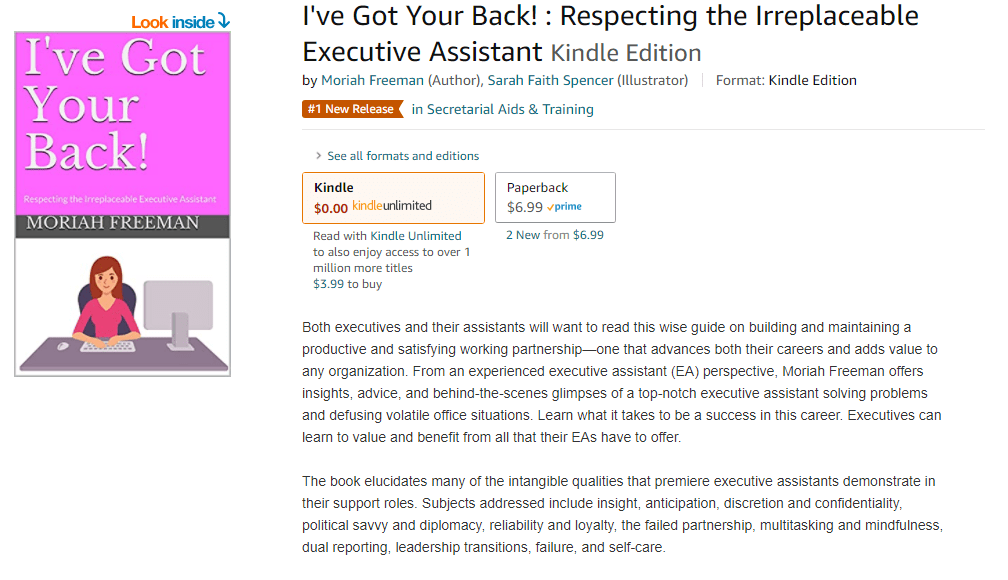
This series has now been published as a book entitled I’ve Got Your Back: Respecting the Irreplaceable Executive Assistant.  You can find it on Amazon.com at Amazon.com: I’ve Got Your Back! : Respecting the Irreplaceable Executive Assistant eBook: Freeman, Moriah, Spencer, Sarah Faith : Kindle Store