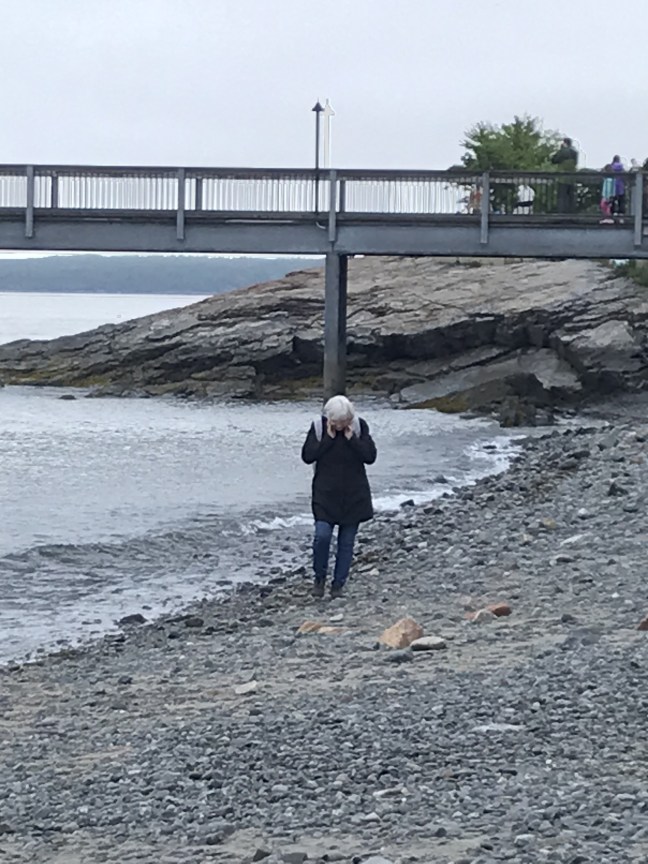
I’m sitting on the small beach in downtown Bar Harbor, Maine, on a cool, showery day in late June. My sister, Ann, visiting me from Nova Scotia, has just arrived on the CAT, the ferry between Bar Harbor and Yarmouth. We’ve walked the main street, popping in and out of shops, and are now killing a little time before having lunch at a nearby Italian Restaurant—she’ll tell anyone how much she loves pasta!
Ann saunters down the short stretch of rocky beach, eyes trained on the ground before her, searching for elusive beach glass and unusually shaped and colored beach stones. I’m wearing my navy Sketchers with white soles, and I don’t want to get them wet and dirty, so I have decided to sit still on a large stone at one end of the beach and wait for Ann to carry out her meticulous search.
A few feet away sit two fortyish women, also perched on large stones, chatting easily about summer clothing they have purchased or hope to purchase. A few children—I’m not paying attention—ranging in age from about eight to perhaps sixteen, wander back and forth from their mothers to the water’s edge. A teenage boy settles beside one of the women and sorts through the wet stones at his feet.
All this is happening within my peripheral vision. I’m staring off into space, focusing on my private thoughts, so I only half see what happens next in the twinkling of an eye. The teenager picks up a stone, large enough to fill the palm of his hand, and raises his arm to toss it into the water. He pulls his arm back, but instead of throwing forward, he loses his grip on the stone, and it flies sideways, out of his control.
I hear a crunch, like a finger poking through an eggshell, then a gasp and an “Oh my God!” I focus my attention on the group. One of the women clutches her head in her hands, bright red blood spreading through her quickly matting hair and dripping between her fingers. Her face is pink and blotchy, and she is rocking back and forth, gasping for breath.
“Mom! I’m so sorry. I’m sorry! Mom! Mom!” the boy pleads in a hushed but urgent voice. His mother doesn’t answer. She’s trying desperately to master the pain. The second woman and the children cluster; they whisper urgently to one another, asking what to do. The woman at the center of the circle is silent, rocking. I sit still, saying nothing, willing them to know what to do next. I’m tempted to pull out my phone and dial 911, but I wait. This is their crisis; let them handle it. I have no right to intrude, at least not yet.
“Can you walk? Let’s get you off the beach,” says the other mother. She and the boy lift the injured woman, holding her under one arm and by the other elbow, wrapping arms around her waist. She leans on them, and they slowly and jerkily shuffle toward the parking lot just a couple hundred yards away. As they trudge, the uninjured mother pulls her phone out of her bag, and I hear the beep, beep, beep of the dial tone.
I watch them go, then turn to see that Ann, oblivious to this scene, has almost completed her beachcombing and is ready for lunch. When she approaches, I tell her what’s happened, emphasizing the eerie sound of the stone connecting with the woman’s skull. We talk about how a day, and sometimes a life, can change in a moment—from a relaxed vacation at the seashore to a head injury that may have traumatic and lasting effects. As Ann and I leave the beach for the restaurant, the ambulance arrives, sirens wailing, lights flashing. That family’s day has changed irreversibly, without warning or intent, in the twinkling of an eye.
I cannot get this incident out of my mind for the rest of the day. I wonder how the woman feels, whether she is still in the emergency room or if the injury was serious enough to put her in ICU. Or was it just a minor cut, and she is already back at the B&B with her husband, family, and friends, sipping a cocktail before dinner?
That night I lay in bed before sleep, musing on life’s fragility, insecurity, and uncertainty even in the calmest and most seemingly benign situations. When we wake up each morning, we never know what the day will hold—celebration or grief, joy or tragedy, safety or danger, a new beginning, or a sudden end. I carry my reflections to the extreme, as I am wont to do, and imagine what it must have been like for Jews to wake up in the morning in Auschwitz, wondering if they would eat the usual wormy porridge, freeze while pointlessly hauling heavy rocks, or die in a shower of gas. Or would they see a smile from a fellow prisoner handing them a scrap of bread or hear the sound of the tramping boots of friendly soldiers opening the gates to deliver them from hell?
How do we live with such overwhelming uncertainty? We pretend that it doesn’t exist, that we know what to expect and what the future holds. We forget or do not allow ourselves to remember that circumstances, large or tiny, change in the twinkling of an eye.
After our recent trip to Italy, where my partner spent five days in the hospital with acute asthmatic bronchitis, I grumbled about the time and effort of filing the trip insurance claim to recover the extra medical, food, and accommodation costs. I slogged irritably through the tedious paperwork and bureaucracy, expecting it to drag on for many months. One morning, I determined I could no longer avoid filing what the instructions told me were the last pieces of information necessary to complete the claim. I logged on to the insurance website to do so, frustrated, bored, and tired of it all. Lo and behold, in the twinkling of an eye, my mood and my day changed. The claim status page announced that the company had mailed checks for nearly $1000 more than I had originally claimed. “Hallelujah!” I shouted. We never know, do we?
It’s a truism, and while we are tired of hearing it, the only way to live with uncertainty is to accept it and face it, moment by moment, trusting that we will have the inner and outer resources to meet whatever arises. Let’s not pretend, though, that the unpredictability and changeableness of life are not uncomfortable. Let’s be real. However, the more we try to resist the constantly changing nature of our existence, the more certainty and control we try to establish in our minds or circumstances, the more anxiety we bring to ourselves. The more expectations we entertain, the more disappointment, dread, and suffering we invite.
“Let go, accept, and surrender” are hard words to hear or say—challenging attitudes to adopt. But they, like all new habits, become easier with practice. Embracing life just as it is, moment by moment, can lead to the only security and confidence we will ever know in the face of our groundlessness. All occasions are opportunities for understanding and insight. There is a kernel of goodness at the heart of everyone and everything.
The only truth we can hold onto as things constantly change in the twinkling of an eye is the promise given to St. Julian of Norwich in the 14th century, “All shall be well, and all shall be well, and all manner of thing shall be well.”

 With All Due Respect