Okay: Part Two

Though I am categorizing this as a story, it is creative nonfiction — based on real events. Names have been changed to protect privacy. Each of us approaches and responds to death uniquely. I want to honor that particularity.

Over the last three years, I visited Sarah about every couple of months.  I’d call or email a day or so in advance, and we’d agree on a time in the early afternoon.  Sarah didn’t see well or move quickly, so I would ring the doorbell, peek in the window to see her sitting in her usual chair awaiting my arrival, and then I’d open the unlocked door and announce myself.  “It’s Moriah.”

“Come in, come in.” 

I’d settle in the chair opposite her, and she’d ask how I was.  I’d tell her exactly what was on my mind at that moment, no matter how personal or difficult it was to admit or express.  Her head shook, and her voice quavered more and more as the months passed, but I listened closely to every word she said in response. I had come to rely on her utter sincerity and genuine concern. I was convinced Sarah, who had only recently become my friend, understood and cared deeply about me.  When I was finished opening my heart, I’d ask about her, and she would tell me—honestly but without drama—the health problems and every day difficulties she was experiencing; not in a complaining fashion, but matter-of-factly, always ending with gratefulness for the simple gifts in her life that brought her happiness.

I learned that Sarah was a Buddhist of Tibetan lineage and that she meditated regularly.  I meditate too, so that created a bond between us.  She told me about her teacher and some of the practices she had learned.  She joined me several times to meditate with a local mindfulness group. She always asked me about my writing and insisted on buying my novel when it was published.  I don’t know if she was able to get someone to read it to her. Her near blindness prevented her from doing so herself.

Sarah was so quiet and undemanding that people may have forgotten she lived in the neighborhood.  She would tell me she felt lonely and she was hungry for news about the neighbors and the goings-on in our retirement community.

She found workarounds for her limitations, though.  A personal assistant helped her with email, bill-paying, and the ubiquitous paperwork that inundates us all. Her daughter, Riley, came every evening to have dinner with her and help with anything that Sarah could not do on her own.

About a month ago, we noticed more traffic in and out of Sarah’s driveway. Riley began coming during the day, as well as in the evenings. Then she started staying overnight also.  I stopped in for a short visit to learn that Sarah was on hospice and declining rapidly.  Riley led me to Sarah’s room, where she was stretched out in a recliner with a cool cloth on her forehead.  She clasped my hand, told me how much I meant to her, and thanked me for our friendship.  She knew her time was short and was ready for death. We were both aware that this was, perhaps, goodbye. 

But it was not. She lived for another week or so, and I saw her a few more times.  The last one was the evening of her death. She was unconscious, breathing very lightly and gently.  While her daughter took a short break, I played a Buddhist chant, hoping that Sarah could hear and understand the reassuring words.  In the early morning, while I slept, a text came in that she was gone.  I saw it as soon as I awoke and rushed to her house in my pajamas to see her one last time, standing by her bed, kissing her smooth forehead and gazing at her peaceful face.

After that, Riley came and went from the house, handling the tasks one does after death: taking care of property, family, and financial matters with the help of Sarah’s personal assistant.  When I was finally able to catch her alone one evening, just before Christmas, she showed me the memorial altar she had lovingly and sensitively created around Sarah’s colorful tree. In the center sat her urn, carved with a Tree of Life.  Surrounding it were photographs and mementos from her life, several that I recognized, and one, a Buddha card I had given her a while back.  The altar was characteristically Sarah—unpretentious and beautiful. 

Sarah told me she was okay after Joe’s death, and I am okay after hers.  Each morning for the forty-nine days of her journey through the bardo or transitional state, I am ringing a bell and saying this gatha in her honor: “Body speech and mind in perfect oneness, I send my heart along with the sound of this bell.  May all who hear it (especially Sarah) be awakened from forgetfulness and transcend all anxiety and sorrow.”  Because everything is impermanent, I am letting Sarah go, along with the bell’s vibrations, into the universe on her journey home to the Source of Life.

The End

What Now?

With All Due Respect has never been, nor is it about to become, a forum for expressing political opinion, mine or anyone else’s. However, I don’t feel I can overlook the outcome of the 2024 election at this web address. Its effects are too far-reaching to ignore completely. The people of the USA have elected a president who aspires to become an autocrat, a person ruling with unlimited authority. (Merriam-Webster Dictionary.)

I am bewildered by this outcome and have spent considerable time and mental effort in the last three weeks trying to understand how and why it occurred, though my gut always told me it was a strong possibility. I’ve listened to the various theories apportioning blame to politicians, political parties, educational elites, globalism, immigrants, and the “woke” culture, but I’m still baffled. I’m entertaining the possibility that I might never understand.

I’ve spent early morning meditation sessions asking myself what this new reality in America might require of me, a white woman, moderately well-educated, of the middle class (with working-class origins), a 72-year-old lesbian living in the relatively liberal southern part of the conservative state of Maine. Oh, and I also identify as a former Episcopal nun, now a practicing Buddhist-cum-Taoist.

I’m looking for an anchor to help me move forward into the unknown, changing, uncontrollable, undoubtedly challenging future. I want to do so with integrity, courage, and hope, but frankly, I’d just like to know how to put one foot in front of the other and not make a mess of things.

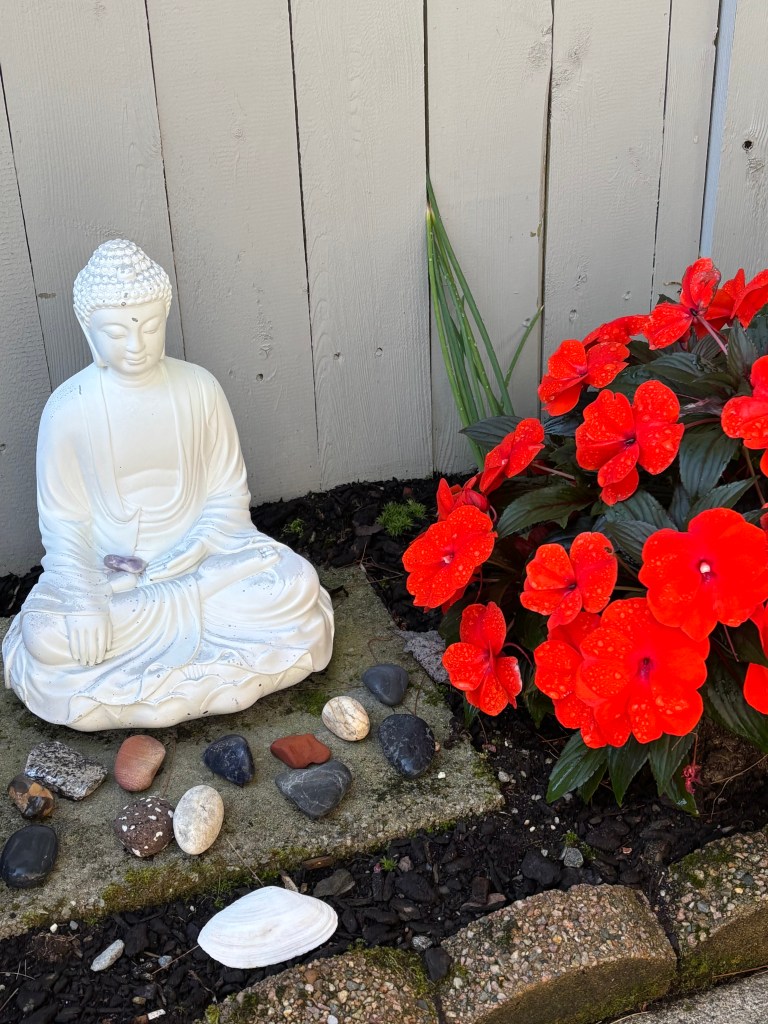
For the last two years, I have done the same thing each morning when I get out of bed. At home, this ritual is preceded by feeding my dog and two cats, making tea, and turning on my heating pad. I then stand before my stone statue of the Buddha and sound my singing bowl three times, sending delicately beautiful vibrations out into the universe, my way of greeting the new day. Next, I light three tea lights (no live flames allowed in my retirement housing) and recite three commitments for the day. 

When I am away from home, my routine gets simplified. I just call the intentions to mind:

  • Do no harm
  • Help others
  • Embrace the world just as it is, using everything as a means for further awakening.

Invariably, as I turn to walk across the room to my meditation seat, I become aware of some fresh insight, a spring of hope, or a surge of encouragement. I developed this daily practice after reading the Buddhist nun Pema Chödrön’s book, Living Beautifully With Uncertainty and Change. The book expounds Tibetan Buddhism’s Three Vows or Three Commitments. According to Chödrön, they are “methods for embracing the chaotic, unstable, dynamic, challenging nature of our situation…”

Sound like our situation? Yours and mine?

Recalling these commitments at the beginning of the day for the last nearly eight hundred days has provided a much-needed anchor amidst the exigencies of my life. On many mornings, they have pierced the prison of my limited perspective and illuminated a path forward when I have felt trapped, confused, misunderstood, vulnerable, tired, and scared—pretty much how I have felt ever since November 5, 2024.

The first vow or commitment is to do no harm in thought, words, or actions. I think of it as the refraining vow. If I can’t figure out how to think, say, or do good, helpful things, can I at least refrain from doing anything? After years of practice, I’m getting a little better at sometimes shutting my mouth and doing nothing. The thought thing is still beyond my reach.

The next vow is to help others. This one can be problematic for me, a compulsive caregiver, intervener, and do-gooder. I add the words “if you can” to the vow. It’s what’s known as the “Bodhisattva Vow,” the orientation towards opening our hearts in compassion for everyone to relieve suffering in the world.

The final commitment is to embrace life just as it is, using everything that happens to wake up and become more self-aware. This is the most fruitful of the vows for me. Sitting across from the three flickering candles in the early morning darkness, I often ask myself, “What does this situation weighing so heavily on my heart and mind have to teach me about myself? How can I see the truth about myself and respond with self-compassion, the will to change, and the patience to start anew?”

So, back to my original questions, “What now? What might this new reality, the second presidency of Donald Trump, require of me?” After lighting the candles and reciting the three commitments this morning, I made a list: respect, simplicity, moderation, generosity, truth, courage, kindness, and resilience. I’m confident I will add more qualities as the new reality dawns. Or is it new? Will it require anything that every day of my 72 years has not already called for?

  • Do no harm.
  • Help everyone.
  • Embrace life just as it is.