What Now? Reprise

It’s been over a month since I posted here and over two since I wrote the first “What Now?” article. Honestly, I don’t know what to think or say about anything these days. I’m tongue-tied. That’s as it should be, counsels the Tao te Ching: “Those who know, don’t talk. Those who talk, don’t know.”

Each morning, sometimes before and sometimes just after my meditation time, I read Heather Cox Richardson’s daily newsletter, Letters from an American. I choose to follow her rather than some other news commentator because I like her framing of current events in the context of history, and she’s a Mainer from near my home. Her newsletter and listening to the occasional few minutes of NPR while driving are my meager attempts at awareness of significant events in our country and the world. Like many of my friends, I feel a responsibility to be aware but cannot cope with more intense and in-depth exposure to the news. It is too depressing, frightening, and immobilizing.

As I’ve grown older, I’ve identified and clung to specific anchors that steady me in times of turmoil like this one—help me rise and fall with the tides but keep me from drifting in rough currents. Some anchors are rituals or repetitive practices that calm and focus me. Some are objects or words that inspire or guide me. I’m always looking for symbols that help me make meaning and keep me steady. 
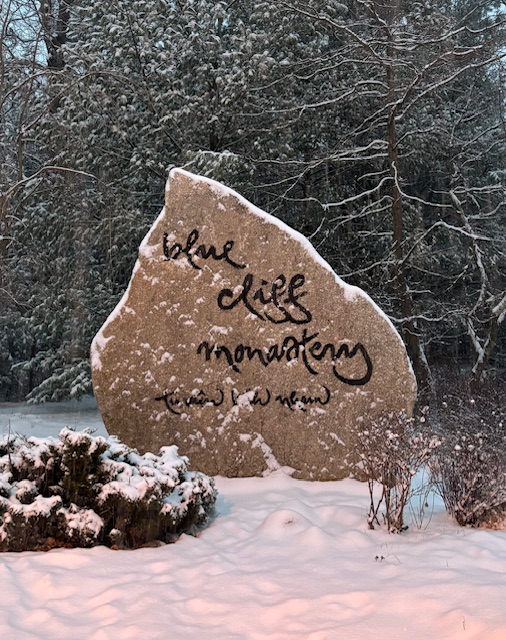
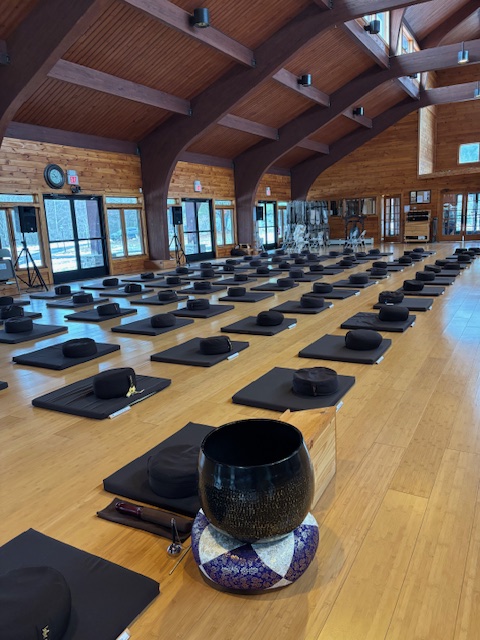
A few weekends ago, I visited Blue Cliff, a Vietnamese Buddhist Monastery in upstate New York. The monks and nuns who live there practice the Thich Nhat Hanh Buddhist tradition. That weekend, they were celebrating the third anniversary of his death, or “continuation” as they call it. Besides a few American Buddhists from Maine, Vermont, and elsewhere, dozens of Vietnamese Americans from the New York-New Jersey area came to meditate, chant, hear Buddhist teachings, and eat delicious Vietnamese food. I was fascinated by the rituals and chanting, curious about the customs, and delighted by the food. It wasn’t the sort of silent, secluded retreat I typically seek or enjoy, but it had a simplicity, pageantry, and wisdom that moved me deeply.
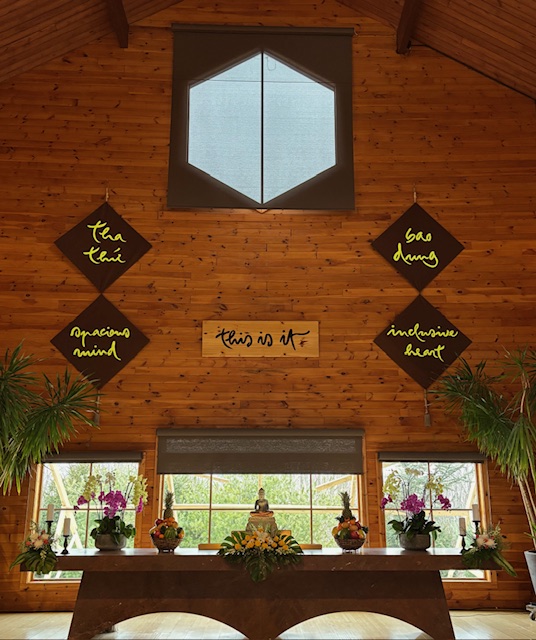
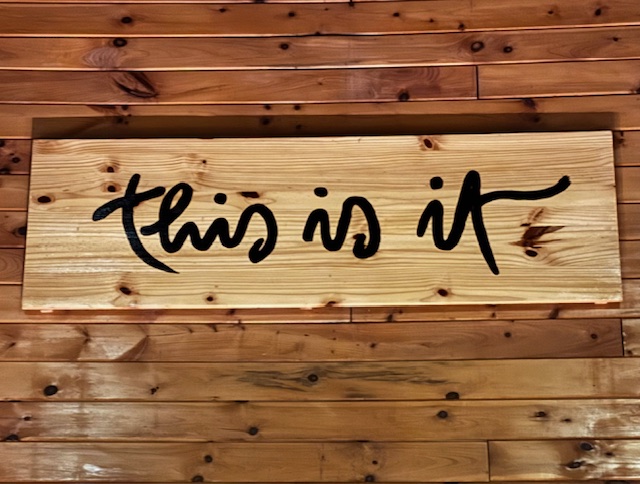
One of the most potent takeaway images from the weekend was this wooden calligraphy panel that focused the eyes immediately upon entering their exquisitely designed meditation hall.

I was awestruck the moment I saw it—so profoundly true and precisely the message I needed to receive, an anchor I could cling to. This Is It. This moment, this place, this situation, this country, this world—this is all there is. So, stop wishing for this to end, for something else to come, to be somewhere else, to be rescued from this current calamity. This is it—the only thing you have to work with, the only reality, your only opportunity. So, embrace it, celebrate it even. Open your eyes, ears, and heart, let the right action arise within you and proceed from you, and let go of the burden of the outcome. This is it. Nothing more, nothing less, nothing other.
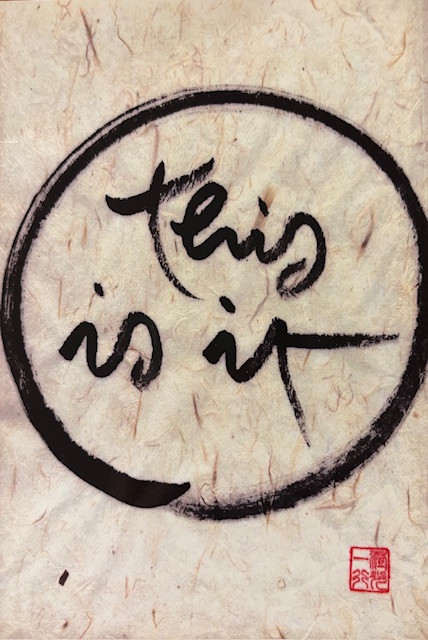
For an hour on Sunday afternoon, their gift shop was open for guests to browse and shop. I went looking for a token of the message I had received and found this simple postcard in Thich Nhat Hanh’s calligraphy. I purchased it and brought it home to place in the window opposite my meditation seat so, as candles flicker beneath it and the sun rises behind it each morning, I can look at it and beyond it to what is outside my window.  

This Is It—the only time and place I have. I am surrounded by the only people I can respect and love. This is the only moment when I can recognize beauty, speak the truth, be kind, and do justice.
Cherished Outcomes

If you want to accord with the Tao,

Just do your job, then let go.

The Tao Te Ching, translated by Stephen Mitchell

I’m a planner, but I’m not naïve enough to think that meticulously planning something will make it turn out exactly how I want it to. Decades of experience have taught me that control is an illusion—a dear one. Still, planning is in my bones, and I might as well embrace it as part of who I am. Planning, like everything, has its shadow side and its bright side. The shadow side is about clinging—to outcomes. The bright side is about creativity, fruition, and letting go.

Giving myself fully and genuinely to a task or project without getting attached to the final product is one of my biggest challenges. How does one go all-in on something without being wedded to the result? I care; therefore, I plan. I do everything possible to ensure the desired outcome has its best chance.

I’m talking about passion—giving everything you’ve got, then offering your beloved creation to the world and letting go. Huge risk, right? Like nursing an injured baby seal that has beached itself. You painstakingly feed it, protect it, and watch it regain its strength, then set it free with absolutely no expectation that you will ever see it again or faith that it will survive beyond your sightline as it heads out into the deep. Or, like a parent raising a child, I imagine, since I have never raised one.

A friend of mine advocates “holding things lightly,” meaning, I think, that caring passionately and relinquishing control are both essential to being fully alive. It is possible to be committed to an outcome and hold it lightly, ready to let it go. Challenging but possible.

Scientists tell us we are hard-wired for planning. Research has shown that some areas of the brain, known as the default mode network, carry out this planning function. They

become active when our attention is not occupied with a task. These systems function in the background of consciousness, envisaging futures compatible with our needs and desires and planning how those might be brought about….Human brains have evolved to do this automatically; planning for scarcity and other threats is important to ensure survival….Our background thinking is essential to operating in the world. It is sometimes the origin of our most creative images.”  Why we are hard-wired to worry, and what we can do to calm down (theconversation.com)

So, we will plan no matter what, and sometimes planning, when unhooked from worry, can be a very creative and valuable form of flow state. If I am going to plan, I want to give it my very best effort. I want the idea and the plan for its execution to be as detailed as possible, take as many contingencies as conceivable into account, and be thoroughly tested, broadly vetted, and profoundly considered. I want to be wholly absorbed, plan passionately, launch my plan confidently and enthusiastically, and then let go of the outcome!

Why? Because no matter the outcome, whatever happens—success, disaster, or somewhere in between—is an opportunity for learning, growing, transforming, and embracing reality just as it is.

Sometimes, when I meditate, my mind is pulled toward a problem that captivates me or a situation that needs resolution. I try to turn away from the flow of thoughts and return focus to my breathing once, twice, three or more times. Finally, I will sigh and let my mind have its way, go with the flow. Sometimes, the most fitting solutions emerge from giving my default mode network free reign. I’ve learned, though, not to act on these plans immediately but to let them mull and mature for a while and to be willing to let go of them, to change my mind.

During my 71 years, life has required me to let go of hundreds of cherished outcomes for multiple carefully laid plans. It’s gotten easier as I’ve begun to notice a pattern of unexpected gains amid losses, of auspicious signs amid clouds of disappointment. Gradually, I’ve become more curious about than afraid of the unknown final outcome of life—my life.

This past week, the Christian Church celebrated Ash Wednesday, the day of the year when we look death straight in the eye and remember that we all came from dust and will ultimately return to it. “Remember that you are dust, and to dust you shall return.” One of the ministers at the Episcopal Church in my town told me that some clergy are now reciting the words, “Remember that you are stardust, and to stardust you shall return,” when they imprint the sign of a cross in ashes on their members’ foreheads. The words point to our smallness and our greatness and are a sparkling reminder that we have always been and will always be part of the immense universe. How I cherish that outcome!