What Now? Reprise

It’s been over a month since I posted here and over two since I wrote the first “What Now?” article. Honestly, I don’t know what to think or say about anything these days. I’m tongue-tied. That’s as it should be, counsels the Tao te Ching: “Those who know, don’t talk. Those who talk, don’t know.”

Each morning, sometimes before and sometimes just after my meditation time, I read Heather Cox Richardson’s daily newsletter, Letters from an American. I choose to follow her rather than some other news commentator because I like her framing of current events in the context of history, and she’s a Mainer from near my home. Her newsletter and listening to the occasional few minutes of NPR while driving are my meager attempts at awareness of significant events in our country and the world. Like many of my friends, I feel a responsibility to be aware but cannot cope with more intense and in-depth exposure to the news. It is too depressing, frightening, and immobilizing.

As I’ve grown older, I’ve identified and clung to specific anchors that steady me in times of turmoil like this one—help me rise and fall with the tides but keep me from drifting in rough currents. Some anchors are rituals or repetitive practices that calm and focus me. Some are objects or words that inspire or guide me. I’m always looking for symbols that help me make meaning and keep me steady. 
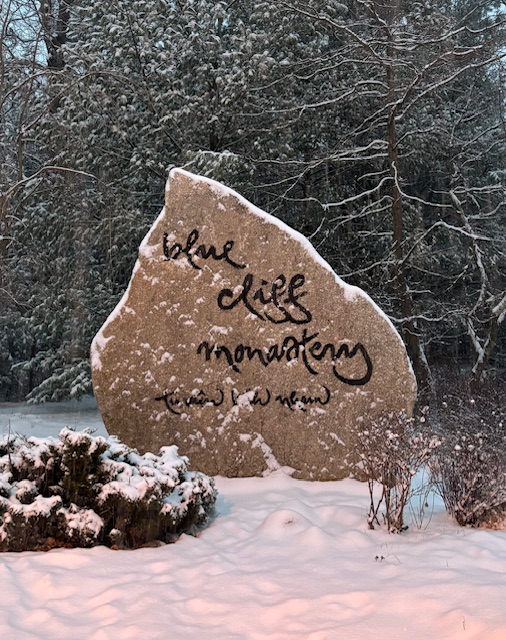
A few weekends ago, I visited Blue Cliff, a Vietnamese Buddhist Monastery in upstate New York. The monks and nuns who live there practice the Thich Nhat Hanh Buddhist tradition. That weekend, they were celebrating the third anniversary of his death, or “continuation” as they call it. Besides a few American Buddhists from Maine, Vermont, and elsewhere, dozens of Vietnamese Americans from the New York-New Jersey area came to meditate, chant, hear Buddhist teachings, and eat delicious Vietnamese food. I was fascinated by the rituals and chanting, curious about the customs, and delighted by the food. It wasn’t the sort of silent, secluded retreat I typically seek or enjoy, but it had a simplicity, pageantry, and wisdom that moved me deeply.
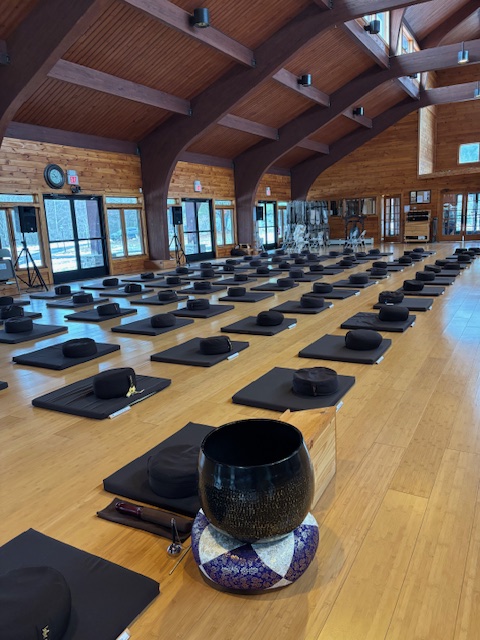
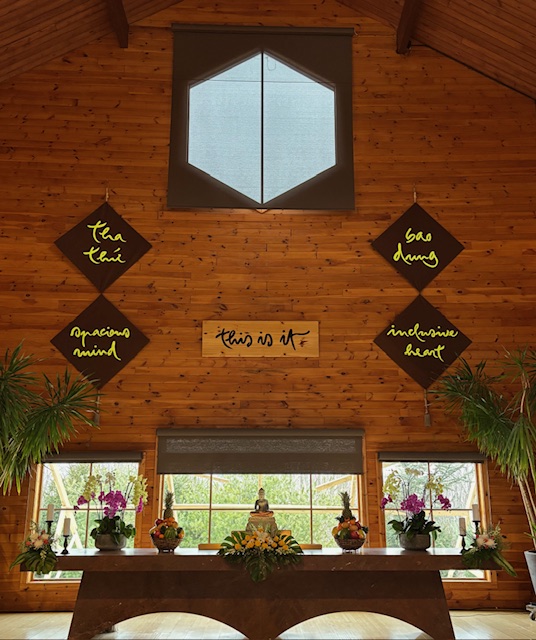
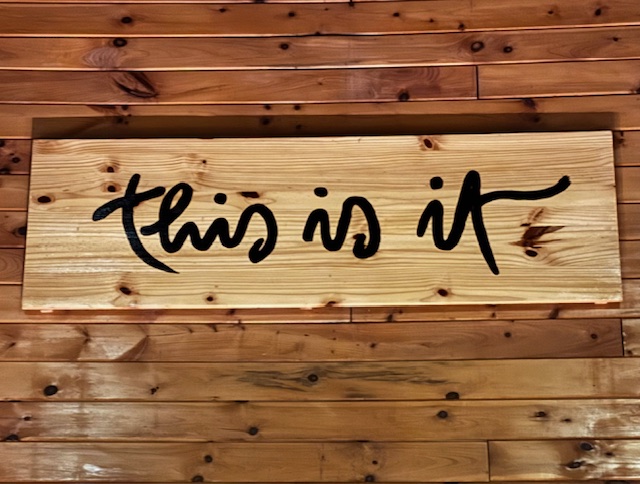
One of the most potent takeaway images from the weekend was this wooden calligraphy panel that focused the eyes immediately upon entering their exquisitely designed meditation hall.

I was awestruck the moment I saw it—so profoundly true and precisely the message I needed to receive, an anchor I could cling to. This Is It. This moment, this place, this situation, this country, this world—this is all there is. So, stop wishing for this to end, for something else to come, to be somewhere else, to be rescued from this current calamity. This is it—the only thing you have to work with, the only reality, your only opportunity. So, embrace it, celebrate it even. Open your eyes, ears, and heart, let the right action arise within you and proceed from you, and let go of the burden of the outcome. This is it. Nothing more, nothing less, nothing other.
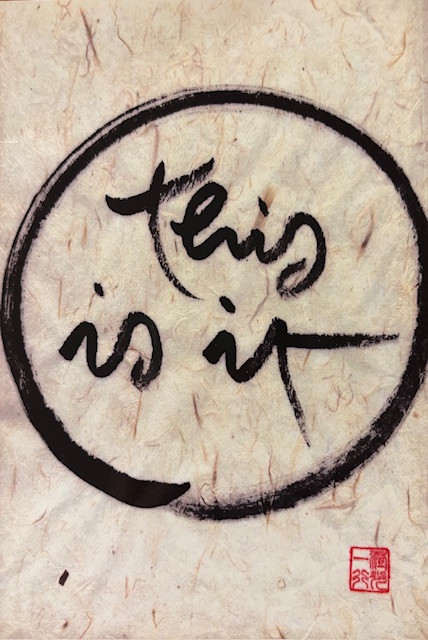
For an hour on Sunday afternoon, their gift shop was open for guests to browse and shop. I went looking for a token of the message I had received and found this simple postcard in Thich Nhat Hanh’s calligraphy. I purchased it and brought it home to place in the window opposite my meditation seat so, as candles flicker beneath it and the sun rises behind it each morning, I can look at it and beyond it to what is outside my window.  

This Is It—the only time and place I have. I am surrounded by the only people I can respect and love. This is the only moment when I can recognize beauty, speak the truth, be kind, and do justice.
What Now?

With All Due Respect has never been, nor is it about to become, a forum for expressing political opinion, mine or anyone else’s. However, I don’t feel I can overlook the outcome of the 2024 election at this web address. Its effects are too far-reaching to ignore completely. The people of the USA have elected a president who aspires to become an autocrat, a person ruling with unlimited authority. (Merriam-Webster Dictionary.)

I am bewildered by this outcome and have spent considerable time and mental effort in the last three weeks trying to understand how and why it occurred, though my gut always told me it was a strong possibility. I’ve listened to the various theories apportioning blame to politicians, political parties, educational elites, globalism, immigrants, and the “woke” culture, but I’m still baffled. I’m entertaining the possibility that I might never understand.

I’ve spent early morning meditation sessions asking myself what this new reality in America might require of me, a white woman, moderately well-educated, of the middle class (with working-class origins), a 72-year-old lesbian living in the relatively liberal southern part of the conservative state of Maine. Oh, and I also identify as a former Episcopal nun, now a practicing Buddhist-cum-Taoist.

I’m looking for an anchor to help me move forward into the unknown, changing, uncontrollable, undoubtedly challenging future. I want to do so with integrity, courage, and hope, but frankly, I’d just like to know how to put one foot in front of the other and not make a mess of things.

For the last two years, I have done the same thing each morning when I get out of bed. At home, this ritual is preceded by feeding my dog and two cats, making tea, and turning on my heating pad. I then stand before my stone statue of the Buddha and sound my singing bowl three times, sending delicately beautiful vibrations out into the universe, my way of greeting the new day. Next, I light three tea lights (no live flames allowed in my retirement housing) and recite three commitments for the day. 

When I am away from home, my routine gets simplified. I just call the intentions to mind:

  • Do no harm
  • Help others
  • Embrace the world just as it is, using everything as a means for further awakening.

Invariably, as I turn to walk across the room to my meditation seat, I become aware of some fresh insight, a spring of hope, or a surge of encouragement. I developed this daily practice after reading the Buddhist nun Pema Chödrön’s book, Living Beautifully With Uncertainty and Change. The book expounds Tibetan Buddhism’s Three Vows or Three Commitments. According to Chödrön, they are “methods for embracing the chaotic, unstable, dynamic, challenging nature of our situation…”

Sound like our situation? Yours and mine?

Recalling these commitments at the beginning of the day for the last nearly eight hundred days has provided a much-needed anchor amidst the exigencies of my life. On many mornings, they have pierced the prison of my limited perspective and illuminated a path forward when I have felt trapped, confused, misunderstood, vulnerable, tired, and scared—pretty much how I have felt ever since November 5, 2024.

The first vow or commitment is to do no harm in thought, words, or actions. I think of it as the refraining vow. If I can’t figure out how to think, say, or do good, helpful things, can I at least refrain from doing anything? After years of practice, I’m getting a little better at sometimes shutting my mouth and doing nothing. The thought thing is still beyond my reach.

The next vow is to help others. This one can be problematic for me, a compulsive caregiver, intervener, and do-gooder. I add the words “if you can” to the vow. It’s what’s known as the “Bodhisattva Vow,” the orientation towards opening our hearts in compassion for everyone to relieve suffering in the world.

The final commitment is to embrace life just as it is, using everything that happens to wake up and become more self-aware. This is the most fruitful of the vows for me. Sitting across from the three flickering candles in the early morning darkness, I often ask myself, “What does this situation weighing so heavily on my heart and mind have to teach me about myself? How can I see the truth about myself and respond with self-compassion, the will to change, and the patience to start anew?”

So, back to my original questions, “What now? What might this new reality, the second presidency of Donald Trump, require of me?” After lighting the candles and reciting the three commitments this morning, I made a list: respect, simplicity, moderation, generosity, truth, courage, kindness, and resilience. I’m confident I will add more qualities as the new reality dawns. Or is it new? Will it require anything that every day of my 72 years has not already called for?

  • Do no harm.
  • Help everyone.
  • Embrace life just as it is.