
Tea Bag Wisdom – Self Respect

I drink Yogi Tea every morning, first thing, right after I feed the animals and take the dog out for his first sniff and tinkle of the day. Just after I ring my meditation bell, turn on three tea lights in front of my Buddha statue, and sink into my seat on the couch, facing the window overlooking our garden. I take a sip of Yogi tea, a deep breath, set my timer for twenty minutes, and come home to myself.

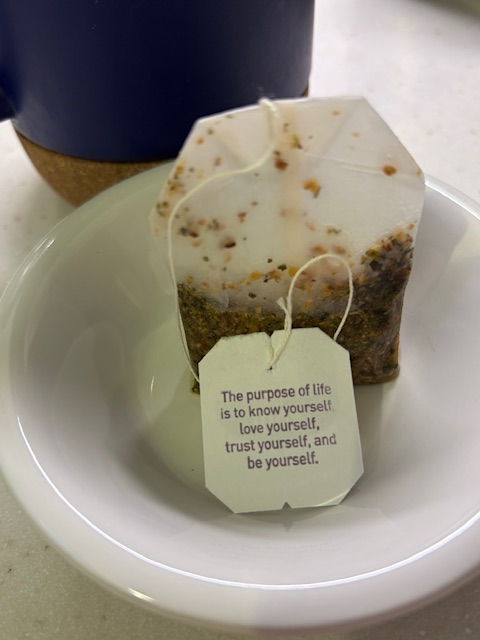
The other morning, as the cats were chowing down and my electric kettle was bubbling, I opened a new tea pouch and pulled out a fresh bag of ginger tea. As I unwound the paper tag attached to the bag by a thin thread, I was astounded to see this message: “The purpose of life is to know yourself, love yourself, trust yourself, and be yourself.”

I’m fond of the word ‘gobsmacked,’ which is British slang for being astonished. I was gobsmacked that the universe had sent me such a message, first thing on a July morning in the politically, socially, and personally turbulent summer of 2025. Right away, I knew it was a message that needed some unpacking, so I settled into my meditation posture—the dog tight to my left thigh, the Maine Coon cat spread across my lap. The black and white cat was, of course, doing his aloof morning meditation on chipmunks, squirrels, and birds at the screen door that opens onto the patio. I took a sip of ginger tea and began.

Know yourself. No problem for me, the most introspective creature on-the-planet, as my friend Bruce would say. Self-examination is my middle name, has been since birth, for good or ill. For most of my life, self-examination has meant self-critique. I have a more than passing familiarity with all my faults, bad habits, propensities, temptations, mistakes, and the karma that results from them. However, genuine self-knowledge or self-awareness has only emerged in later life as I learned to meditate and look deeply at the roots of my motivations—my fears, attractions, and repulsions. That self-awareness, though more true, is also softer, as I’ve allowed self-compassion to touch and soothe the wounds uncovered by my x-ray inner eye. It felt good to have my ingrained habit of self-reflection validated as part of life’s purpose by the Yogi Tea Messenger. Part of myself is okay. Phew! That’s a relief!

Love yourself. My stomach twisted in a knot, and I knew this was not going to be an easy one to delve into. I make this deeply personal revelation only because I suspect there may be a few of you out there who share my experience, and I want you to know that you are not alone. Since early childhood, I have sensed that I am, at my core, a flawed person. There is something wrong with me that makes me do bad things, or, at least, fear that I will do bad things. I think this sense may have come from my mother, and I am certain my Baptist upbringing with its emphasis on original sin reinforced it. I long ago forgave my mother, but I will never forgive St. Paul and the Christian Church for instilling the hideous notion that I was born full of sin. Buddhism, which I’ve gravitated towards in recent years, teaches that we each contain both good and harmful seeds in our store consciousness and can learn to nurture the former rather than the latter.

But let’s not get too theoretical here. Loving myself is challenging! And I don’t believe I am alone with this challenge. Understanding what self-love is and how to practice it will take me the rest of my life and then some, and I’m getting a very late start. But, while breathing evenly and gently as the ten-minute meditation bell chimed, I remembered the self-compassion I congratulated myself on developing as I’ve aged. Let’s start there, add a little self-forgiveness, tenderness, thanksgiving—whatever else might water those tiny seeds of goodness the universe has planted in me. I recalled my connection to all the beauty around me and recognized that I am made of the same stuff. Soon, I thought, I may have enough confidence in my basic goodness to…

Trust myself! Again, the passage of time, also called aging, is of some help here. It teaches lessons of humility but also repeatedly validates my intuition, my gut, or bodily intelligence. As I’ve looked back over my life, I’ve seen instances where I had a premonition, an insight, or an inner sense about the reality of a situation, the right course of action, or an action to avoid. Sometimes I heeded the hint, and other times I ignored the impulse.   But time and again, what my body intuited was revealed as events unfolded. I pay more attention to my un-rational intelligence these days. The more self-aware I am, the more I accept and love myself, the more I can trust myself to make the right choices, the life-giving, kind, and just ones. And I understand these three—self-awareness, self-love, and self-trust as inextricably linked, forming the foundation on which I can…

Be myself. What a sense of relief and ease washed over me as I entered the home stretch of that morning’s meditation. I paid attention to my body, as I set my imagination free to envision what it might be like to be who I truly am, instead of who I or others expect me to be. I noticed a sense of effortlessness. Straining and striving melted away, replaced by an unhurried settledness. A pervasive feeling of well-being and wholeness refreshed my tired mind and body. Yet, on the horizon, I saw the tremendous responsibility of freedom dawning, and I experienced a charge of fear, like a tiny electric shock—joy and sadness, pain and pleasure co-arising and interdependent.

The meditation bell chimed three times, signaling the end of twenty minutes. I breathed out, letting go, and lingered for a few moments longer in the silence and stillness. Then I lifted my cup and took a long, full gulp of still-warm tea while reciting the Tea Messenger’s morning wisdom one more time: “The purpose of life is to know yourself, love yourself, trust yourself, and be yourself.”

Noticing Respect in 2022

“Is treating someone respectfully fundamentally different from respecting him, her, or it?”

I posed this question in my first blog post in 2022, and I return to it in my last. (Though technically, it’s 2023 already, today is New Year’s Day Observed on the iPhone calendar.)

In the last year, I have reflected on, written about, and invited your comments on various instances of respect—situations I have encountered in daily life that have caused me to examine the meaning of respect more closely. For example, I wrote about respecting others through an open, honest, invitational style of communication embraced by Maine’s CDC Director, Dr. Nirav Shah, as he interacted with the people of our state during the height of the COVID pandemic.

I shared the “Just Like Me” practice of recognizing that everyone, even those whose ideas and actions are sometimes antithetical to our own, has many of the same human attributes, desires, hopes, fears, sorrows, and losses as we do. This practice encourages points of identification to generate empathy and nurture even the tiniest grain of respect. In “Respect Amid Conflict,” I wrote about two principles crucial to navigating conflict respectfully: understanding oneself and seeking to understand the other, ferreting out one’s deepest motivations and underlying assumptions, and keeping an open heart and mind about the experience and perspective of the other.

In “Respect in Extremis,” I reflected on respecting the essence of a human being when accomplishments, attractiveness, and self-control are stripped away at the end of life. In the article titled “What Is,” I illustrated the habit of noticing and accepting the ordinary miracle of each moment, welcoming and flowing with it instead of resisting and wishing things were different. In “Two Tales About Respect,” I explored how experiencing disrespect from another may tap into our lack of self-respect. I also exemplified how inner doubt and confusion about the right thing to do in a situation can cause one to act disrespectfully toward others.

The three posts about my friends Jack and Vicky dealt in depth with their experience of years of homelessness, followed by a brief period of stable housing, Vicky’s severe illness, and ultimately their deaths within two weeks of each other. The articles, telling the story of our friendship, were my memorial gift to honor them. Their backgrounds and life experience and mine were dramatically different, yet we came to understand, respect, and love one another.   And finally, “Respecting Limitations and Letting Go.” Recognizing and accepting our limitations and those of others is a lesson we must all learn as we grow older. Learning to let go when the time is right will prepare us for the end of life when we must ultimately let go of everything.

So, back to the original question: “Is treating someone respectfully fundamentally different from respecting him, her, or it?” I’m currently living in a divisive atmosphere. There are many perspectives on the problem we share, but for clarity, I think I can safely say that two slightly porous camps have emerged. Each wants respect from the other. Each desires to be heard, understood, honored and treated kindly and politely. Trust has been damaged, and respect is frayed and floundering. 

But can we treat each other respectfully, even if each camp has done and said things that have damaged the esteem we formerly felt for one another? And would respectful words and actions move us toward restoring genuine respect? Would they help us navigate this situation, repair the divisions, and solve the problems? 

And what would treating each other with respect look like, even if we are not feeling it? We could begin with the old gem, “Do unto others as you would have them do unto you.” That might include giving everyone the benefit of the doubt, not presuming to understand all the complicated nuances of the situation or the difficulties others face. Listen and communicate. Recognize defensiveness in yourself, but don’t act out. Don’t say hurtful things, be gentle, and practice courtesy. Don’t avoid one another (downcast eyes, looking away) but take risks to build genuine relationships. Listen; communicate. Keep things in perspective by remembering to be grateful. Notice the good and speak up about it. Keep working at the solution, don’t give up or bail. Listen and communicate directly, face-to-face, and eye-to-eye. Behave respectfully, and you may earn respect.

So, I would posit that treating someone respectfully is not fundamentally different from respecting that person. Famously it is said you can’t make peace; you have to be peace. You can’t create respect; you have to be respect.

Two Tales About Respect

One – Self-Respect

I’m trying to help someone hard of hearing fill a prescription for her asthma inhaler. First, I call the pharmacy to see if the refill order we submitted several days ago has been filled. The pharmacist tells me the inhaler is ready for pick up, so I send S off to the pharmacy to get it. She returns and says that the inhaler costs $50 more than it did the last time she refilled it; insurance has refused to pay for it, and the pharmacist recommends calling the insurance company. I sigh because this has happened before, and sorting it out has not gone smoothly, but I make the call.

The customer service representative tells me that, oddly enough, for this script, the brand inhaler is less expensive ($50) than the generic, and the doctor has ordered the generic, which costs $100. Still, he says, there should be no problem because he can see on S’s record that the pharmacy placed a claim yesterday for $50 for the brand inhaler. So why I ask, is the pharmacy now trying to charge $100? He says he doesn’t know; I should call the pharmacy back.

I do. The pharmacist says the insurance company is wrong; the doctor prescribed the $100 generic, but the patient refused to accept it, so they canceled the order. The calm tone in my voice deteriorates, and its pitch rises. I am frustrated. The insurance company is saying one thing, the pharmacy another. I try again to explain what the insurance agent has said and ask the pharmacist why a claim was made yesterday for $50. The pharmacist denies this. Why can’t they just give us the brand version, I ask. The pharmacist repeats, slowly, as if talking to a child, that she can do nothing more to help except call the doctor’s office on our behalf, or I can call instead. I ask her to stop and listen to me. I say I’m not stupid, and she responds that she didn’t say I was stupid. I counter, “You are talking to me like I am stupid.” Suddenly, a light goes off in my head, flashing neon red – DISRESPECT! 

Now I am angry. I snap at the pharmacist, “Never mind. I will call the doctor’s office and sort this out myself.” We hang up, and I do so. I try to explain calmly to the medical assistant that I’m frustrated and need to talk directly to a human being about a prescription refill—no voicemail, no leaving a message. This is an emergency. The patient has asthma and needs her inhaler right away. I explain the cost differential between brand and generic. The assistant gets it, takes the matter in hand, puts me on hold for a couple of minutes, then returns to say it’s all set. They have sent a script for the brand inhaler to the pharmacy. I hang up and feel relieved. Then S comes to me holding her phone, which transcribes voicemails into texts. She shows me a text from the pharmacy, received while I was on the phone with the doctor’s office, saying they have sorted everything out, re-run the prescription for the brand version, and it’s ready for pick up. No apology and no recognition that there had been any previous confusion. “OMG! Why didn’t they do that in the first place?” I scream.

Later, I reflect on this incident. First, I am embarrassed and ashamed of my childish and rude behavior toward the pharmacist. Second, I realize that the moment I felt disrespected, my controlled frustration turned into boiling anger. Then I ask myself why feeling disrespected disturbs me so much. Suddenly I have a flash of insight; someone else’s disrespectful treatment triggers my lack of respect for myself—my deep-rooted sense that I am stupid, inadequate, and unacceptable. So, besides working on breathing and calming down when disrespect provokes anger, I must also work on respecting myself. And that is a really tall order! But, if I can do that, perhaps it will help me genuinely respect the others I encounter in pharmacies, doctor’s offices, insurance companies, and everywhere. 

Does this ring a bell, touch a nerve, or resonate with you?

Two – Other Respect

It’s 11:00 a.m. on a hot summer day. I pull into the parking lot of a memory care facility where I am visiting a patient. When I exit my car, I notice a small dog in the car parked next to mine. Alarm bells go off in my head as I remember all the warnings about leaving children and animals in closed-up vehicles in hot weather. The driver cracked all four windows about two inches, but it must still be sweltering inside the car. What shall I do? I decide to go inside and ask the receptionist if they know who owns the vehicle. They don’t. I’m pretty worked up by this time, wondering what to do, so I go back to the car and try the passenger side door. To my great relief, it opens. The little dog, looking forlorn but okay, lays on the front passenger seat and looks up at me with sad eyes.

The dog is no longer the problem, but I know the owner will be one. So I decide to wait until they return and confront them about leaving the dog in a hot car. I wait about 10 minutes, petting the dog on the head, talking soothingly to it, and looking around for the owner. I worry about what to say to them but can’t settle on anything that feels comfortable, so when he arrives, I haven’t decided what to say, and I’m not ready.

I begin badly. “This is terrible; it’s too hot to leave a dog in a closed car!” His back goes up immediately, and he defensively explains that he is taking care of an elderly father who lives in this facility; he takes excellent care of this dog and doesn’t need my interference to add to his stress load. Besides, it’s not that hot, and he’s only been gone 15 minutes; the dog would have been fine. He slams the passenger door, gets in the car, and drives off. I’m angry and embarrassed and know I have handled the situation poorly, but I try to put it aside and visit the patient I’ve come to see.

Later, as I reflect on the incident, still feeling uncomfortable about my reaction, I try to rationalize my behavior. Probably the dog would have been okay, but how was I to know how long the owner had been gone or when he would return? What if the door had not been unlocked? Would I have called the police? That would have made an enormous scene. Should I have suggested that the next time he leaves the dog in the car, he should leave a note on the window saying how long he would be gone? Should I have expressed sympathy about his stress? However disrespectfully I behaved toward the owner, I still did not regret my intervention on behalf of the dog.

After more self-examination, I realized that I spent the entire ten minutes waiting for the owner’s return stewing about how to confront him. Instead, I could have paused, identified the roots of my feelings and calmed them, opened my mind and heart to the owner’s perspective, and chosen a kind, non-aggressive approach to intervention. One takeaway—if you don’t know what to say, don’t say anything. I knew nothing about the life of this dog owner, but I chose to judge him and find him unworthy of respect.

I still don’t believe he should have left his dog in the car, but I hope I will respond less self-righteously, more courteously, and skillfully in similar future situations.

Does this ring a bell, touch a nerve, or resonate with you?