Love in All Seasons

“Farewell to thee! but not farewell
To all my fondest thoughts of thee:
Within my heart they still shall dwell;
And they shall cheer and comfort me.”

—Anne Brontë

One morning, a couple of years ago, as I accompanied my dog on his first walk of the day along a well-worn trail through the woods near my home, I was surprised by something I had not noticed before. I saw a path, intentionally bordered on either side by clean barkless branches, which led away from the beaten track over dead leaves, broken sticks, and brown ferns shriveled by frost.

 It was the height of tick season in Maine, so I hesitated to step into the underbrush, trailing my dog on his lead, but my eyes followed the branch borders of the path deeper into the woods.  There, on a stick wedged between two conjoined tree trunks, something brown and out of place dangled.  I couldn’t believe my eyes, so I had to get closer to be sure. 

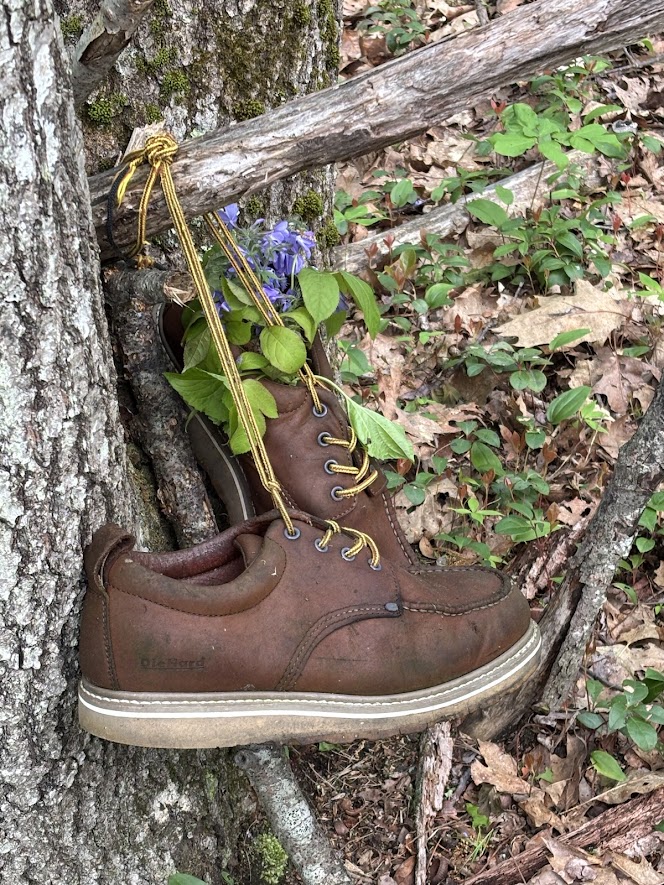
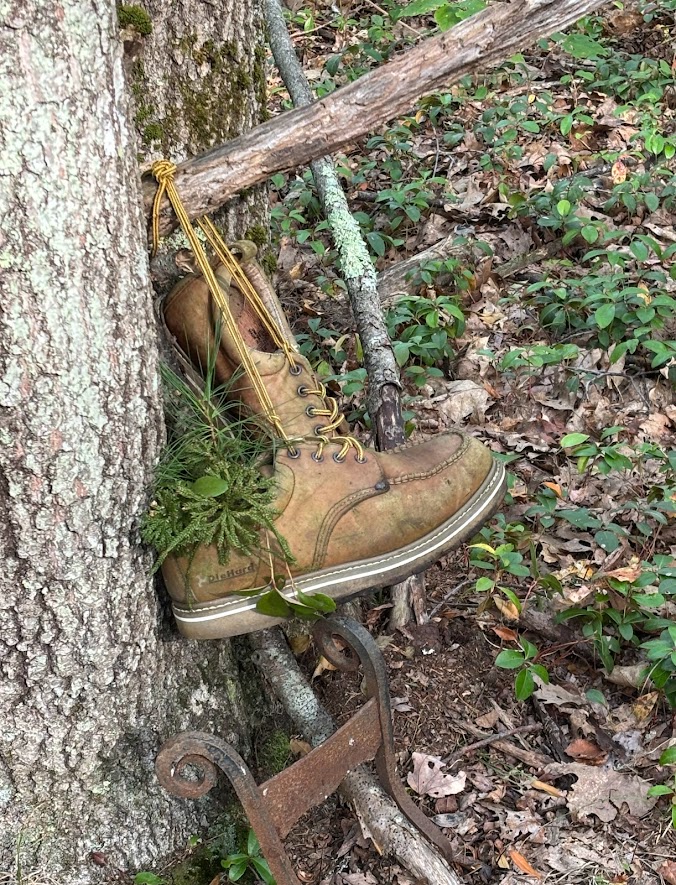
Taking a deep breath and hoping no deer ticks would crawl up my legs or bury themselves in my dog’s curious muzzle, I stepped onto the path and gingerly picked my way about twenty paces into the woods.  My eyes had not deceived me.  A sturdy pair of men’s walking shoes hung by their laces, artfully draped over the stick. What could this mean?  Who would leave their shoes behind in the woods?  These lace-ups still had a lot of life in them.

Something prevented me from touching them—some intuition that this was a holy place.  I took a picture of them, and retraced my steps, my dog tugging me back to our usual route. However, the image of the shoes stayed with me for the rest of our morning walk, and the place where they hung became the destination for frequent pilgrimages in days to come.

After several visits, I began to suspect that these were my neighbor Simon’s shoes, and that they had been lovingly arranged in the woods where he frequently walked, his camera dangling from his neck.  Simon had died several months before, and I surmised that his widow deposited the shoes in a setting he loved near their home, where she could visit them often to commune with her husband.  I took the risk of asking her if I had guessed correctly, and she, blushing but shyly pleased that someone else had discovered her memorial, confirmed it. 

Over the last couple of years, my pup and I have visited Simon’s shoes countless times.  Cynthia, Simon’s wife, adds bits of flora to mark the seasons—sometimes delicate wildflowers in spring, ferns in summer, red, yellow, and golden leaves in fall, and, of course, winter provides its own decoration. Each time I set out on my pilgrimage, I look forward to discovering these simple but artful adornments.

All I know of Simon are these shoes and the few memories of her beloved husband that Cynthia has shared with me. By the time the couple moved into my neighborhood, he had already begun to decline.  I would pass him on my afternoon walks and receive a silent smile in response to my cheerful hello.  He was, by then, not much of a conversationalist, especially with strangers.  His soft-spoken words were sparing, but the few I heard were direct and gentle. 

I marveled that the memorial shoes were in such good shape.  According to his wife, Simon had worn them on hikes all over Europe and America.  Once, on a walking trip in Ireland, amid a powerful wind and rainstorm, he and Cynthia took refuge in a farmhouse along their way.  The family welcomed them to warm up and dry off at the hearth. So, Simon propped his feet in front of the open fire, scorching the soles of his shoes before he realized what was happening. Thrifty as he was, he saw no reason to replace the singed footwear. Like his shoes, Simon was humble, loyal, and resilient.

Simon’s memorial shoes, their constancy, adaptation, and beauty in every season, have become an icon for me.  A symbol for the humility that embraces and accepts what is, even when the reality is absence. Gradually, these old shoes will succumb to the elements and disintegrate, but not before they have taught many passersby a profound lesson.  We continue after death, transformed surely, but ultimately, reunited with the elements that made us, enlivened us, warmed us, fed us, cleansed us, and sheltered us. Finally, we come home.

Simon and Cynthia are not the real names of my neighbors.

The Relief of Letting Go

My friend, Jim, is a crotchety nonagenarian. He has been crotchety his entire life, more or less charmingly so in his youth but annoyingly intensifying as he has grown older. Like many his age, he has consigned everything modern to the rubbish heap and glorified everything he remembers of the good old days. As he has aged, he has grown more self-centered, believing his views are the only correct ones, his tastes are the most tasteful, and his ways of doing things are the only sensible ways. Some of his ways of doing things involve growing his hair and beard long, eating sausage for breakfast every morning, and devouring an entire quart of ice cream at a sitting.

Jim’s health has been gradually declining, and he is less able to care for himself. The decline is noticeable to everyone who sees him regularly, but he won’t admit it. He insists that he can live independently, make all his own decisions, and do so ad infinitum. He believes he does not need to change anything about his life and has gruffly rebuffed all attempts to hire caregivers or suggestions he move to a more supportive living situation.

A little while ago, Jim fell and broke his collarbone. Overnight, he could no longer cook his breakfast sausage, pull up his pants and put on his suspenders, write his checks, or accurately sort his medications. His family bravely and good-naturedly stepped in and did what they had wanted to do for quite some time. They took over his finances, cleaned up his apartment, sent him for a haircut, and insisted he move to assisted living, at least for a month of respite care, until his collarbone healed and he could be reevaluated for independent living. He did not enthusiastically embrace this plan, but surprisingly, he acquiesced more quietly than expected. 

When I visited him in his new efficiency apartment, I was amazed at the transformation. He was more cheerful than I had seen him in years. The boundaries of his life had shrunk to a one-room studio, with a huge closet containing a few of his clothes, a TV with minimal channels, three meals a day served in the facility’s dining room, medications delivered and taken on time, and lively interactions with the staff. They take him for who he is and chide and prod him in a no-nonsense fashion. He mentions a couple of them fondly. He is less isolated than he was when living alone, though he still stays in his room most of the time.

I ask him how he’s doing, and he jokes about not knowing what will happen to him, so he doesn’t bother thinking or worrying about it. One of his children has taken over his finances, and he has no idea how the bills are being paid or how much money is in his bank account. His life has become simpler. The staff takes him to meals, helps him to bathe and dress, and transports him to doctor’s appointments. They do his laundry and give him his pills. He just goes with the flow. Finally, after months of resistance, he has learned to use his cell phone because it is now the only way to stay in touch with family and his few remaining friends. It’s all okay, he says lightly.

I reflect back to him that he seems more peaceful, and he doesn’t disagree. I float the notion that he has let go of control of his life and seems happier for it. He shrugs and chuckles. Once his respite stay is up, if he becomes a permanent resident of this assisted living facility, I think he will do so without a fight. I could be wrong, but I doubt it. His surrender and his letting go are a relief for all of us—his family, his friends, and Jim himself. Even if temporary, Jim’s transformation is one more proof to me that miracles happen.

Of Tulips and Letting Go

In the fall of 2023, I purchased a package of twenty-four tulip bulbs from White Flower Farm. I planted them in the mid-November chill of Mid Coast Maine, hoping they would grace my front yard with some cheerful color come spring. Tulips and daffodils, like every other perennial, are always a risk in our frigid northern climate. I lose several plants yearly, no matter how carefully I bed them down for the winter. As I planted the bulbs, I remember saying to myself and others, “If this doesn’t work out, that’s it; no more attempts at my advanced age to improve the garden.”

Spring comes late in Maine, and I expectantly examined the front garden for weeks in April before I noticed the tiniest of green shoots poking through the brown soil. The steadily growing leaves, coaxed on by days of drenching rain and the occasional few hours of sunshine, cheered me tremendously. Leaves but no stems, though. My experience with daffodils has been that after the first year of blooms, I usually get nothing but leaves in subsequent years, no flowers. I feared the tulips would go the way of the daffs. But no, gradually, hearty green stems with tightly sealed blossoms shot up from the parting leaves. I counted. All twenty-four bulbs had produced a bud. I was amazed and gratified. Now, all I had to do was wait until the sunshine coaxed the buds into bloom. Or so I thought.

This spring, my household hosted a family of four chipmunks on and under our patio. We, the cats, and the dog watched, mesmerized as they scampered around, under, and over the patio furniture with acorns stuffed in their cheeks. They dug a neat burrow at the edge of a flower bed and, we imagined, created a warren of tunnels beneath it with living, pantry, and sleeping quarters branching off the main thoroughfare. These fantasies tickled us. Mom, Dad, and the two kids settled into their new home, slithering in and out of it many times a minute. We were delighted with their antics and those of their cousins, the grey squirrels, who are also abundant this spring. Last year was a mast year (a boom season) for acorns, so squirrels and chipmunks multiplied exponentially. Our side garden was a rodent carnival.

Meanwhile, out front, I noticed, one by one, the unopened tulip blossoms disappear, and their green leaves torn and tattered. Oh no! It must be the chipmunks and squirrels! But they don’t eat all tulips, apparently, because my neighbor’s yard was a riot of red, orange, and yellow flowers, as were many other gardens in our community. My heart sank. After all that work, waiting, and hoping, these entertaining little creatures, without regard for human labor, had stolen my joy.

I gave myself a little talking to: “They’re just flowers, they’re ephemeral anyway. They weren’t that expensive, so the loss is no big deal. You told yourself if this didn’t work, you wouldn’t try again, so just let it go!” Nevertheless, I googled how to prevent squirrels from eating tulips and found a recommendation to try cayenne pepper. We had none in the house, so I sprinkled red pepper flakes around the base of each plant instead. Completely ineffective. 

Having given up on a riot of color like my neighbor’s, I considered how I might redeem the situation. I know so little about flowers and gardening that I had no idea what might happen if I cut the few remaining tightly closed tulip flowers and put them in water indoors. Even this modest experiment was fraught with risk. One of our cats eats flowers, so I had to hide my vase with the unopened tulips in the bathroom. Talk about letting go of my dream of a pretty bed of tulips in the front garden! I was making do with a few tiny green buds on the bathroom vanity behind a closed door. But somehow, the joy was just as sweet when I opened the door to these delicate blooms one morning.

This experience, in all its silly simplicity, speaks to me of the wisdom of letting go. Because so much is beyond our control and everything is constantly changing, creating any plan, investing any effort, and expecting or hoping for any particular outcome are risky business. We do all three continually, of course; they come as naturally as breathing. However, the pervasive visceral tension we carry proves that we live in a constant state of risk—risk of loss, failure, or disappointment. Any time we wake up to this reality is a moment of potential change. Missing tulip blossoms can speak to us of the groundlessness of our existence. They may carry the gift-wrapped message of surrender. Opening a bathroom door to behold pale reflections of pink and white flowers can offer a lesson in revision and redemption.

And how closely married are delight and destructiveness – chipmunk and squirrel antics on one side of the coin and flower devastation on the other. Imagine the deliciousness of tulip petals to a squirrel’s palate! Consider my sober, reasonable resolution not to waste time and money planting tulips again. The whole funny, frustrating, messy situation can be profoundly instructive if I let go and let it be so.

We never know what exquisite new vista the portal of disappointment will offer us or what ultimate peace might issue from the surrender of letting go.

Cherished Outcomes

If you want to accord with the Tao,

Just do your job, then let go.

The Tao Te Ching, translated by Stephen Mitchell

I’m a planner, but I’m not naïve enough to think that meticulously planning something will make it turn out exactly how I want it to. Decades of experience have taught me that control is an illusion—a dear one. Still, planning is in my bones, and I might as well embrace it as part of who I am. Planning, like everything, has its shadow side and its bright side. The shadow side is about clinging—to outcomes. The bright side is about creativity, fruition, and letting go.

Giving myself fully and genuinely to a task or project without getting attached to the final product is one of my biggest challenges. How does one go all-in on something without being wedded to the result? I care; therefore, I plan. I do everything possible to ensure the desired outcome has its best chance.

I’m talking about passion—giving everything you’ve got, then offering your beloved creation to the world and letting go. Huge risk, right? Like nursing an injured baby seal that has beached itself. You painstakingly feed it, protect it, and watch it regain its strength, then set it free with absolutely no expectation that you will ever see it again or faith that it will survive beyond your sightline as it heads out into the deep. Or, like a parent raising a child, I imagine, since I have never raised one.

A friend of mine advocates “holding things lightly,” meaning, I think, that caring passionately and relinquishing control are both essential to being fully alive. It is possible to be committed to an outcome and hold it lightly, ready to let it go. Challenging but possible.

Scientists tell us we are hard-wired for planning. Research has shown that some areas of the brain, known as the default mode network, carry out this planning function. They

become active when our attention is not occupied with a task. These systems function in the background of consciousness, envisaging futures compatible with our needs and desires and planning how those might be brought about….Human brains have evolved to do this automatically; planning for scarcity and other threats is important to ensure survival….Our background thinking is essential to operating in the world. It is sometimes the origin of our most creative images.”  Why we are hard-wired to worry, and what we can do to calm down (theconversation.com)

So, we will plan no matter what, and sometimes planning, when unhooked from worry, can be a very creative and valuable form of flow state. If I am going to plan, I want to give it my very best effort. I want the idea and the plan for its execution to be as detailed as possible, take as many contingencies as conceivable into account, and be thoroughly tested, broadly vetted, and profoundly considered. I want to be wholly absorbed, plan passionately, launch my plan confidently and enthusiastically, and then let go of the outcome!

Why? Because no matter the outcome, whatever happens—success, disaster, or somewhere in between—is an opportunity for learning, growing, transforming, and embracing reality just as it is.

Sometimes, when I meditate, my mind is pulled toward a problem that captivates me or a situation that needs resolution. I try to turn away from the flow of thoughts and return focus to my breathing once, twice, three or more times. Finally, I will sigh and let my mind have its way, go with the flow. Sometimes, the most fitting solutions emerge from giving my default mode network free reign. I’ve learned, though, not to act on these plans immediately but to let them mull and mature for a while and to be willing to let go of them, to change my mind.

During my 71 years, life has required me to let go of hundreds of cherished outcomes for multiple carefully laid plans. It’s gotten easier as I’ve begun to notice a pattern of unexpected gains amid losses, of auspicious signs amid clouds of disappointment. Gradually, I’ve become more curious about than afraid of the unknown final outcome of life—my life.

This past week, the Christian Church celebrated Ash Wednesday, the day of the year when we look death straight in the eye and remember that we all came from dust and will ultimately return to it. “Remember that you are dust, and to dust you shall return.” One of the ministers at the Episcopal Church in my town told me that some clergy are now reciting the words, “Remember that you are stardust, and to stardust you shall return,” when they imprint the sign of a cross in ashes on their members’ foreheads. The words point to our smallness and our greatness and are a sparkling reminder that we have always been and will always be part of the immense universe. How I cherish that outcome!

Practicing for “The Big Let Go”

I’ve been using this phrase for some time now. When I drop it into conversation, as in, “I’m practicing for The Big Let Go,” I usually get a puzzled look from the one I’m talking to. When I explain what it means, I get a “You’ve got to be out of your mind!” look. 

So, what is “The Big Let Go?” Well, it’s Death, of course—the most crucial moment of letting go in our lives. Death is when no more alternatives, options, arguments, or excuses exist. Procrastination is impossible; the hope of avoidance is patently hopeless, and you are entirely alone, whether or not a friend or loved one is sitting at the bedside holding your hand. It is the ultimate moment of giving in, surrendering, and trusting—letting go of control and our grip on life.

Some go out fighting, refusing to let go until death steals their last breath. That’s usually not a pretty or dignified exit, which is what we all want, whether we say so or not. How often have you heard someone say they hope they die peacefully in their sleep? And speaking of sleep, it’s a perfect opportunity for practicing letting go—or death, to put it bluntly.

What does it mean to practice something? The Oxford Dictionary defines practice as “repeated exercise in or performance of an activity or skill to acquire or maintain proficiency in it.” Synonyms are training, rehearsal, repetition, drill, and warm-up. Practice makes perfect, we say flippantly. Practice is mundane and often drudgery; perfection is sublime and unachievable. The child practices the piano faithfully to win an invitation to play at Carnegie Hall; you practice your golf swing to win the office tournament. I practice drawing to become an artist or throwing pots to become a potter. We practice silent restraint so that our angry words don’t hurt others, or we practice listening attentively and openly to understand one another.

Practice develops skills and changes habits. It can change your life, even set you free from addictions and compulsions. In a sense, we are what we practice—from the mundane (I brush and floss my teeth meticulously to have a healthy, attractive smile) to the sublime (I practice meditation daily to be in touch with my true self and reality.)

The notion that one might practice letting go throughout one’s life to be good at it when the time for death arrives is, for many, weird and morbid. It may be so for those who see death as a tragedy, a loss, something to be resisted and put off. But in all faith traditions and reports of near-death experiences, death is portrayed either as a moment of release, culmination, reward, or welcoming, or, conversely, of terror and punishment, depending on what one has practiced in life.

Buddhists are encouraged to think of death frequently to be ready for it and for what it can teach them about how to live before it arrives. Charnel Ground meditation involves imagining or observing the gradual dissolution and decay of the body to internalize the truth that all things are impermanent—everything changes and passes away.

Buddhistdoor.com 12-16-02

Christian reflection on death focuses more on reward or punishment and is encouraged to put the fear of God, the ultimate Judge, into its adherents. According to theologians, Jesus died and rose again to save us from death and damnation.

https://www.goodreads.com

But in general, and particularly at this time in history, we ignore death until it becomes unignorable, and then we lament it. So, how counter-cultural is the notion of practicing to do death well—gracefully, peacefully, with joy and dignity—instead of hanging on for or to dear life? Can one practice gently relinquishing, letting go, releasing, and opening to the unknown daily to prepare for The Big Let Go?

Pema Chodron, in her book How We Live, is How We Die, quotes a verse from a Tibetan Buddhist teacher, Dzigar Kongdrul Rinpoche,


“When the appearances of this life dissolve,
May I, with ease and great happiness,
Let go of all attachments to this life
As a son or daughter returning home.” (p.22)

I find this image of a child returning home enormously comforting. It conjures up memories of long day trips when I was young, perhaps to visit relatives or friends or the beach. Days full of play and food would end with a car ride homeward in the dark. We kids would fall asleep in the backseat, lulled by full stomachs, the hum of the car engine, and the rocking of the seats beneath us. Then, when we finally arrived home, we’d be carried inside, undressed, and put to bed in the safety and familiarity of our rooms. What ease and great (sleepy) happiness! 

Or imagine the scene of the Prodigal Son in Jesus’ parable. The dirty, starving, ashamed son returns home to a father’s generous welcome, greeted with a feast, new clothes, and the warm embrace of forgiveness. What ease (relief) and great happiness!

Death may not resemble either of these images, but I believe it is a return to the source of all life. If death is a return to our source, it is impossible to do it without letting go of our attachments to this life—a tall order indeed. It involves letting go of our attachment to our youthful good looks, our health and strength, career and family successes, fame, financial security, mental acuity, friendships, loves, regrets, anger, fear, and failures. I could go on.

Since dropping these far-reaching and self-defining attachments is a momentous task, I believe it is worth practicing now for the challenge ahead of us. For some time, I have been trying to recognize small and large opportunities for letting go in my daily life—letting go of people, outcomes, feelings, memories, hopes, expectations, opinions, and judgments. When I encounter an opportunity for letting go, I try to notice what it feels like in my body, first to hold on and then to let go. Viscerally, the experience of holding on is tight and painful; letting go is a feeling of “ease and great happiness.”

            Over the next few posts, I will explore some everyday experiences of letting go, keeping in mind that you, like I, may want to develop a skill that will stand us in good stead when The Big Let Go arrives. Will you reflect and practice with me?

Noticing Respect in 2022

“Is treating someone respectfully fundamentally different from respecting him, her, or it?”

I posed this question in my first blog post in 2022, and I return to it in my last. (Though technically, it’s 2023 already, today is New Year’s Day Observed on the iPhone calendar.)

In the last year, I have reflected on, written about, and invited your comments on various instances of respect—situations I have encountered in daily life that have caused me to examine the meaning of respect more closely. For example, I wrote about respecting others through an open, honest, invitational style of communication embraced by Maine’s CDC Director, Dr. Nirav Shah, as he interacted with the people of our state during the height of the COVID pandemic.

I shared the “Just Like Me” practice of recognizing that everyone, even those whose ideas and actions are sometimes antithetical to our own, has many of the same human attributes, desires, hopes, fears, sorrows, and losses as we do. This practice encourages points of identification to generate empathy and nurture even the tiniest grain of respect. In “Respect Amid Conflict,” I wrote about two principles crucial to navigating conflict respectfully: understanding oneself and seeking to understand the other, ferreting out one’s deepest motivations and underlying assumptions, and keeping an open heart and mind about the experience and perspective of the other.

In “Respect in Extremis,” I reflected on respecting the essence of a human being when accomplishments, attractiveness, and self-control are stripped away at the end of life. In the article titled “What Is,” I illustrated the habit of noticing and accepting the ordinary miracle of each moment, welcoming and flowing with it instead of resisting and wishing things were different. In “Two Tales About Respect,” I explored how experiencing disrespect from another may tap into our lack of self-respect. I also exemplified how inner doubt and confusion about the right thing to do in a situation can cause one to act disrespectfully toward others.

The three posts about my friends Jack and Vicky dealt in depth with their experience of years of homelessness, followed by a brief period of stable housing, Vicky’s severe illness, and ultimately their deaths within two weeks of each other. The articles, telling the story of our friendship, were my memorial gift to honor them. Their backgrounds and life experience and mine were dramatically different, yet we came to understand, respect, and love one another.   And finally, “Respecting Limitations and Letting Go.” Recognizing and accepting our limitations and those of others is a lesson we must all learn as we grow older. Learning to let go when the time is right will prepare us for the end of life when we must ultimately let go of everything.

So, back to the original question: “Is treating someone respectfully fundamentally different from respecting him, her, or it?” I’m currently living in a divisive atmosphere. There are many perspectives on the problem we share, but for clarity, I think I can safely say that two slightly porous camps have emerged. Each wants respect from the other. Each desires to be heard, understood, honored and treated kindly and politely. Trust has been damaged, and respect is frayed and floundering. 

But can we treat each other respectfully, even if each camp has done and said things that have damaged the esteem we formerly felt for one another? And would respectful words and actions move us toward restoring genuine respect? Would they help us navigate this situation, repair the divisions, and solve the problems? 

And what would treating each other with respect look like, even if we are not feeling it? We could begin with the old gem, “Do unto others as you would have them do unto you.” That might include giving everyone the benefit of the doubt, not presuming to understand all the complicated nuances of the situation or the difficulties others face. Listen and communicate. Recognize defensiveness in yourself, but don’t act out. Don’t say hurtful things, be gentle, and practice courtesy. Don’t avoid one another (downcast eyes, looking away) but take risks to build genuine relationships. Listen; communicate. Keep things in perspective by remembering to be grateful. Notice the good and speak up about it. Keep working at the solution, don’t give up or bail. Listen and communicate directly, face-to-face, and eye-to-eye. Behave respectfully, and you may earn respect.

So, I would posit that treating someone respectfully is not fundamentally different from respecting that person. Famously it is said you can’t make peace; you have to be peace. You can’t create respect; you have to be respect.

Respecting Limitations and Letting Go

One of my dreams for retirement was to adopt a dog and train it as a therapy dog. I had owned several cats over my 63 years but never a dog, and I wanted one badly, almost like some women long to have children. I had admired service dogs for many years—their calm, competent demeanor and the trust between them and the people they serve. But I knew I didn’t have the patience or skill to train service dogs. Still, I imagined I could meet the training standards for a therapy dog—well-behaved in public, gentle, reliable, and willing to allow himself to be petted to comfort others. 

So, shortly after retirement, I adopted Digby. I had not planned on getting a puppy, but he was so darn cute I couldn’t resist him. When I met him for the first time, he had just had surgery to repair a broken leg, and he lay on the couch beside me, a huge cone circling his head, licking my hand like crazy, trying to make friends and quell his anxiety. He weighed about ten pounds and was white and apricot, a mix of Pomeranian and Papillon. I thought he would make a perfect therapy dog. His cuteness alone would bring joy to those he visited, and he was small enough to lift onto beds and into laps.

And so, the training journey began. Digby was six months old; still an exuberant, sometimes crazed puppy, and I was sixty-three, inexperienced, with limited energy and patience. The mixture was not quite a recipe for disaster but certainly portended frustration and exasperation for both of us. I could not control his barking, chewing, cat chasing, and peeing indoors for a long time. Likewise, he could not figure out how to please me.

Once we started training classes, I quickly learned I needed training as much as he did. Consistency was my biggest problem. I could not remember to act or react using the same commands in the same order (click, praise, and reward) each time I taught a new behavior. But I persisted, for almost three years, class after class—beginners’ obedience, intermediate, tricks, agility, nose works, advanced obedience, and Canine Good Citizen, repeating some of these classes multiple times. Eventually, he stopped chewing everything in sight and peeing indoors and could walk calmly next to my left knee, which I called “walking nicely.” However, he’s never stopped barking or cat chasing.

Finally, Digby and I made it to the moment of truth, evaluation by a representative of a therapy dog licensing organization in a real live therapy context—a senior healthcare facility. We were both nervous and needed correction and pointers from the evaluator, but after three trials, we were certified. He got his little red heart therapy dog tag, and I got a certificate I could show to volunteer coordinators in settings where we would visit to offer comfort and entertainment. Along the way, I learned that Digby was a performer and a ham. He loved doing tricks to entertain an audience, but he was less comfortable being trotted around from one person to another for pets and cuddles. He loved children and was great at Read to Dog programs in local libraries and schools, but he was terrified of being surrounded by a group of college students seeking the calming presence of a dog during exam week. He was more freaked out than they were. Digby had his limitations, and I had to tailor our volunteer commitments to those.

After discovering his strengths and weaknesses, I focused our therapy work on tricks shows. We offered them to seniors in various healthcare facilities and children at a local library. He loved the mental stimulation, the applause, and the treats he got as rewards. His audiences loved him! “What an amazing little dog!” they clapped and shouted. To keep him stimulated, I taught him more and more tricks, up to 35 or so, and built him an indoor agility course, including a hoop to jump through, a tunnel, a teeter-totter, a ramp for climbing, and poles to weave around. He danced, shook hands, rolled over, crawled, spun, played soccer by rolling a ball through goalposts, and dazzled in many more ways. 

Watch Digby training to roll a ball through goalposts.

Performing together created a special bond between us. I was so proud of the little guy when he turned on a dime and did precisely what I asked, trick after trick, for over half an hour. He looked to me for guidance during the performances in ways he didn’t in other situations. We depended on each other. I loved seeing him succeed and bring joy to the audience; he loved my excitement and praise.

But he got older, and so did I.  After nearly four years of performing, Digby’s formerly broken leg began to show some weakness. He barked more during shows (sometimes frightening the children), tired more quickly, and became impatient during some of the tricks. On the other hand, I found it harder to load the heavy agility equipment in and out of the car and set it up in various venues. And it was hard for me to keep up with Digby as he ran around the agility course. I’d often be nervous about his behavior and enormously relieved when he performed well. We’d come home after a show and take a long nap together, both stressed and tired.

It seemed like Digby’s run as a therapy dog performer had been a short one, barely four years, but I decided we needed to retire, for both our sakes. It was a hard decision. I had invested much time, money, and effort in training. But it wasn’t just that; I would also miss the interdependence we had developed as we trained and performed together and the intimacy it brought to our relationship. And he would miss the mental and physical challenges of doing tricks and the admiration of his audiences. I wondered how I would keep him stimulated and exercised, especially during the long, cold Maine winters. When they heard of our retirement, the volunteer coordinators we worked with were disappointed but said they understood.

I tell this rather long story as an illustration of how many of us feel as we age and bump up against increasing limitations—our inability, for one reason or another, to continue doing the things we love or keep longstanding commitments. Sometimes it feels like failure to admit I no longer have the energy, skill, or interest I once had for certain activities. I hate letting others down, and I may experience a sense of diminishment as the circumference of my life shrinks.

I have three choices. I can try to push myself beyond my limits, whine about my losses, or accept and respect my limitations. Like all living things, I am of a nature to grow old, lose my freshness and vigor, decline into poor health, and eventually die. I try to mitigate these inevitable changes as long as I can—exercising to stay healthy and strong, eating well, and staying involved in work or leisure that stimulates my mind and keeps me connected to others. But do I know how to let go gracefully, when the time is right, of things I can no longer do safely or happily? I built my ego around the things I have accomplished, and when those accomplishments fade, who am I? Do I have anything to contribute? Do I matter to those I love or to the world around me? Respecting my limitations and letting go of what no longer serves me is an opportunity to turn inward and get to know who I am at my core—the I who will survive, transcend, and continue beyond the increasing outward limitations and diminishments.

Digby, reputed to be a fantastic trickster, will soon blend into the growing pack of aging dogs taking shorter and shorter walks around our retirement community. And, though it may not happen quickly, I will one day acquire a walking stick to keep me from tottering as he “walks nicely” beside me.  

Accepting and respecting my limitations is an opportunity to learn graceful letting go and practice it daily as I approach the biggest “let go” of all. As Pema Chodron’s recent book says, How We Live Is How We Die.

One Word

Carolyn, a friend and blogger I deeply respect and whose posts I follow avidly, has recently revamped her blog site.  It’s now called Your One Word. The idea is that you select, through a process of inner listening, a word that will be a hallmark of your life for a year.  Hallmark is, for this purpose, defined as a distinguishing characteristic, trait, or feature.  It may be a quality or virtue you aspire to, a practice you want to embrace, or something you want to understand more deeply.  Through reflection, active noticing, perhaps even study, you will let the meaning of the word unfold in your daily life for a year, checking in monthly or even weekly to become aware of its effect on your thoughts, dreams, and actions.

Carolyn provides some helpful resources for choosing your word and working with it regularly.

My word for 2021 is REST.  My word for 2020 was “slowly,” but I was a dismal failure at incorporating it into my life.  Anyone who knows me will laugh at my 2020 choice because I do everything as fast as possible – walk, eat, exercise, clean, shower, dry my hair, read, type, cook…ad infinitum. One thing I learned from “slowly” last year was how fast is my usual pace.  I also observed others around me, particularly my partner, and noticed how graceful and gentle moving slowly is by comparison.

I am 68 now, and I’m tired, in general, and in particular of going fast. So, without moving too far from last year’s aspiration, I chose “rest” for 2021, or rather, it chose me.  Already, with Carolyn’s help and inspiration, I am learning about what rest means for me.

I want to share with you the list of questions that arose when I began to explore my word:

  • What is the definition of rest? What are some synonyms?
  • How does rest show up in my hobbies: photography, writing, coloring, card design?
  • How is rest affecting my chronic pain?
  • Has rest helped me to move more slowly?
  • Am I struggling against something? Can I stop and rest?
  • When I have rested, what have I noticed?
  • Does rest help me to let go?
  • How are rest, solitude, and retreat related?
  • What three memories of rest can I recall this week, this month?
  • Have I seen examples of rest in nature? In others? What can I learn from them?
  • How are rest and saying “no” related for me?
  • How are rest and mindfulness related?
  • And, for the sake of this blog, how is rest related to “respect?”

For me, rest has an essential relationship with self-respect.  It gets at a part of my nature that has always been troublesome – my difficulty setting limits.  Limits on my workday’s length and intensity, limits on my care for others, limits on the physical demands I place on my body. Getting older, if you pay attention, can teach you vital lessons about limits.

This year, I hope to practice self-respect by discovering what rest is and incorporating it into my physical, mental, relational, and spiritual life.

Is “one word” calling you?