
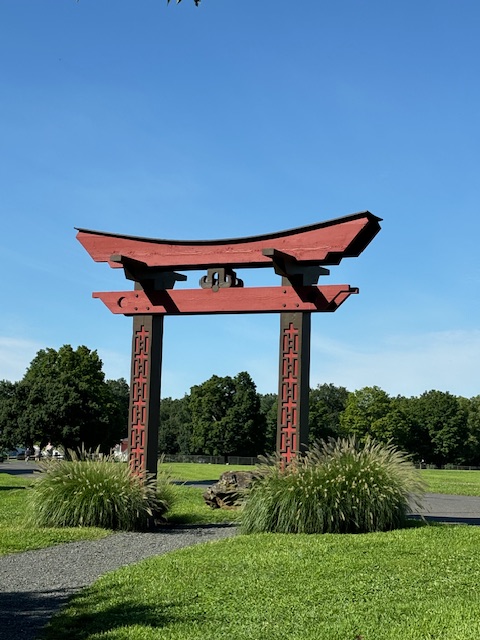
I enter the Japanese Garden through the Shinto Gateway, the Torii, which marks a transition from the mundane to the sacred. This morning, I’m not looking for the sacred but simply a place to rest my eyes, mind, and body. This particular Torii resides in Stanley Park, in the Western Massachusetts town of Westfield, what I have dubbed the “middle America of New England,” where conservative values, working-class families and businesses, community spirit, and the American dream appear to be embraced with gusto.
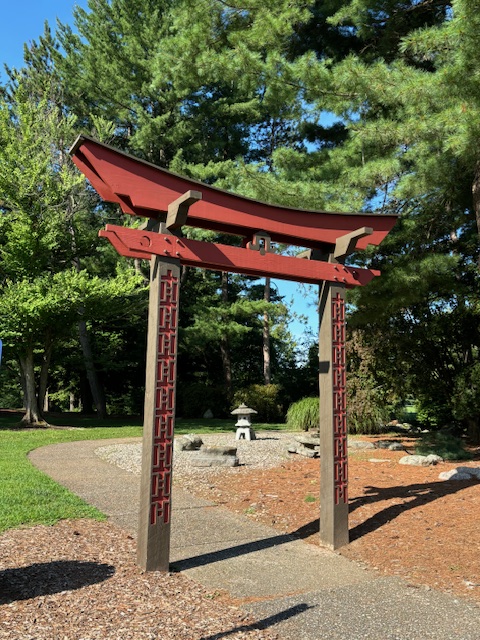
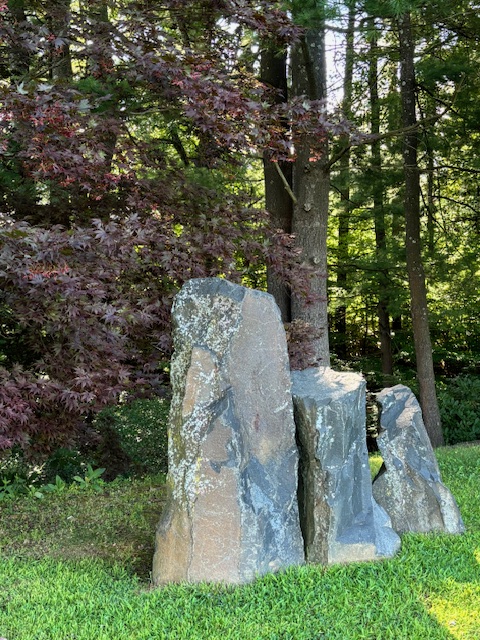
Beyond the gateway, robed in every shade of green, lies a perfectly proportioned landscape. Thoughtfully placed benches, most sporting plaques in memory of departed loved ones or honored benefactors, nestle in shady patches. Smooth and jagged stones are strategically placed to delight the eye. Manicured trees, reminiscent of bonsai, glow green in the early morning sun. Flowing Japanese-style structures blend with the scenery. Simply elegant bridges span bubbling streams.
I stroll lazily, framing the natural beauty in my lens, noticing the coolness of the air on my skin, hearing the burbling brooks, and delighting in the shapes, sounds, and freshness around me.
A middle-aged woman in a floppy sunhat, sweating from the exertion, pushes a large stroller along the path. A grandmother with twins, I think. I say good morning, wanting to acknowledge that we are sharing this earthly space. I had consciously decided to greet each person I met this morning, looking them openly in the eyes. She pauses and responds. I notice that it is not children, but a white-snouted dog enclosed in the mesh stroller. I compliment her on the ingenuity of this arrangement, and she explains with a fond smile that her old dog enjoys the outdoors comfortably while she gets her morning workout.
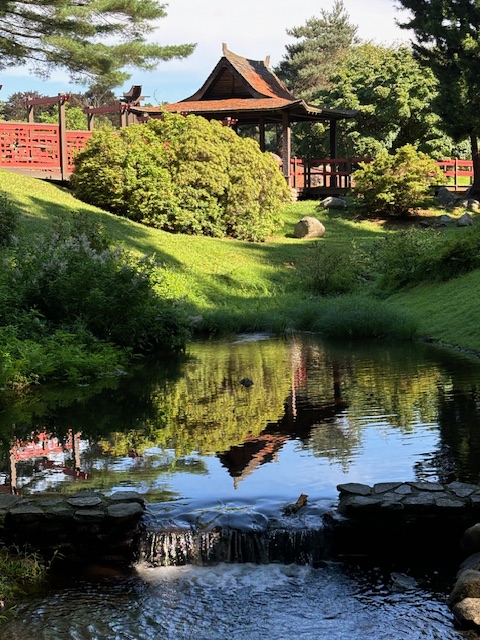
I wander downward to the floor of a small valley and along the edge of a dancing stream. Ahead of me, a young mother with her toddler son uses the activity paper she picked up on the way into the park to point out rocks, water, plants, insects, and squirrels. Her bare arms are tattooed colorfully, and I bristle momentarily. But my curiosity overcomes my distaste, and I wonder what has caused her to decorate her body thus. I’ll Google later, I promise myself, and ask why tattoos are so popular these days.
Following the brook, I come to The Braille Walk—a short section of the path set off by a knotted rope. Next to each knot is a sign in English and Braille describing what a blind traveler might hear, smell, or sense in her immediate surroundings. I think how lovely, how inclusive.
It’s quiet, uncrowded, bright, clear and cool. A waterfall rushes joyfully down into the first of two large artificial ponds, turning a waterwheel on its way. Ducks swim passively. Single parents with single children wander aimlessly. Canadian geese, who had been feeding in the field beyond a few moments ago, fly honking noisily overhead and land gracefully among the unfazed ducks. A sign begs the guests in this welcoming corner of the earth not to feed bread to the birds, causing disease and death, but instead, to buy a small handful of proper food for fowl to cast on the waters.
A wooden boardwalk borders the upper and lower ponds. Like other wanderers, I peer over its railings to the brownish depths below, startled by what I find. Dozens of enormous koi, speckled white, black, and red, swim lazily along the shore, looking for a handout. They weave past each other endlessly and gracefully, parting the muddy waters. I stand, relaxed and delighted, wishing for someone to share this perfect moment in time and space—longing for someone beside me, to echo my smile and look deeply into my eyes, reflecting what I see, knowing what I know. But life has taught me no one sees exactly what I see and feels what I feel, so I pull back inside myself and gaze at the large, lumbering fish, appreciating their patience and calmness.
Two dogs pass each other and me on a bridge; one is a large boxer whose owner mumbles to it urgently in a foreign language. The other, serene and beautiful in its sleek black and white body, sniffs my leg as it passes. Good morning, I say to its owner, and he responds in kind. I tell him his dog is beautiful, and he says thank you.
Pads crowd the lily pond, but no lilies. I walk over its arched stone bridge and into the bright, undappled sunlight, away from the tended, managed, perfectly curated gardens and water features along the path to the wilderness sanctuary. This stretch is even quieter, except for the mild and unintrusive hum of distant traffic. Trees shade the way, but a closely trimmed lawn carpets an intentional clearing near the entrance. The sun beams down on the dew-laden grass. I think it is the perfect place for a picnic, but move on.
I meet no one. The river meanders on my left. The path slopes down. Mud from the recent rain makes it necessary to pay attention to where I place my feet. I come to an opening in the trees, a collection of large rocks on the riverbank, and stop, knowing I must turn and retrace my steps before my aching back, tired legs, and the slight chill on my skin strain my enjoyment of this place.

And so, I do turn, walk up the gentle slope, back past the sun-warmed clearing, across the stone bridge, up several tiers of terraced steps, and towards the rose garden at the top of the hill.
I need to use the toilet. I skirt the party venue, the concert venue, the manicured gardens of brightly colored annuals, the rose gardens far past their prime, and the formal fountain. I arrive at the spotless restrooms, where I relieve the building pressure in my aging bladder.
Relaxed again, I walk back the way I came. As I pass the wedding venue, I see two middle-aged Indian women in Saris and hear them chatting in their native language. The nearby clock tower tolls the half hour. Beneath it, a family of tourists takes photos of itself and speaks excitedly in what, Polish?
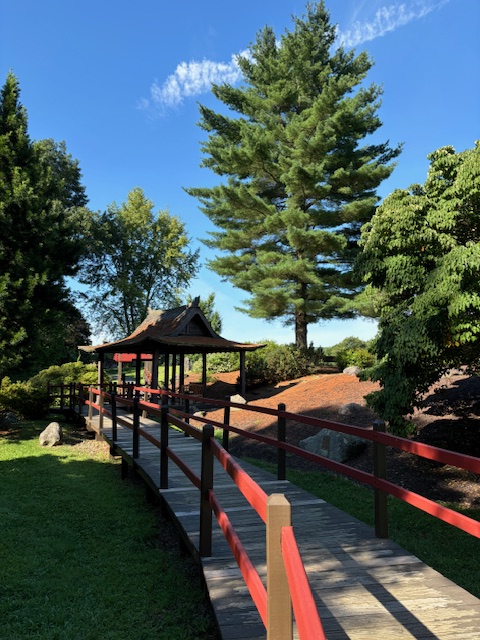
Again, I slowly and cautiously descend the stone stairway, which minutes ago I climbed, to the bottom of the narrow valley, to the ponds, the waterfalls, the streams, ducks, koi, and geese. A cluster of families with young children gathers on the pathway to the covered bridge—a gaggle of geese and kids are making an awful commotion. I pick my way between them, careful to avoid goose splat, pass through the coolness of the shaded bridge, and climb up the other side of the valley, wending my way back to the Japanese Garden for one last glimpse of order before I depart. A family sits on a ledge overlooking the falling water—an elderly man in a wheelchair decked out in sweatpants and slippers, a husband and wife, and a small child. I wonder if this is a Sunday morning outing for Dad, who may live in a nearby nursing home. Again, good morning, I say, and they smile.
Tired, satiated, and quiet within, I approach the end of my stroll—the Torii Gate, where I began. I sit briefly on a sun-warmed bench overlooking Stanley Park, a modern-day Eden where the ordinary and the extraordinary are interwoven. I think of the words from the creation myth in Genesis, chapter one. “God saw everything God had made, and it was good.” I also think of the part of the story that tells us we are destined to tend and care for, protect, enhance, and love the goodness of which we are an integral part. I breathe in the variety, the abundance, the freshness, the vitality surrounding me in that ordinary moment, and it is, indeed, supremely good.
(Thank you to Nancy S., who encouraged me to write about this sacred moment.)


 With All Due Respect