
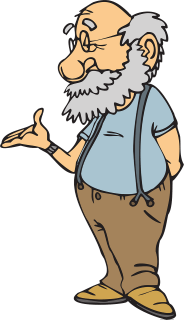
My friend, Jim, is a crotchety nonagenarian. He has been crotchety his entire life, more or less charmingly so in his youth but annoyingly intensifying as he has grown older. Like many his age, he has consigned everything modern to the rubbish heap and glorified everything he remembers of the good old days. As he has aged, he has grown more self-centered, believing his views are the only correct ones, his tastes are the most tasteful, and his ways of doing things are the only sensible ways. Some of his ways of doing things involve growing his hair and beard long, eating sausage for breakfast every morning, and devouring an entire quart of ice cream at a sitting.
Jim’s health has been gradually declining, and he is less able to care for himself. The decline is noticeable to everyone who sees him regularly, but he won’t admit it. He insists that he can live independently, make all his own decisions, and do so ad infinitum. He believes he does not need to change anything about his life and has gruffly rebuffed all attempts to hire caregivers or suggestions he move to a more supportive living situation.
A little while ago, Jim fell and broke his collarbone. Overnight, he could no longer cook his breakfast sausage, pull up his pants and put on his suspenders, write his checks, or accurately sort his medications. His family bravely and good-naturedly stepped in and did what they had wanted to do for quite some time. They took over his finances, cleaned up his apartment, sent him for a haircut, and insisted he move to assisted living, at least for a month of respite care, until his collarbone healed and he could be reevaluated for independent living. He did not enthusiastically embrace this plan, but surprisingly, he acquiesced more quietly than expected.
When I visited him in his new efficiency apartment, I was amazed at the transformation. He was more cheerful than I had seen him in years. The boundaries of his life had shrunk to a one-room studio, with a huge closet containing a few of his clothes, a TV with minimal channels, three meals a day served in the facility’s dining room, medications delivered and taken on time, and lively interactions with the staff. They take him for who he is and chide and prod him in a no-nonsense fashion. He mentions a couple of them fondly. He is less isolated than he was when living alone, though he still stays in his room most of the time.
I ask him how he’s doing, and he jokes about not knowing what will happen to him, so he doesn’t bother thinking or worrying about it. One of his children has taken over his finances, and he has no idea how the bills are being paid or how much money is in his bank account. His life has become simpler. The staff takes him to meals, helps him to bathe and dress, and transports him to doctor’s appointments. They do his laundry and give him his pills. He just goes with the flow. Finally, after months of resistance, he has learned to use his cell phone because it is now the only way to stay in touch with family and his few remaining friends. It’s all okay, he says lightly.
I reflect back to him that he seems more peaceful, and he doesn’t disagree. I float the notion that he has let go of control of his life and seems happier for it. He shrugs and chuckles. Once his respite stay is up, if he becomes a permanent resident of this assisted living facility, I think he will do so without a fight. I could be wrong, but I doubt it. His surrender and his letting go are a relief for all of us—his family, his friends, and Jim himself. Even if temporary, Jim’s transformation is one more proof to me that miracles happen.
 With All Due Respect
Although I have not been moved into an assisted living facility, I resonate with much of what you have written here. 2024 has been defined by what I have let go, both voluntarily and involuntarily, but increasingly I hope it will be defined by what remains present in my life.
Love,
Jeff
J. L. Richey, Ph.D.
Professor of Asian Studies, Berea College
(on sabbatical 2023-24)
tinyurl.com/JLRicheyhttps://www.berea.edu/academics/departments-programs/asian-studies/faculty-staff/dr-jeffrey-l-richey
LikeLike
Thank you again.
LikeLike